Not on view
Aleksandr Rodchenko was one of the innovators and most dedicated practitioners of Russian Constructivism, the state-approved, post-Revolution artistic style that encouraged the application of standardized abstract designs to utilitarian objects. This style was in direct contrast to traditional art, with its emphasis on individual expression. Rodchenko and like-minded artists worked in a wide variety of mediums, including textiles, ceramics, posters, furniture, architecture, and exhibition design.
Rodchenko's focus was on graphic design, photography, and photomontage—a filmic medium that combines and juxtaposes photographic fragments. His designs for books ranged from collaborations with poet friends to propaganda magazines intended for mass distribution. Among his most fruitful collaborations was that with poet Vladimir Mayakovsky, who also embraced Rodchenko's goal of reaching out to the Soviet proletariat rather than to the artistic elite. Together they produced government advertising posters, books, and several journals. One such joint project, About This: To Her and to Me, featured the first photomontages by Rodchenko to be used in book design. The illustrations provide a lively counterpoint to the long love poem Mayakovsky wrote for his lover and muse Lily Brik, whose portrait is on the cover.
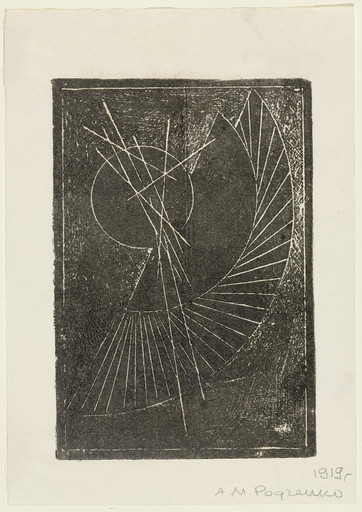
Rodchenko's work in book design had begun with handmade carbon-copied books in the late teens that continued an earlier Futurist aesthetic and were made in very small editions. By contrast, his later Constructivist book covers were issued by the state publishing house in much larger numbers. One of the latter is the wraparound cover for Orator: Verse, which exemplifies the architectural, rationalized, compositional structure of the post-Revolution design aesthetic.
an essay by Sarah Suzuki, in Deborah Wye, Artists and Prints: Masterworks from The Museum of Modern Art, New York: The Museum of Modern Art, 2004, p. 81.
Explore more
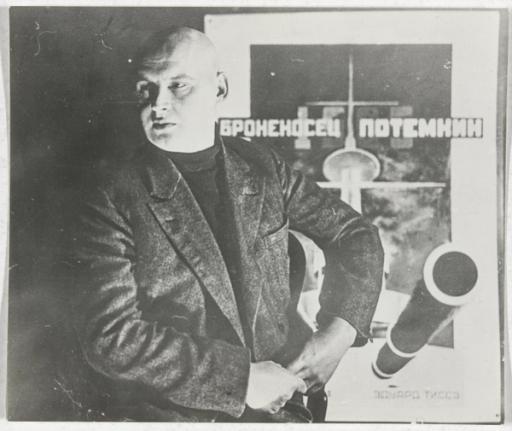
Aleksandr Rodchenko
Russian, 1891–1956 247 works onlineWhen The Museum of Modern Art’s first director, Alfred H. Barr, Jr. , met Aleksandr Rodchenko on his trip to Moscow in 1927—one of the first times an Anglophone art historian had visited the Soviet Union in the years since the Russian Revolution—he wrote, “Rodchenko showed us an appalling variety of things— Suprematist paintings (preceded by the earliest geometrical things I’ve seen, 1915, done with compass)— woodcuts , linoleum cuts , posters , book designs, photographs , kino sets, etc….
Learn more →


Propaganda
Any systematic, widespread dissemination or promotion of particular ideas, doctrines, practices, etc. intended to further one’s own cause or to damage an opposing one. Propaganda is often used to deceive a public or distort information.
Learn more →



From MoMA Design Store


Installation views
We have identified this work in the following photos from our exhibition history.
Licensing
Artwork or archival images
If you would like to reproduce an image of a work of art in MoMA's collection, or an image of a MoMA publication or archival material (including installation views, checklists, and press releases), please contact Art Resource (publication in North America) or Scala Archives (publication in all other geographic locations).
Audio and film clips
MoMA licenses archival audio and select out of copyright film clips from our film collection. At this time, MoMA produced video cannot be licensed by MoMA/Scala. All requests to license archival audio or out of copyright film clips should be addressed to Scala Archives at [email protected]. Motion picture film stills cannot be licensed by MoMA/Scala. For access to motion picture film stills for research purposes, please contact the Film Study Center at [email protected]. For more information about film loans and our Circulating Film and Video Library, please visit Circulating Film and Video Library.
Text from a publication or the archives
If you would like to reproduce text from a MoMA publication, please email [email protected]. If you would like to publish text from MoMA's archival materials, please fill out this permission form and send to [email protected].
Feedback
This record is a work in progress. If you have additional information or spotted an error, please fill out this feedback form.