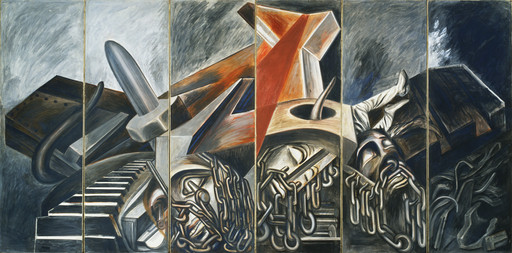
Collective Suicide is an apocalyptic vision of the Spanish conquest of Mexico. Siqueiros shows armored Spanish troops advancing on horseback, a bowed captive staggering before them in chains. The broken statue of a god demonstrates the ruin of the indigenous culture. Chichimec Indians, separated from their tormentors by a churning pit, slaughter their own children, hang themselves, stab themselves with spears, or hurl themselves from cliffs rather than submit to slavery.
Siqueiros, one of the Mexican mural painters of the 1920s and 1930s, advocated what he called “a monumental, heroic, and public art.” An activist and propagandist for social reform, he was politically minded even in his choices of materials and formats: rejecting what he called “bourgeois easel art,” he used commercial and industrial paints and methods. Collective Suicide is both a memorial to the doomed pre-Hispanic cultures of the Americas and a rallying cry against contemporary totalitarian regimes.
2013
Explore more



Mexican Muralism
A movement beginning in the early 1920s in Mexico in which the government commissioned artists to make art that would educate the mostly illiterate population about the country’s history and present a powerful vision of its future.
Learn more →
Modern art
Art made from the 1880s to the 1970s—a time marked by the growth of cities, the rise of industry, a surge in technologies, and the development of mass media.
Learn more →

From MoMA Design Store


Installation views
We have identified this work in the following photos from our exhibition history.
Licensing
Artwork or archival images
If you would like to reproduce an image of a work of art in MoMA's collection, or an image of a MoMA publication or archival material (including installation views, checklists, and press releases), please contact Art Resource (publication in North America) or Scala Archives (publication in all other geographic locations).
Audio and film clips
MoMA licenses archival audio and select out of copyright film clips from our film collection. At this time, MoMA produced video cannot be licensed by MoMA/Scala. All requests to license archival audio or out of copyright film clips should be addressed to Scala Archives at [email protected]. Motion picture film stills cannot be licensed by MoMA/Scala. For access to motion picture film stills for research purposes, please contact the Film Study Center at [email protected]. For more information about film loans and our Circulating Film and Video Library, please visit Circulating Film and Video Library.
Text from a publication or the archives
If you would like to reproduce text from a MoMA publication, please email [email protected]. If you would like to publish text from MoMA's archival materials, please fill out this permission form and send to [email protected].
Feedback
This record is a work in progress. If you have additional information or spotted an error, please fill out this feedback form.