Not on view
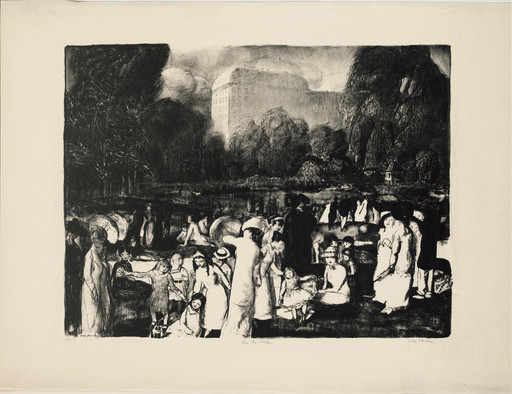
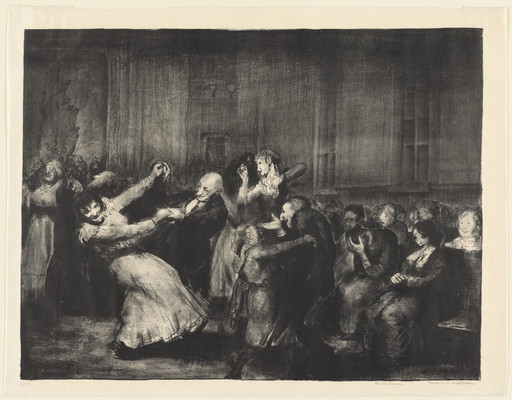
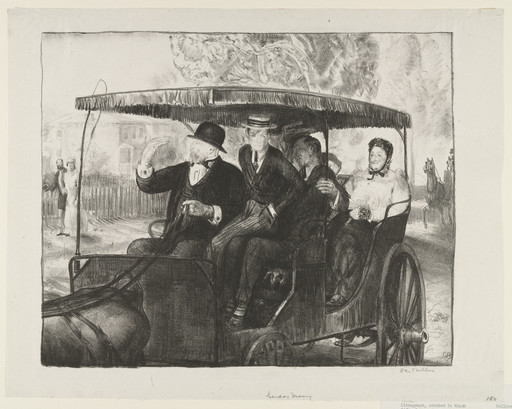
When George Bellows made his first print in 1916, he was already an established illustrator and a painter of what would come to be known as the Ash Can School, a reference to artists who recorded everyday life among New York's working class in sympathetic, often gritty detail. Bellows was initially inspired by the etchings of John Sloan, his supervisor at the Socialist magazine The New Masses, but after making one etching, he switched to lithography, finding it more suited to his fluid, gestural draftsmanship.
Bellows produced nearly two hundred lithographs between 1916 and his untimely death in 1925. His subjects range from genre scenes, social issues, and the atrocities of war to portraiture and the nude. His prints were occasionally based on earlier works in other mediums, particularly his illustrations, but prints also led to new paintings and drawings. In the 1920s Bellows worked with master printers George C. Miller and Bolton Brown, both of whom were known for their contributions to the practice of lithography among American artists at the time. In addition, Bellows owned his own press, enabling him to rework compositions through multiple states and to experiment with tonal effects.
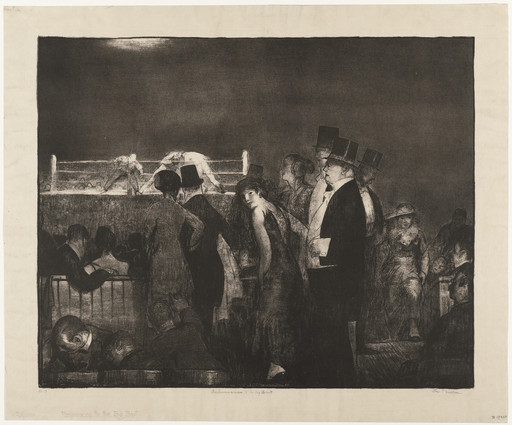
Bellows's boxing series comprises eighteen lithographs, twenty-two drawings, and six paintings, dating from 1907 to 1924. Dempsey and Firpo was the result of an assignment Bellows received from the Saturday Evening Post to cover a prizefight between the champion Jack Dempsey and the Argentinean contender Luis Firpo. The artist chose to depict the moment when Dempsey was knocked out of the ring. Many believe the crowd pushed Dempsey back in, making his subsequent victory controversial. The lithograph captures the fall and the stunned expressions of the audience. Light-and-dark effects describe the muscular, athletic bodies and also convey the drama of the struggle.
an essay by Jennifer Roberts, in Deborah Wye, Artists and Prints: Masterworks from The Museum of Modern Art, New York: The Museum of Modern Art, 2004, p. 116.
Explore more

Lithography
A printmaking technique that involves drawing with greasy crayons or a liquid called tusche, on a polished slab of limestone; aluminum plates, which are less cumbersome to handle, may also be used.
Learn more →


From MoMA Design Store


Installation views
We have identified this work in the following photos from our exhibition history.
Licensing
Artwork or archival images
If you would like to reproduce an image of a work of art in MoMA's collection, or an image of a MoMA publication or archival material (including installation views, checklists, and press releases), please contact Art Resource (publication in North America) or Scala Archives (publication in all other geographic locations).
Audio and film clips
MoMA licenses archival audio and select out of copyright film clips from our film collection. At this time, MoMA produced video cannot be licensed by MoMA/Scala. All requests to license archival audio or out of copyright film clips should be addressed to Scala Archives at [email protected]. Motion picture film stills cannot be licensed by MoMA/Scala. For access to motion picture film stills for research purposes, please contact the Film Study Center at [email protected]. For more information about film loans and our Circulating Film and Video Library, please visit Circulating Film and Video Library.
Text from a publication or the archives
If you would like to reproduce text from a MoMA publication, please email [email protected]. If you would like to publish text from MoMA's archival materials, please fill out this permission form and send to [email protected].
Feedback
This record is a work in progress. If you have additional information or spotted an error, please fill out this feedback form.