Not on view
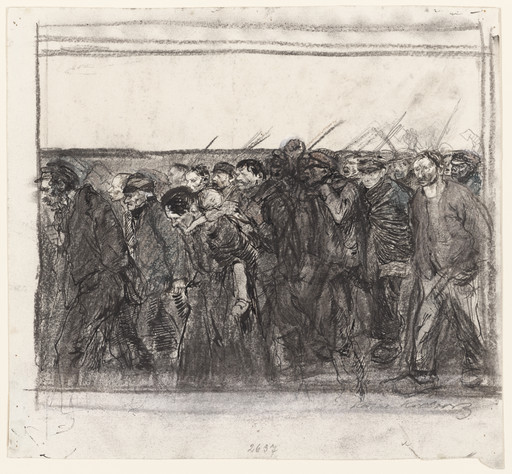
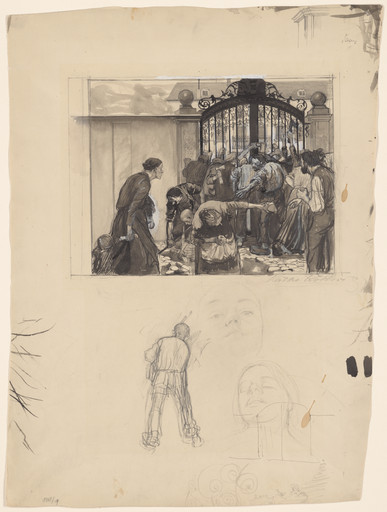
In 1919, Käthe Kollwitz began work on Krieg (War), her response to the tragedies endured during what she called those "unspeakably difficult years" of World War I and its aftermath. The portfolio's seven woodcuts focus on the sorrows of those left behind—mothers, widows, and children. Kollwitz had struggled to find the appropriate means of expression until she saw an exhibition of Ernst Barlach's woodcuts in 1920. Revising each print through as many as nine preparatory drawings and states, Kollwitz radically simplified the compositions. The large-format, stark black-and-white woodcuts feature women left to face their grief and fears alone, with their partners, or with each other.
Only one print, Die Freiwilligen (The volunteers), shows the combatants. In it, Kollwitz's younger son, Peter, takes his place next to Death, who leads the troops in an ecstatic procession to war. Peter was killed in action just two months later. Kollwitz wanted these works to be widely viewed. By eliminating references to a specific time or place, she created universally legible indictments of the real sacrifices demanded in exchange for abstract concepts of honor and glory. The prints were exhibited in 1924 at the newly founded International Anti-War Museum in Berlin.
Heather Hess, German Expressionist Digital Archive Project, German Expressionism: Works from the Collection. 2011
Publication excerpt from The Museum of Modern Art, MoMA Highlights , New York: The Museum of Modern Art, revised 2004, originally published 1999, p. 113.
These prints express the raw agony that war inflicts on humanity. In The Widow I a woman hugs herself in anguish. Her rounded form and the tender contact of her massive hands over her chest and abdomen suggest that she may be pregnant, lending further poignancy to her situation. In The Mothers, a group of women locked in tight embrace console each other, while two frightened children peer out from beneath their protective huddle. In The Volunteers, four young men, whose distressed faces and clenched fists betray their sense of doom yet determination, volunteer to fight as they follow a drumming figure with a deathlike mask. Grief and torment pervade each of these images, so graphically conveyed by the crude slashes and gouges of the woodcut medium.
Kollwitz's Seven Woodcuts about War is one of several portfolios of prints by German artists focusing on the savagery of World War I. But rather than show the brutalities of warfare and bombing experienced by soldiers, the artist portrays the emotional responses of civilians. Although her sense of loss was very personal—her younger son Peter was killed in combat in Flanders—Kollwitz presents universal visions of the unending sorrow generated by war for those left behind.
The Museum of Modern Art, MoMA Highlights, New York: The Museum of Modern Art, revised 2004, originally published 1999, p. 113.
Gallery label from German Expressionism: The Graphic Impulse , March 27–July 11, 2011
These woodcuts—stark icons of concentrated emotion—focus on the anguish suffered by wives, parents, and children whose men fought and died in the war. In The Sacrifice a new mother offers up her infant as a sacrifice to the cause. In The Widow II a woman and her baby lie in a heap, perhaps dead from starvation. Volunteers is the only print to show combatants. In it, Kollwitz's son Peter takes his place next to Death, who leads a band of young men in an ecstatic procession off to war. Peter had been killed in action two months after joining the military, in 1914, a loss from which Kollwitz never fully recovered.
German Expressionism: The Graphic Impulse, March 27–July 11, 2011
Gallery label from Käthe Kollwitz, March 31–July 20, 2024
War, Kollwitz’s third print portfolio, memorializes the anguish of those who lost sons, husbands, and fathers in World War I. Its sequence mirrors Kollwitz’s evolution from war supporter to pacifist as she coped with the death of her own son in the conflict. “[This series] is my confrontation with that part of my life, from 1914 to 1918, and these four years were difficult to reckon with,” she wrote. The first two sheets portray a mother holding her infant as if offering a sacrifice, and a band of volunteers marching ecstatically to battle. Subsequent sheets shift to parents and widows grieving their losses. One of the final sheets depicts mothers protecting children—an image of resistance against Germany's culture of military sacrifice.
Käthe Kollwitz, March 31–July 20, 2024
Explore more
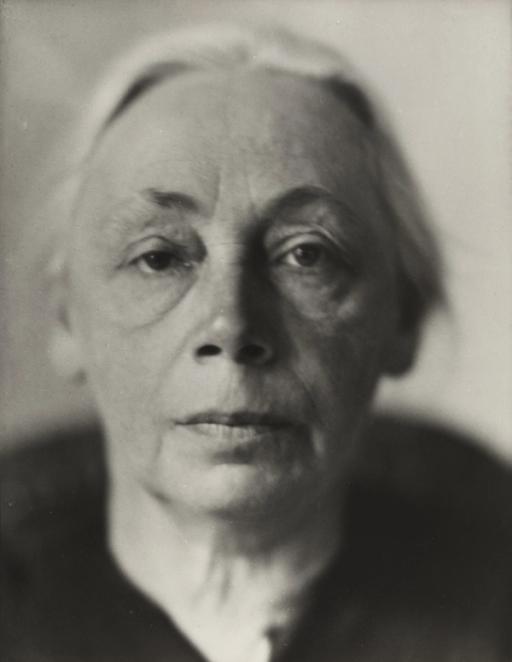
Käthe Kollwitz
German, 1867–1945 49 works onlineBorn in the Prussian city of Königsberg (now Kaliningrad, Russia) in 1867, Käthe Kollwitz established herself in an art world dominated by men by developing an aesthetic vision centered on women and the working class.
Learn more →
Edition
A set of identical prints made from the same printing surface. Editions may be limited or unlimited in number. Often a certain number of prints—including artist’s proofs, printer’s proofs, and hors commerce (not for sale)—are made at the same time but kept apart from the numbered edition.
Learn more →

From MoMA Design Store


Installation views
We have identified this work in the following photos from our exhibition history.
Provenance Research Project
This work is included in the Provenance Research Project, which investigates the ownership history of works in MoMA's collection.
Ruth Arnhold Steiner, Piedmont, California; given to The Museum of Modern Art, New York, 1992
Provenance research is a work in progress, and is frequently updated with new information. If you have any questions or information to provide about the listed works, please email [email protected] or write to:
Provenance Research Project
The Museum of Modern Art
11 West 53 Street
New York, NY 10019
Licensing
Artwork or archival images
If you would like to reproduce an image of a work of art in MoMA's collection, or an image of a MoMA publication or archival material (including installation views, checklists, and press releases), please contact Art Resource (publication in North America) or Scala Archives (publication in all other geographic locations).
Audio and film clips
MoMA licenses archival audio and select out of copyright film clips from our film collection. At this time, MoMA produced video cannot be licensed by MoMA/Scala. All requests to license archival audio or out of copyright film clips should be addressed to Scala Archives at [email protected]. Motion picture film stills cannot be licensed by MoMA/Scala. For access to motion picture film stills for research purposes, please contact the Film Study Center at [email protected]. For more information about film loans and our Circulating Film and Video Library, please visit Circulating Film and Video Library.
Text from a publication or the archives
If you would like to reproduce text from a MoMA publication, please email [email protected]. If you would like to publish text from MoMA's archival materials, please fill out this permission form and send to [email protected].
Feedback
This record is a work in progress. If you have additional information or spotted an error, please fill out this feedback form.