Not on view
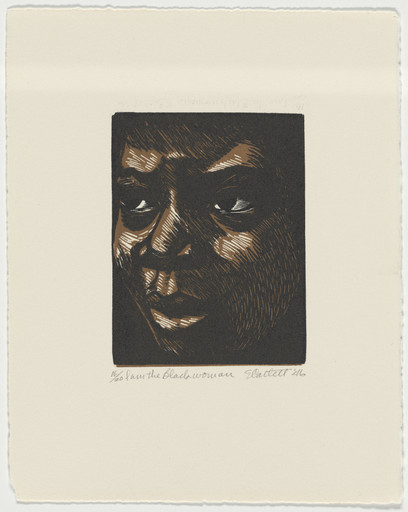
Elizabeth Catlett has said that the purpose of her art is to "present black people in their beauty and dignity for ourselves and others to understand and enjoy." As a sculptor and printmaker, she blends figurative and abstract traditions with social concerns, and has maintained a deep belief in the democratic power of printed art to reach a large audience. She has completed some eighty prints in woodcut, screenprint, lithography, and, most importantly, linoleum cut, a technique she learned at El Taller de Gráfica Popular (People's Graphic Workshop). This renowned workshop and artists' collective was first visited by Catlett while she was in Mexico City on a fellowship in 1946. The workshop's aim is to continue the Mexican tradition of socially engaged public art. It specializes in linoleum cut, as it is a technique that is easy to work with, produces inexpensive prints, and can accommodate large editions.
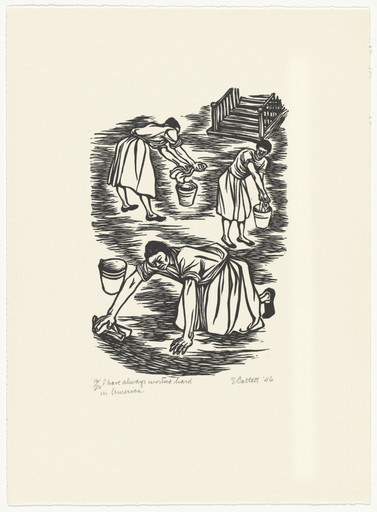
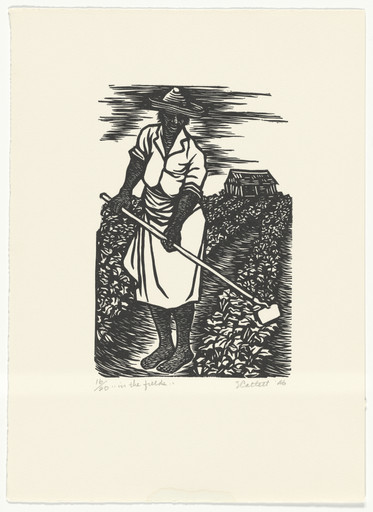
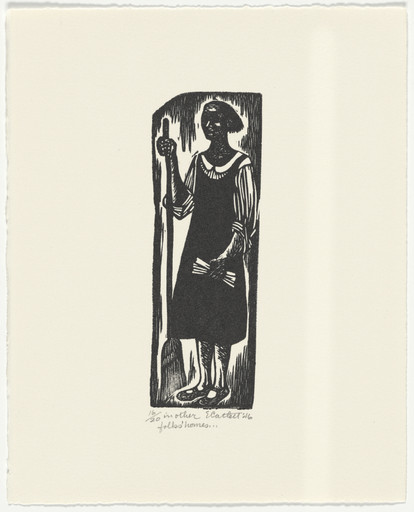
Catlett's attraction to Mexican printmaking reflects a social and political concern she shares with the great muralists. Like them she uses her art to advance causes of particular interest to her, including the African-American experience and the plight of the lower classes. Many of her prints show the multidimensional aspects of women as mothers, workers, and activists. Sharecropper evokes Catlett's belief in the strength and dignity of the working poor, while it also offers a heroic portrait of this anonymous woman. She also depicts great women from African-American history, including Harriet Tubman, who is shown leading slaves to freedom as a "conductor" on the Underground Railroad. Catlett's continued support of the civil rights movement in the United States during the 1960s is visible in the print completed after Malcolm X was shot and killed. It expresses Catlett's enthusiasm for the leader's successful efforts in inspiring pride in African-American women.
an essay by Harper Montgomery and Sarah Suzuki, in Deborah Wye, Artists and Prints: Masterworks from The Museum of Modern Art, New York: The Museum of Modern Art, 2004, p. 218.
Explore more
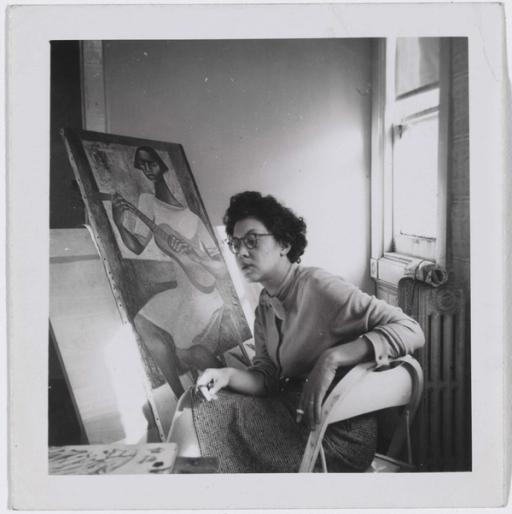
Elizabeth Catlett
American and Mexican, 1915–2012 22 works onlineWhat makes a work of art revolutionary? For the artist and educator Elizabeth Catlett, the answer depended on who the work addressed.
Learn more →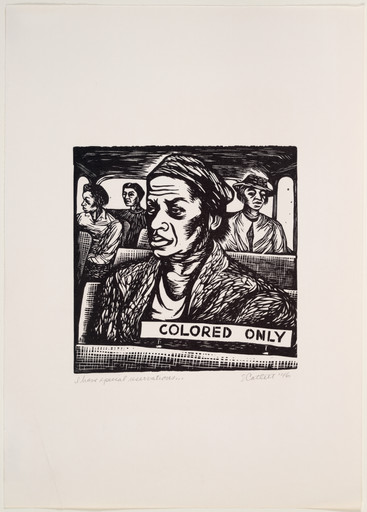
Edition
A set of identical prints made from the same printing surface. Editions may be limited or unlimited in number. Often a certain number of prints—including artist’s proofs, printer’s proofs, and hors commerce (not for sale)—are made at the same time but kept apart from the numbered edition.
Learn more →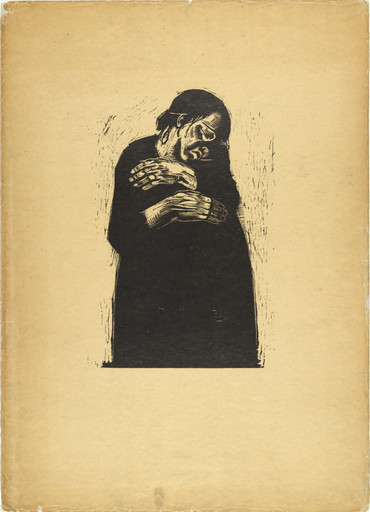

Linoleum cut
A relief printmaking technique, also called linocut, that is usually characterized by flat, clearly delineated areas of color. An image is cut or gouged from a sheet of linoleum, which is softer and easier to carve than wood.
Learn more →
From MoMA Design Store


Installation views
We have identified this work in the following photos from our exhibition history.
Licensing
Artwork or archival images
If you would like to reproduce an image of a work of art in MoMA's collection, or an image of a MoMA publication or archival material (including installation views, checklists, and press releases), please contact Art Resource (publication in North America) or Scala Archives (publication in all other geographic locations).
Audio and film clips
MoMA licenses archival audio and select out of copyright film clips from our film collection. At this time, MoMA produced video cannot be licensed by MoMA/Scala. All requests to license archival audio or out of copyright film clips should be addressed to Scala Archives at [email protected]. Motion picture film stills cannot be licensed by MoMA/Scala. For access to motion picture film stills for research purposes, please contact the Film Study Center at [email protected]. For more information about film loans and our Circulating Film and Video Library, please visit Circulating Film and Video Library.
Text from a publication or the archives
If you would like to reproduce text from a MoMA publication, please email [email protected]. If you would like to publish text from MoMA's archival materials, please fill out this permission form and send to [email protected].
Feedback
This record is a work in progress. If you have additional information or spotted an error, please fill out this feedback form.