
Practice: Foundations for Engagement with Art
This guide explains how to engage individuals with dementia and their caregivers with art. The methods can be used with groups or one-on-one, and can be adapted for various settings, from art museums and galleries to care organizations and private homes. These foundations can help to create meaningful experiences in any environment.
Overview
Engaging with Art
Engagement with art can have significant benefits for people with dementia and their caregivers. This is true whether the experience involves looking at and discussing art or creating art. In both cases, art can be used as a vehicle for meaningful self-expression. Indeed, engagement with art, through close looking and discussion, offers a person with Alzheimer's disease the chance to:
- Explore and exchange ideas about art and artists
- Experience intellectual stimulation
- Make connections between personal stories and the world at large
- Access personal experiences and long-term memories
- Participate in a meaningful activity that fosters personal growth
In addition to the above benefits, caregivers also gain from art experiences by exploring their own interests in art while the person in their care is present, safe, and engaged. In some settings, such as museums and care organizations, they can interact socially with other caregivers, share stories, and learn in a supportive environment where they are relaxed both physically and mentally.
Furthermore, their relationship with the person in their care may be enhanced because art programs provide singular opportunities for communication and connection. Finally, participants learn about each other in a new context and gain new insights into each other's ideas and interests.
Defining Art
Definitions of art vary greatly among theorists, philosophers, art historians, artists, and art educators. Indeed, one of the aims of individual artists and one of the primary characteristics of modern and contemporary art movements is the constant redefining of what constitutes art. Getting a sense of what is meant by "art" is important, regardless of how open-ended we leave that definition, since our concept of art dictates what objects or images will be discussed and how participants will engage in these discussions.
Overall, in this book, our use of the terms art, the arts, or artworks refers to works generally included in the categories of visual arts—namely, sculpture, painting, drawing, prints, film, photography, architecture, design, and multimedia projects. All of these mediums are represented in MoMA's collection and whether on exhibit in the galleries or accessible online are freely labeled "art." They can all be used to spark engagement and discussion.
Planning a Program
The most essential steps for preparing an art-looking experience are listed below and explained in detail on the following pages. A sample module for a museum program is included in this section.
- Select a theme that will be your organizing principle.
- Select four to six works to view and discuss in relation to the theme.
- Determine the sequence in which you will view the works.
- Prepare three to five art-historical points per work to insert into the conversation at an appropriate moment.
- Prepare three to five questions per work that could spark conversation about each work.
- Plan small-group conversations to conduct toward the middle of your program.
Selecting a Theme
Select a theme that is appropriate and relevant for individuals with cognitive impairment but that captures the interest and imagination of all participants. Your theme should be general enough to be accessible for everyone and appropriate for an adult audience.
Possible themes include:
- Portraiture
- Materials in Sculpture
- Art and Music
- The Road to Abstraction
- Why is This Art?
- The Portrayal of Women in Art
- Telling Stories through Photographs
- Museum Collection Highlights
You could also focus on a single artist (such as Pablo Picasso or Vincent van Gogh), an art movement (like Impressionism or Cubism), art from a geographical region (South America or Europe, for instance), or art from a certain time period (such as the Renaissance or the nineteenth century).
If you are working with individuals or a group that you know—or if you learned of their interests in Advance—try to choose a theme you think will pique their interest.
Selecting the Works of Art
Once you have selected a theme, choose four to six relevant works. It is possible that you might not fit all the works within the allotted time, but it is better to be prepared with too many works than not enough. You may select the theme and the works simultaneously. You might have certain works in mind that you want to talk about, and you might select a theme that accommodates those works. You can create positive and purposeful experiences with almost any work of art. Choose works that you find interesting, that you are comfortable speaking about, and that you think will engage the audience. You can focus on just one medium (such as painting, sculpture, or photography) or present works in different mediums.
If you will be viewing original works in a museum or gallery, be aware of their scale and how they are installed. Very small works may be hard for a group to see, and works that are installed close to others may be difficult to focus on. Also keep in mind where the works are in relation to one another and the level of mobility of your group.
Determining the Sequence
The sequence in which you view the works should offer a helpful way to connect them in the context of the theme you have chosen. It should be coherent in terms of the thematic connection between one work and the next and the location of works relative to one another (if using original works in gallery spaces). If the works are scattered throughout a museum or gallery, their various locations will influence the sequence. It may simply be chronological, from the oldest work to the newest or vice versa.
The order will also depend on the questions you plan to ask and the ways you will link the works to each other. As a rule of thumb, it is often better to begin with works that are simpler in composition and move to those that are more complex or to move from more figurative works to those that are more abstract. Alternatively, you can begin with works that fit your theme in a literal fashion and move toward those that relate more metaphorically or conceptually.
While selecting the works and determining the sequence, ask yourself:
- How will I introduce the theme?
- How do the works relate to the theme and each other, and in what order is this best expressed?
- How will I make a seamless transition from one work to the next?
- What are some questions I will ask about the works?
- What art-historical information will I share?
- How will I relate the works to my theme in my summary and conclusion?
Preparing Art-Historical Information
Using online resources, exhibition catalogues, wall labels, and books, research the works and the artists that you will be discussing. Look into each artist's practice, the time period in which he or she lived and worked, and information regarding any movements or artist groups he or she was a member of. You can also include information about the subject matter, quotations from the artist, or quotations from contemporary critics about the work or the artist's general style. Of all this information, select a few main ideas that are relevant to the work and your theme and are conducive to conversation. Settle on a limited number of points for each work (three or four); this will help you avoid lecturing and encourage a wider range of participation.
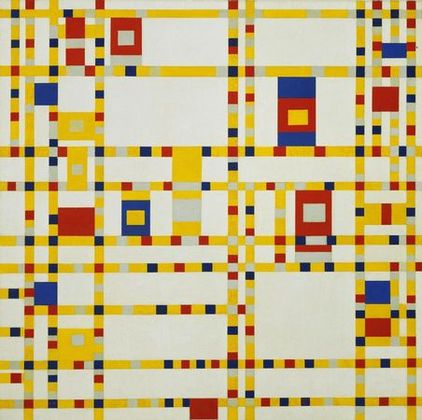
Art-historical information should be used throughout the discussion to strengthen participants' understanding and appreciation of the work and help place the work in the context of developments in art and world history. When discussing a work, always share the information typically found on a museum label with your participants—the name of the artist, date of the work, and materials used. This can be done at the beginning, the end, or at a relevant moment during the discussion. You can give the title of a work as a way to encourage further discussion. You might say, "Picasso titled this work Girl before a Mirror," and then follow with, "Does knowing the title change the way you think about the work? How?" Provide additional information during the program as it becomes relevant based on participants' responses. For example, if you're looking at Broadway Boogie Woogie by Piet Mondrian, and someone says, "This looks like a map of Times Square," you could mention that when Mondrian painted this picture in 1942–43, he had recently moved to New York City.
Remember that this is a conversation and not a lecture. Your goal is not only to provide art-historical facts but also to encourage the participants to engage in a discussion and share their own opinions. Sharing art-historical information can validate participants' responses and spark new conversation.
Preparing Discussion Questions
Prepare three to five questions to frame the discussion of each work as it relates to your theme, knowing that when you are actually in front of the work you will inevitably ask many more questions based on participants' responses.
Below are some helpful tips to keep in mind throughout the discussion:
- Ask concrete questions and be specific. Ask "What do you see in this painting?" instead of "What is going on here?"
- Alternate between open-ended questions and questions with definite answers, and be ready to mix in or switch to either/or or yes/no questions to keep the discussion moving. For example, you might ask, "Does this work suggest a specific season?" If no one responds, you could name the seasons, or ask, "Do the colors in the painting make you think of the summer or the spring?" Or, further, you could invite yes/no answers to simpler questions, such as "Does this painting make you think of springtime?"
- Be aware that some participants may not speak. This does not mean that they are not engaged. They are likely benefiting from the experience in multiple ways.
- Be conscious of making comparisons to works you have already discussed, which may not be easily recalled by the participants. You should only compare works that are easily visible at the same time.
In Front of a Work of Art
It is essential to use inquiry-based techniques to facilitate the experience. That is, do not lecture or continuously provide information but rather ask questions to allow participants to reach their own interpretations through a lively discussion. In order to understand what types of questions to prepare and ask, it is important to familiarize yourself with the different parts of a discussion: Observation, Description, Interpretation, Connection, Small-Group Conversation, and Summary. While the framework for discussing a work of art that follows is designed for a group, it can be easily adapted for a one-on-one conversation. For an example of how this method can be applied directly to a specific work of art see In Front of London Bridge.
Observation
Invite participants to approach the work and take a close look before they take their seats. Make sure each participant has an unrestricted view of the work. Tell the group that the first step is to look closely, and provide a timeframe for this observation.
Participants should have adequate time to look at the work and not feel like they are being rushed. Encourage them to take a "visual inventory" of the work of art quietly, focusing on it and noticing details for about one minute.
Description
Next, begin to describe the work as a group to establish a fundamental understanding of what is being seen. It is useful to start by simply listing what everyone sees. Description rests upon the exploration of the formal properties of the work, as well as naming recognizable subject matter. Touch on:
- Line and Shape. For example, ask, "What lines and shapes do you see in this drawing?"
- Color. For example, ask, "Does any one color dominate this painting?"
- Composition. For example, ask, "Where is the female figure in relation to the landscape?"
- Material. For example, ask, "What do you think this sculpture is made of?"
- Technique. For example, ask, "By looking closely at this painting, can you describe the brushstroke?"
- Subject matter. For example, ask, "What objects do you see in this painting?"
This process allows a wide range of participation and will benefit future interpretation. If participants immediately interpret the work, ask them which visual clue led them to that idea. Once you feel that the group has thoroughly described the work, summarize all the elements mentioned and point out any important details that have been missed.
Interpretation
Now you are ready to interpret the work. Interpretation rests on assigning meaning to various elements of the work and thinking about its overall significance. Responses can vary widely. Encourage breadth and variety, and use ideas generated to expand the conversation. Ask questions that prompt participants to reflect on what is not clearly visible in the work but perhaps merely suggested. Touch on:
- Time and Place. For example, ask, "What season is suggested by this scene?"
- Narrative. For example, ask, "What is implied by the way these two figures are interacting?"
- Mood or Psychological Effect. For example, ask, "What overall mood is conveyed in this photograph?"
- Artist's Intention (related to choice of subject matter, use of formal properties and technique, and overall aesthetic philosophy). For example, ask, "Why do you think the artist used these found objects together to create this sculpture?"
- Artist's Biographical Information. For example, ask, "What possible influence do you see of this artist's native land in this drawing?"
- Historical and Social Context. For example, ask, "This painting was done in 1940. Are there elements within the work that you associate with the political events of that time?"
Follow your inquiries with deepening questions, such as, "Could you say a little bit more about that?" or, "What do you see that makes you say that?" Balance your questions by sharing art-historical information relevant to the responses you receive from the group to validate individual interpretations, make connections, and encourage further discussion.
Allow for a wide range of interpretive freedom. Repeat remarks and link ideas. Enable participants to come to their own conclusions, instilling in them a sense of pride, accomplishment, and a deeper understanding of the work.
Connection
Encourage members of the group to connect the works to their life experiences. This process will help the participants gain new insights and will make the works more relevant to them. Ask if the participants like the works, and feel free to share your own opinions, making it clear that your remarks are subjective. There are various ways of making connections to:
- Personal Life Experience. For example, ask, "Does this look like the New York of today or the New York of when you were a child?"
- Psychological and Emotional Effect. For example, ask, "How does this painting make you feel?"
- Personal Opinion. For example, ask, "Do you like this painting?"
- Cultural Changes and World Events. For example, ask, "Does this war scene remind you of any specific war or historical conflict?"
- Other Artwork and the Art-Historical Canon. For example, ask, "How does this drawing of a landscape compare to the painting next to it that depicts the same scene?"
Small-Group Conversation
(Turn and Talk)
When working with a group, conversations in smaller groups provide a chance for individuals to share stories and connect on a more personal or imaginative level to the work. This activity also gives participants who are more reticent in the larger group a chance to engage on a more intimate level.
At some point during the program have each pair of participants (the person with dementia and his or her caregiver) join one or two other pairs (for a total of four or six people in each smaller group). It is best to do this toward the middle of the program. Make sure to go through the observation, description, and interpretation phases before initiating the Turn and Talk.
Tell the groups to discuss a particular idea or theme that relates to the work of art. Your prompt should be straightforward and appropriate to the participants' cognitive abilities. The discussions should last no longer than ten minutes. At the end of the period bring everyone back together and encourage participants to share their conversations with the whole group.
Summary
Toward the end of the discussion of each work (and at the end of the program), bring together the various threads of conversation, summarizing and synthesizing the points you have touched on. Thank the participants and open up the discussion to final comments.
In Front of London Bridge
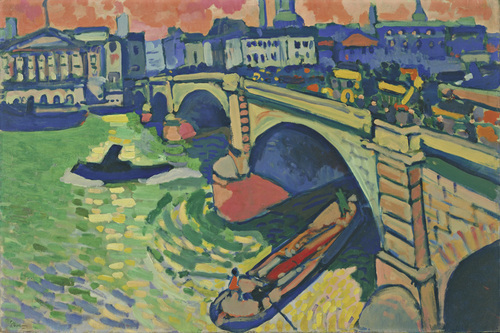
We have included a list of questions for different parts of the discussion of Derain's London Bridge, the first work in our example program, The City in Modern Art.
Observation
Before we begin our discussion, why don't we take a minute to look closely at this painting?
Description
What are some recognizable buildings or structures in this painting?
Where is this scene? Indoors or outdoors?
Are the artist's brushstrokes visible? If so, describe them.
What colors do you see in the water? What about the sky?
Interpretation
What is the overall feeling you get from this London scene?
Why do you think Derain chose to paint this bridge?
Do you think it held special meaning for him or that he saw it often?
Why do you think the water is painted green and yellow?
What time of day do you think this scene represents?
What title would you give this work? Why?
Connection
How does this scene relate to your experience of the city?
The most prominent aspect of this work is the bridge. When you think of bridges, is there one in particular that comes to mind? Why?
Is this a place you'd like to visit? Why or why not?
Can you think of other artists who painted city scenes? How do they compare?
Facilitation Strategies
Certain facilitation strategies can help create a supportive environment.
Frame of Mind
Throughout the program be sure to:
- Internalize the goals of the experience: share, explore, and enjoy the experience.
- Remain relaxed and allow the conversation to go in unexpected directions.
- Convey a sense of lightness and humor.
- Support and show interest in the comments and interpretations of all participants.
- Stay attuned to the effects of the disease on participants, and be patient.
- Never mention Alzheimer's disease.
- Always keep in mind that this is a reciprocally rich and rewarding experience.
Communication Techniques
The communication strategies below address the specific needs of individuals with dementia.
- Make eye contact with the participants.
- Be aware of nonverbal communication: facial expressions, body language, and gestures.
- Talk directly to the person with Alzheimer's disease, even if he or she is nonverbal.
- Emphasize and define key words.
- Avoid vague words and colloquial expressions.
- Supplement or reinforce words by referring and pointing to the artwork.
- If you are having trouble understanding a comment, try to interpret what is being said, and clarify with the participant.
- Never chastise any member of the group. Instead, validate frequently and with sincerity.
Group Dynamics
If you are working with a group it can be difficult to balance the interests, abilities, and personalities of each of the participants. Below are a few tips that will help keep the entire group engaged and involved.
- Always repeat answers and questions that come up so that all can hear. When you cannot hear what a participant is saying, approach him or her and listen, and then walk back to the front and repeat the comment for the whole group.
- Encourage genial debate among the participants.
- Do not create multiple planes of conversation; rather, maintain one thread of conversation that involves both caregivers and individuals with dementia.
- Allow participants to comment as much as they like, but do not let any one person monopolize the conversation.
- Patiently and creatively bring to a close a comment that goes on too long.
- Make a theme out of the responses, build on them, repeat them, and take them in different directions.
- Summarize often. This helps to keep people's attention and reinforces the information shared.
Challenging Scenarios
Inevitably, challenging situations will arise, whether you are working with a group or one-on-one. Consider what you might do if the following scenarios occur: a participant is very enthusiastic and starts monopolizing the discussion; a participant makes a comment that seems to have little to do with the artwork being discussed; several people in your group seem reluctant to speak no matter what strategy you use to draw them out; a caregiver and a person with dementia keep having side conversations; a participant repeats the same point during the entire program. There are many ways to handle these different scenarios, but in all cases you should take into consideration the following when responding to the situation:
- Provide a meaningful and positive experience. You want people to leave the program feeling good about themselves and their participation. Never chastise or be patronizing. Being sincere in your interactions and genuinely committed to an exchange of ideas will go a long way in validating everyone's experiences.
- Trust that nonverbal communication will go a long way in providing a positive experience. If people are not responding verbally, it does not mean that they are not engaged. Look for clues of engagement: are participants looking at you or at the work? Do they seem to be taking an interest in what is going on? Some people might be more reluctant to talk in a large group.
- Try to invite participants into the group conversation using different strategies. For example, you can ask questions that invite contributions from everyone (such as, "Do you like this painting?"). Or, if you notice someone smiling or pointing to the work, invite him or her to share what they are thinking.
- Remember that one goal of the program is to encourage positive interactions between individuals with dementia and their caregivers. If a person with dementia and his or her caregiver are having side conversations, allow them to continue as long as they are not disruptive to the group.
- Remember that personal connections and narratives should be encouraged. If a participant makes comments that seem unrelated to the work, trust that some element of the work or the experience is allowing him or her to make a direct or indirect link. For example, if someone begins to talk about lions in Africa when viewing a cityscape, it might be that they are associating colors or other elements of the painting with Africa or they are making indirect connections to life experience. They might have taken a trip to Africa in the past and thus are relating to the painting in terms of travel and their personal experience. Always be aware of the possibilities of these connections.
- Be aware of cognitive issues related to Alzheimer's disease and prepare and act accordingly. If a person makes the same comment repeatedly, acknowledge it often, perhaps in different ways. Try to connect it to a new piece of information or another comment from the group, or use it as a jumping-off point to start a new thread of conversation.
After the tour, you might feel that you could have handled a situation better than you did on the spot. Do not be too hard on yourself. Learn from each experience and strategize how you will handle similar situations in the future.
Overall, your enthusiasm and sincerity will lead to positive experiences. Being well prepared and constantly aware of the dynamics at work one-on-one or in the group will go a long way in creating a positive atmosphere and a great interaction.
In Our Example
Selecting a Theme
For an upcoming tour at MoMA, we selected the theme The City in Modern Art.
Selecting the Works of Art
For our tour, we chose five paintings:
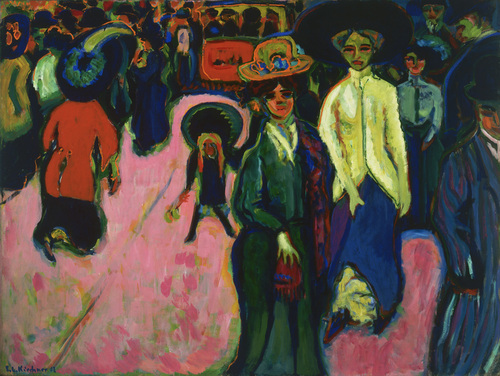
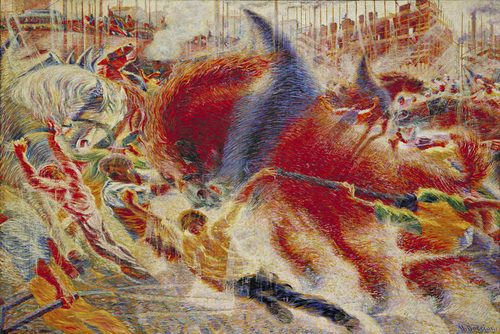
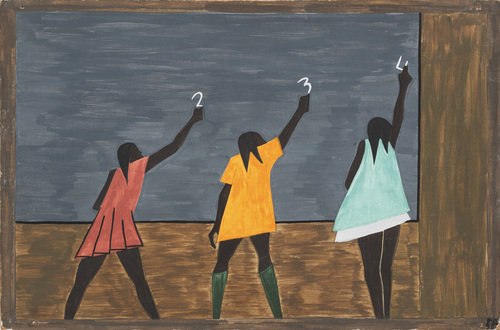
- London Bridge (1906), by André Derain
- Street, Dresden (1908), by Ernst Ludwig Kirchner
- The City Rises (1910), by Umberto Boccioni
- In the North the Negro had better educational facilities (1940–41), by Jacob Lawrence
- Broadway Boogie Woogie (1942–43), by Piet Mondrian
Because our tour focuses on a specific type of landscape (cityscape), we purposely selected works by artists who worked at different times and were from various geographical regions. The works present an interesting overview of several key styles and techniques while showing very different interpretations of the modern city. These points offer intriguing opportunities for discussion and allow participants to tap into their own lives and experiences.
Determining the Sequence
We decided to use a chronological sequence for our selected works. Doing so allows us to organize our discussion through a logical progression in time. In addition, this arrangement progresses from a concrete, representational image to more abstract compositions. It also allows us to discuss developments in the history of modern art through various artists' depictions of similar subject matter.
Preparing Art-Historical Information
Here is some information about each work that we plan to bring into the conversation at appropriate times.
-
London Bridge, by André Derain
Derain was a member of the French movement that came to be known as Fauvism. The Fauves, or "wild beasts," were known for their unbridled use of color. Their disregard for the natural coloring of objects shocked their contemporaries. In this painting, Derain applies wild color in his depiction of the heavily trafficked London Bridge, with multiple boats and barges in the River Thames below. Derain was encouraged to visit London in the early 1900s by the dealer Ambroise Vollard. While there he painted many different views of the city, focusing mainly on the various monuments and bridges along the Thames.
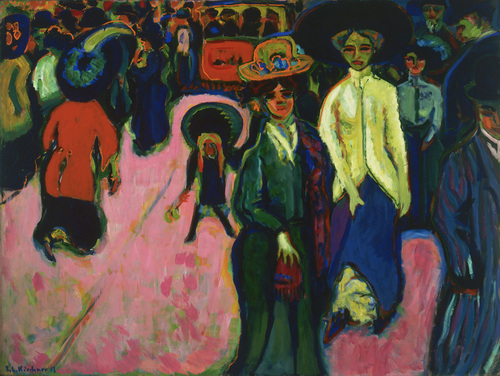
Street, Dresden, by Ernst Ludwig Kirchner
Kirchner was a member of the German Expressionist group Die Brücke (The Bridge). The artists of Die Brücke explored the emotional effects of color and composition in the depiction of contemporary life. Through the use of bright, unrealistic colors, Kirchner energized this scene of Königstrasse street in Dresden.
-
The City Rises, by Umberto Boccioni
Boccioni was a key figure of the Italian Futurist movement. This group of motivated writers, musicians, and visual artists sought to abandon the air of nostalgia that they felt was restricting Italian society. They encouraged their compatriots to embrace the infinite potential of the future powered by technological advancements and humans' will for change. Boccioni uses "lines of force" to communicate this idea of progression in his dynamic composition of a city being built.
-
In the North the Negro had better educational facilities, by Jacob Lawrence
Lawrence's family was one of the thousands of African American families to migrate to the North around the time of World War I. They eventually settled in New York City's Harlem neighborhood, where Lawrence began taking art classes. In 1940 he began The Migration Series, a multipanel series of images that narrates this great migration in American history. Each panel was worked simultaneously, resulting in a uniformity of palette and similarity in overall composition among the sixty panels.
-
Broadway Boogie Woogie, by Piet Mondrian
Through the course of his career Mondrian abandoned representation to focus on the depiction of "pure" forms. For Mondrian this meant the exclusive use of primary colors and geometric shapes. In 1940 he moved from London to New York City. There he joined a vibrant society, constantly in flux. He was influenced not only by the rhythm of city life but also by the syncopated beat of jazz music.
Preparing Discussion Questions
- London Bridge, by André Derain
- What part of the city does this painting represent?
- What city do you think this might be, and why?
- Where is the viewer in relation to the bridge?
- Street, Dresden, by Ernst Ludwig Kirchner
- What are the people in this painting doing?
- What is peculiar about Kirchner's use of color in this scene?
- What is the overall mood of this work?
- The City Rises, by Umberto Boccioni
- What seems to be happening in this painting? What are the figures doing?
- What are some clues that reveal that this painting depicts a city?
- What is the emotional impact of the way Boccioni has decided to depict the city? Consider his choice of brushstroke, color, and composition.
- In the North the Negro had better educational facilities, by Jacob Lawrence
- How is this work related to our theme of the city?
- Do the people in this work look like they come from a particular background?
- What is the impact of the formal choices the artist has made on our viewing experience?
- Broadway Boogie Woogie, by Piet Mondrian
- How many shapes and colors are used in this painting?
- What does this painting make you imagine or think of? Does it represent any particular place or thing?
- The title of this painting is Broadway Boogie Woogie. Knowing this, how does your understanding of the painting change?
Small-Group Conversation
(Turn and Talk)
At Kirchner's painting we invite participants to imagine a busy street in New York City and think of how they would depict it. What medium would they use? What colors and techniques? How would those choices relate to the overall feel of that busy street?
At Jacob Lawrence's work, we discuss societal transformations in the United States in past decades, including shifts in public policy and initiatives in social reform.
The first activity is more imaginative, while the second relates to participants' personal histories. We do not necessarily do two activities in one tour, as they may take a long time. We've included these examples to demonstrate the variety of opportunities for integrating a small-group conversation. In addition, it always helps to have several activities prepared and to introduce the relevant ones based on the overall dynamics of the participants and the tour itself.