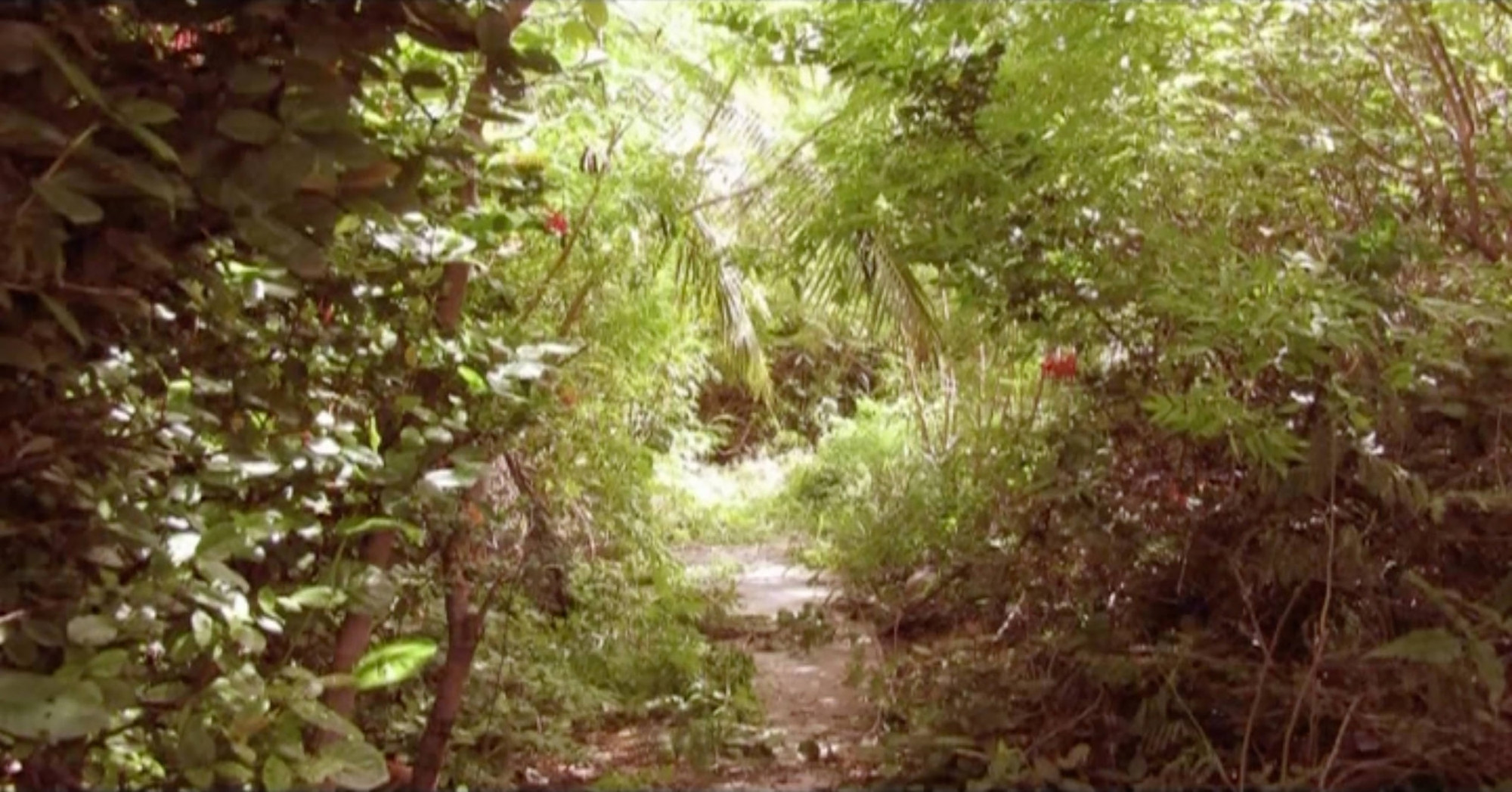
Art and Ecology in Contemporary Latin America
Beginning in 2020 and continuing through 2023, the Cisneros Institute will conduct research on the relationships between art and the environment in contemporary Latin America. The project aims to address how artists, theoreticians, feminist thinkers, ecologists, and climate change activists, among many others, have been rethinking our relationship to territory, resources, and cultural traditions and proposing what seems to be a major cultural shift for the region in terms of its development.
As a preliminary framework, the Cisneros Institute has determined three exploratory themes that demonstrate the complexity and depth of this topic as it pertains to art. The first, “The Vernacular, the Telluric, and Ritual,” examines how contemporary artists use raw materials as evidence of a natural patrimony, and turn to traditional crafts and belief systems of indigenous cultures as a way to re-engage with the natural world. The second theme, “Interspecies, Empathy, and Awareness,” explores artists who question the assumed superiority of human over nonhuman actors (animals, plants, technology, and the planet as a whole). Finally, “Ecology, Sustainability, and Activism” focuses on artists who confront ecological crisis directly, whether by using advanced technology, condemning the commodification of natural resources, or explicitly engaging with local activist communities.
In order to document a history of recent artistic practices and theories, as well as to advance new knowledge on the topic, this project envisions a variety of methodologies and platforms for research. These include seminars and conferences in the United States, as well as workshops in different parts of Latin America, engaging artists, scholars, curators, lawyers, scientists, and ecologists in a choral and complex consideration of the topic.
Energies and Imaginations
Energies and Imaginations brought together scholars, artists, architects, and designers to reflect and speculate on the perils and potentials of energy transitions in Latin America. How are creative practices harnessing the material, social, and spiritual dimensions of energy, and drawing upon the imagination of renewal at the current ecological crossroads? How might collective aspirations and artistic imaginations reframe questions of futures in transition?
This initiative was a collaboration between curators and scholars from the Cisneros Institute at The Museum of Modern Art, New York; Dumbarton Oaks; DRCLAS Art Film and Culture Program; the Mellon Urban Initiative at Harvard University; and the Harvard Department of History of Art and Architecture. In 2021, these organizations collectively organized the online research seminar Recreating Territories: Art and Urban Imaginations, a series of conversations with scholars, artists, and designers to reflect on urban territories in Latin America amid an intensification of ecological and political crises. It is also part of a longstanding research topic of the Cisneros Institute, on questions of art and ecology in contemporary Latin America.
The panel was structured in two parts: a first session will feature short presentations by guest scholars and artists, followed by a roundtable discussion and an open Q&A with the public.
Participants
Pedro Ignacio Alonso holds a PhD in architecture from the Architectural Association School of Architecture, London, and heads the PhD program in architecture and urban studies at Pontificia Universidad Católica de Chile. He was a Princeton-Mellon Fellow at Princeton University in 2015–16, and was resident architect at the Rockefeller Foundation Bellagio Centre in 2019. With Hugo Palmarola, he was awarded the 2014 Silver Lion for the Chilean Pavilion Monolith Controversies at the Venice Architecture Biennale, and they received the 2014 Deutsches Architekturmuseum (DAM) Book Award for their companion book. Alonso and Palmarola also published the book Panel (2014), curated the exhibition Flying Panels: How Concrete Panels Changed the World at the Swedish Centre for Architecture and Design in 2019–20, and are the curators, together with Eden Medina, of the upcoming exhibition How to Design a Revolution: The Chilean Road to Design in Santiago’s La Moneda Cultural Center (2023–24).
Cara Daggett is an associate professor of political science at Virginia Tech. She researches the politics of energy and the environment, feminist studies of science and technology, and histories of empire. Her book The Birth of Energy: Fossil Fuels, Thermodynamics, and the Politics of Work (2019) was awarded the Clay Morgan Award for best book in environmental political theory and the Yale H. Ferguson Book Award from the International Association Northeast, and has been translated into multiple languages. Her work has been published in journals including Environmental Politics, Energy Research & Social Science, Millennium: Journal of International Studies, and the International Feminist Journal of Politics. She has also enjoyed public-facing writing, podcasting, and engagements with artists and architects around questions of energy, and especially how human activities are organized and valued.
Jota Mombaça is an interdisciplinary artist whose work unfolds in a variety of mediums. The sonic and visual matter of words plays an important role in her practice, which often relates to anticolonial critique and gender disobedience. Her work has been presented in several institutional frameworks, such as the 32nd and 34th São Paulo Biennale (2016 and 2020/2021), the 22nd Sydney Biennale (2020), the 10th Berlin Biennale (2018), and the 46th Salon Nacional de Artistas in Colombia (2019). Currently, she is interested in researching elemental forms of sensing, anticolonial imagination, and the relation between opacity and self-preservation in the experience of racialized trans artists in the global art world.
Marina Otero Verzier is head of the social design masters program at Design Academy Eindhoven. In 2022 she received Harvard University’s Wheelwright Prize for a project on the future of data storage. From 2015 to 2022, she was the director of research at Het Nieuwe Instituut, where she led initiatives focused on labor, extraction, and mental health from an architectural and post-anthropocentric perspective. Previously, she was director of global network programming at Studio-X, Columbia University GSAPP, in New York. Otero has curated exhibitions such as Compulsive Desires: On Lithium Extraction and Rebellious Mountains, at Galería Municipal do Porto in 2023; Work, Body, Leisure, the Dutch Pavilion at the Venice Architecture Biennale in 2018; and After Belonging, the Oslo Architecture Triennale in 2016. She is co-editor of Automated Landscapes (2023), Lithium: States of Exhaustion (2021), More-than-Human (2020), Architecture of Appropriation (2019), Work, Body, Leisure (2018), and After Belonging (2016), among others.
Naufus Ramírez-Figueroa’s multidisciplinary work incorporates performance, sound, drawing, and sculpture, exploring themes of loss, displacement, and cultural resistance. Recurring subjects include the Guatemalan Civil War, approached with an absurd and humorous touch that never diminishes its historical weight. His work has been presented in solo and group exhibitions at The Museum of Modern Art, New York; Museo de Arte Moderno de Medellín and Bogotá; Museum Leuven; Times Art Center, Berlin; Thyssen-Bornemisza, Madrid; The Power Plant and Toronto Biennial of Art, Toronto; Sala de Arte Público Siqueiros, Mexico City; New Museum, New York; daadgalerie, Berlin; CAPC musée d’art contemporain, Bordeaux; Venice Biennale; Haus Esters, Krefeld Kunstmuseum; Gasworks, London; Lyon Biennale; Gwangju Biennale; and Tate Modern, London, among others. He is the recipient of fellowships from the Guggenheim, Inga Maren Otto, Artpace Residency, Mies Van Der Rohe prize, Franklin Furnace award, Akademie Schloss Solitude, and the DAAD Berlin Artists-in-Residence fellowship. He holds a BFA from Emily Carr University and an MFA from the School of the Art Institute of Chicago, with a research fellowship at Jan van Eyck Academy in 2013. He is based in Guatemala City.
Elizabeth Wagemann is the director of the City and Territory Lab (LCT) at Universidad Diego Portales, Chile. She is an architect and holds an MA in architecture from the Universidad Católica (Chile) and an MPhil and PhD in architecture from the University of Cambridge. Her research focuses on post-disaster housing, resilience, and sustainable development. Her presentations include the TEDx “From Shelter to Home after Disasters” (2018) and “Living with Uncertainty” at Congreso Futuro (2019). She has published several articles on post-disaster housing and is co-author of Disaster Risk Reduction Including Adaptation to Climate Change for Housing and Settlements (2017) and Resilience, Reconstruction and Sustainable Development in Chile (2019). She has been a research associate at the University of Cambridge, a postdoctoral researcher at CEDEUS and CIGIDEN (Chile), a professor at Universidad Católica (Chile), Universidad Mayor (Chile), and Pontificia Universidad Católica del Ecuador (PUCE), and a visiting professor at University College London.
Respondents and moderators
Bruno Carvalho researches and teaches on the history and experiences of urbanization. He is currently writing The Invention of the Future: A Transatlantic History of Urbanization, about the competing and shared aspirations of city dwellers and urban planners throughout modernity. Carvalho authored the award-winning Porous City: A Cultural History of Rio de Janeiro, published in Brazil in an expanded edition. He has co-edited multiple books and published on topics related to cities, politics, the visual arts, and literature. Carvalho co-edits the book series Lateral Exchanges, on the built environment. At Harvard University, Carvalho is professor of Romance languages and literatures and African and African American studies; affiliated professor in urban planning and design at the Graduate School of Design; co-director of the Harvard Mellon Urban Initiative; and co-chair of the Art, Film, & Culture Committee at the David Rockefeller Center for Latin American Studies.
Thomas B. F. Cummins is the Dumbarton Oaks Professor of the History of Pre-Columbian and Colonial Art in Harvard University’s Department of the History of Art and Architecture, and director of the Dumbarton Oaks Institute. He is the author, editor, or co-editor of 10 books, the latest of which is Sacred Matters: Animacy and Authority in the Americas (2020), co-edited with Steve Koisiba and John Janusek. Cummins served as the director of the University of Chicago Center for Latin American Studies, the interim director of the David Rockefeller Center for Latin American Studies at Harvard, the chair of the Department of History of Art and Architecture, and a member of the Comisión Sectorial del Sistema Nacional de Museos, Perú. He is a faculty member of the Afro-Latin American Research Institute at the Hutchins Center for African & African American Research at Harvard University, where he is co-directing, with Alejandro de la Fuente, a three-year international seminar, “Afro-Latin American Art: Building the Field,” funded by a generous Getty Foundation Connecting Art History Grant. Cummins is a fellow of the American Academy of Arts and Sciences.
Inés Katzenstein joined The Museum of Modern Art in 2018 as curator of Latin American Art and the inaugural director of the Patricia Phelps de Cisneros Research Institute for the Study of Art from Latin America. In her role as curator, she helps conceive the Museum’s collection displays, and heads the Latin American and Caribbean Fund, which is dedicated to acquisitions from the region. She has organized two major exhibitions based on the Patricia Phelps de Cisneros Gift: Sur moderno: Journeys of Abstraction (2018, with Maria Amalia García) and Chosen Memories (2023), and was a member of the curatorial team for Greater New York in 2021. From 2008 to 2018 she was the founding director of the art department at Universidad Torcuato Di Tella, in Buenos Aires, where she created and oversaw an educational program for artists and curators, as well as an exhibition program. Previously, she was curator at Malba-Fundación Costantini, and the editor of Listen Here Now! Argentine Art of the 1960s: Writings of the Avant-Garde, published by MoMA in 2004. She holds a master’s degree from the Center for Curatorial Studies at Bard College, and a BA from the Universidad de Buenos Aires.
Patricio del Real is an architectural historian who works on modern architecture and its transnational connections with cultural institutions, specifically focused in the Americas. Currently an associate professor of the history of art and architecture at Harvard University, he writes and researches on bilateral relationships between racial and cultural imaginaries, stories, and ideologies in the 20th century. He teaches on the ways in which modernism shaped global political and cultural power in such courses as “Making Buildings Beautiful, Architecture and Authoritarianism” and “Mestizo Nations: Architecture in Mexico and Brazil.” His new book, Constructing Latin America: Architecture, Politics, and Race at the Museum of Modern Art, analyzes the way architecture exhibitions were mobilized as cultural weapons during the era of pan-Americanism. He is currently working on his next book, which rethinks the concept of utopia in architecture by looking at alternative building and spiritual practices in the 20th century that developed responses to the universalist mandate of technological modernity, with a particular emphasis on Chile’s Valparaiso School of architecture.
Thaisa Way is the director of the Garden & Landscape Studies and principal investigator for the Mellon-funded Initiative “Democracy and Landscape: Race, Identity, and Difference” at Dumbarton Oaks Research Library and Collection, a Harvard University research institution located in Washington, DC. She teaches at the Graduate School of Design, Harvard University, and is professor emerita at the College of Built Environments, University of Washington, where she was also the founding director of Urban@UW, an initiative to bring together over 400 scholars to advance knowledge of urban futures. As a landscape historian, Way was awarded the Rome Prize in Landscape Architecture at the American Academy in Rome in 2016 and was a resident scholar in 2023. Her multiple publications (including six books) foreground questions of history of the design professions and how gender and race have shaped our landscapes. She holds a PhD in architectural history and urbanism from Cornell University and a master’s of architectural history from the University of Virginia.
June 7-11, 2022
Translated from Spanish by Christopher Winks
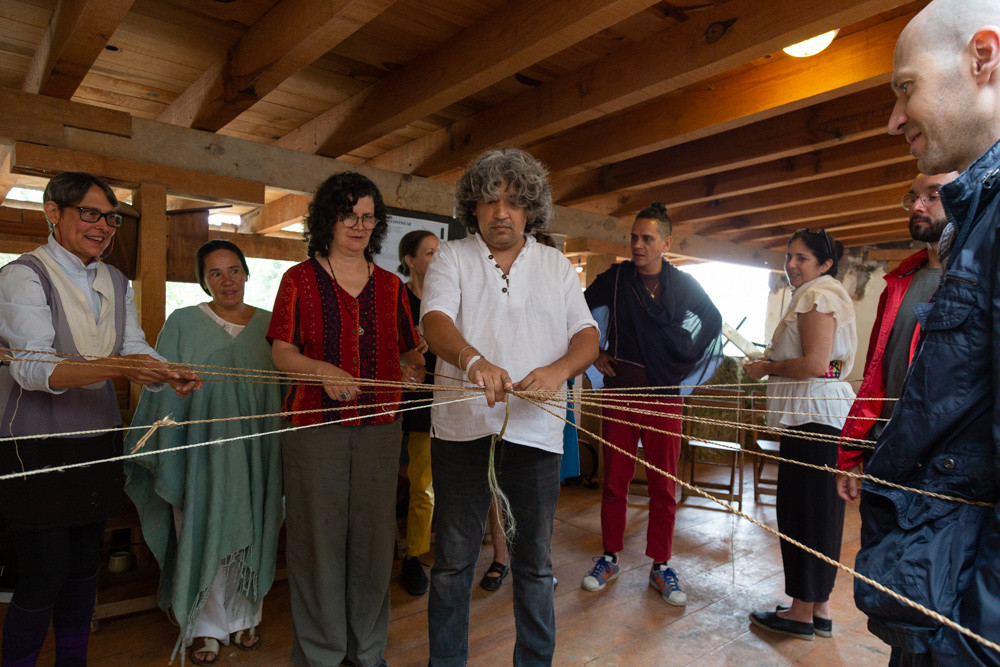
Part of our study of art from Latin America that addresses the environmental movement of the last decades, El canto de la Yerba Bruja was a closed-door research workshop held in Mexico City and Valle de Bravo this past June.
Through case studies of four key Latin American artists who engage in what we defined, collectively, as “longing practices,” the workshop explored how traditional Indigenous knowledge influences contemporary healing and ritualistic practices, as well as craft-making and sound works. The encuentro, or gathering, revived and expanded these cultural expressions with our critical ecological present in mind.
Taking place in the semi-rural setting of Valle de Bravo, west of Mexico City, the workshop featured the discursive and embodied practices of artists Jorge González (Puerto Rico), Bernardo Zabalaga (Bolivia/Argentina), Alia Farid (Puerto Rico/Kuwait), and Ariel Guzik (Mexico).
Organized with curators Michy Marchuax and Mauricio Marcín, El canto de la Yerba Bruja proposed collective, experimental research to find better lifestyles that revisit devalued cultural heritages. We aimed to take these as a springboard to create new ways of being together.
Read a conversation between Ariel Guzik, Catalina Júarez and Julián Sánchez González.
Artists
Jorge González and Alejandra Domínguez (Puerto Rico)
Bernardo Zabalaga (Bolivia-Argentina)
Alia Farid (Puerto Rico-Kuwait)
Ariel Guzik and Catalina Juárez (Mexico)
With the participation of
Colectivo Prácticas Narrativas (Mexico)
David Gutiérrez Castañeda (Colombia-Mexico)
Guest Curators
Michy Marchuax (Puerto Rico)
Mauricio Marcín (Mexico)
Songs and Encounterisms by Michy Marxuach and Mauricio Marcín
Today, it’s our turn to speak. Today, what we can say and tell is that a few weeks ago, the chickens, horses, magueys, and goats received us in silence. Calmly, Silvia approached and said: Welcome to Flor y Canto (Flower and Song). Flor y Canto means the art of living, and it requires continuous experimentation through creativity and self-directed apprenticeship. It is an ancestral philosophy wherein the beautiful and the true are manifested through the song that comes from our hearts.
And in this way, perhaps, El canto de la Yerba Bruja began, although we could say that it comes from afar, from before, and that like every seed it has taken its time to flower, that it has been shaping itself like a clay jar through the slow cooking of time.
Before now, we began collectively to learn healing processes while embarking on a planetary solidarity. Together with projects that continue to be born every day, and looking at the sun, we attempted to practice a world in resonance with beings from whom the modern system and the structures of capital have separated us.
We have identified common commitments while continuing to write as an ensemble. We share here a series of notes and intuitions we are confident about, born out of these collaborative episodes.
El canto de la Yerba Bruja was/is quietude under the shadow of a tree, a listening space, a path which has been walked and continues, resistance and longing. It is/was an interchange of feelings and experiences, of investigations that offer us knowledge rooted in the earth and in respect. The song of the Yerba Bruja (Witchgrass) is a constant encounterism between existences.
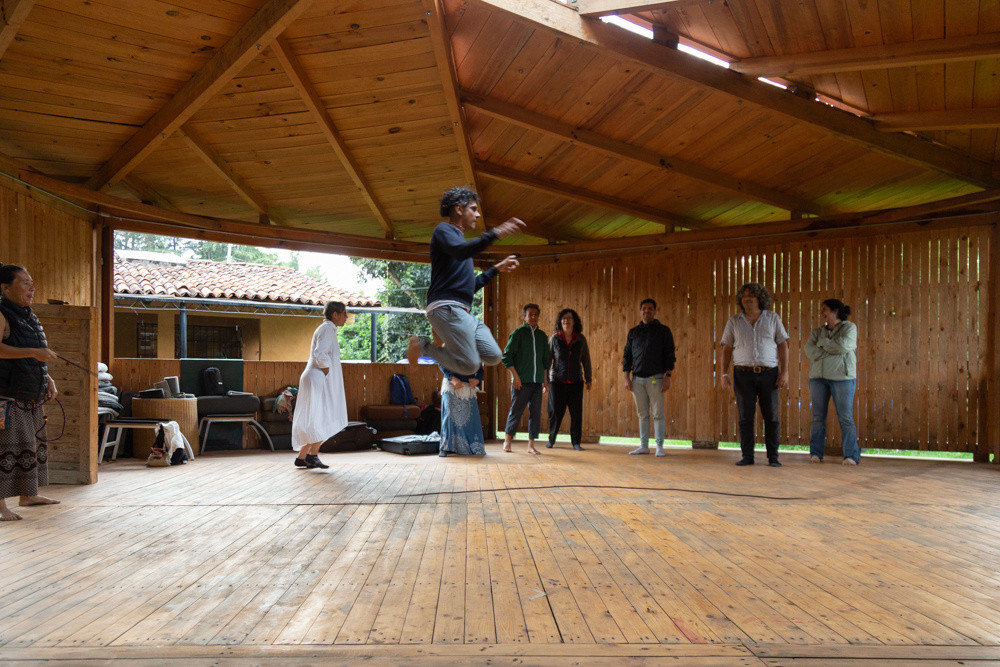
Among those invited were Alia Farid, Jorge González, Ariel Guzik, and Bernardo Zabalaga.
Alia conveys stories unanchored in the domain of Western languages and that navigate outside commercial routes. Transposing symbols generated in colonized territorial spaces shares and brings to light rarely told stories and establishes reconstructive interchanges of the processes of erasures that do violence to beings, zeroing in on untold stories.
Not only symbolically but literally, Alia weaves images and sounds for new solidarities. Through observation and listening, she aims to constellate a dialogue and highlights the interpretation of various forms of strategies of communication and cultural contagion produced by reuniting and transposing knowledges between territories where beings have been displaced. Communication between a buffalo and a community, or between a weaver and an image chosen from diaspora, shatters narratives of occupied history.
Jorge González nourishes himself on oral histories and ancestral techniques, by way of shared collective practices. La Escuela de Oficios (The School of Trades), which he created in Puerto Rico, connects and practices models of self-directed education and explores convivial and communitarian forms of production. He emphasizes relationships with materials and territory, focusing especially on relearning forms that have been deliberately erased or forgotten. With this, he embarks on a continuous process in order to reconnect, recognize, and repair relationships with the cycles of life among beings.
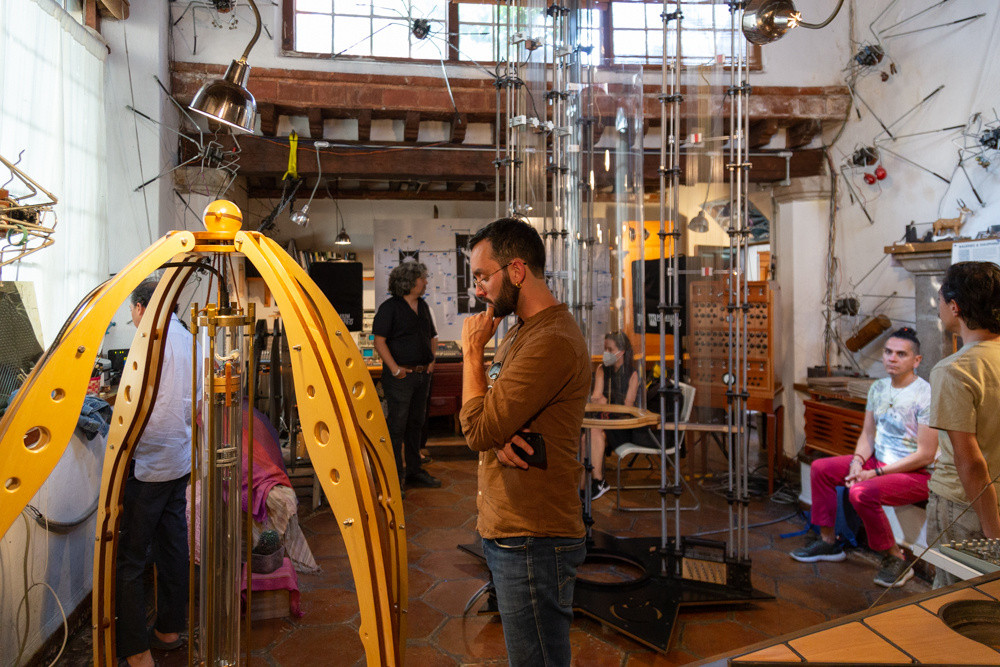
Ariel Guzik is the founder of the Laboratorio de Investigación en Resonancia y Expresión de la Naturaleza (Laboratory of Research into Resonance and Expression of Nature) in Mexico City, through which he has created different machines and instruments enabling communication between humans and other life forms: from cetaceans such as whales and dolphins to various plant species, and other natural phenomena like the wind and magnetic fields.
By means of these machines, the Laboratory carries out investigations and artistic expeditions in which the apparatuses are activated with the intention of giving voice to nature through sound and music. His works propose a radically different position from anthropocentrism, because rather than locate the human being at the center of existence, he postulates a way of living together in which all beings on this planet contribute equally to its equilibrium and form part of the infinite web of relationships that shape life.
Bernardo Zabalaga practices a constant tuning of life processes, assembling the most luminous energies. His project shows us worlds buried by colonial logic and investigates various forms of calling upon magic and actions of power in daily life in order to rethink forms of being that connect us to the energy that makes it possible to unite fissures and cracks between dimensions that have been separated by our modern reading of the world. Bernardo is a new/old spirit who disinters wisdom, asking the mountains for permission, who brings songs of other dimensions in order to bestow harmony.
Together with these four, we harmonize into a group of heterogeneous encounterists in order to say:
We think that the breath animating and uniting us is a way of understanding the world. Through encounterism, we can verbalize the desire for re-enchantment, even when today it seems illusory to do so after so much forgetting: How many rituals have we stopped practicing? How many dreams have we stopped having and remembering? How many technologies and ways of knowledge have we forgotten and how much incomprehension of “resources” have we assimilated? Meanwhile, the world of linear time marches on, wagering on meaningless, abysmal accumulation, and the strata continue to cement colonial memory.
What would happen if we allowed ourselves to be impregnated by other visions, aromas, clouds of smoke, textures, and modes of hearing? Isn’t there, in this, a possibility of inhabiting spaces and faculties we have ignored? We are intuiting a form that will detach us from the dominant structures’ way of understanding.
We believe in the possibility of generating co-conspirators and bringing about worlds and reorganizing us into new routines and relationships in order to work towards other ways of life and other narratives, other possibilities for invention. The beings and collectives brought together in the Canto de la Yerba Bruja have taught us, through their practice that spills over into daily life, that it is possible to challenge technologies, harmonize our existence with natural systems and their rhythms, and recall other ways of relating to life that we can work towards and practice.
Today we believe that a planetary understanding is born from a territorial consciousness. Our territorial consciousness is not that of the hegemonic geopolitics that designates borderlines and domains, but a collective intention that implicates us in the understanding of heterogeneous worlds that live together. Ours is a consciousness of life and death in being, of existence in relation and of vigilance over the displacements that separate, conceal, and occupy by violating lands, bodies, beings.
We are venturing a way of embodying ourselves in time while disdaining others. We see ourselves obligated to take a position, and we do so with humility and imagination. We want to live outside linear time, because development and progress do not nourish us. We do not want to cling to the Aristotelian structure that narrates the world as a conflict or a curve in which a problem appears, develops itself, and concludes. If we had to translate our desire into a representation, we would say that we are walking like this:

Or better:
A circle that deviates shortly before its closure.
This iterated image suggests a rope fastened at its two extremes and waved in such a way as to create a spiral. If we eliminate from our minds the idea of the two extremes of the rope, the spiral predictably becomes infinite.
We desire to be more of what has been disdained: the electromagnetic signal that brings a voice to the other side of the planet, a tender herb opening a path towards the sky and the center of the earth; we are that inverted mirror, we are practitioners of longing, we are the dream of whales, we are their sonar irradiations, we are rite and ceremony, the beat of a drum, the accelerated heartbeat of a hummingbird or a feverish child, we are the moist virtue of weeping. We are flower and so many songs of such joy as not to fit into classifications, categories, or definitions. We are everything old that engenders and renews itself. We are also contradiction and fear amidst the ruins. We have no answers and we offer these words with humility, and we also offer an attentive ear.
Our practices embody hyper-complex and essential interactions (opposites are possible in our worlds) with the ecologies in which we are embedded like seeds in a fabric. We remember. We conspire. We breathe consciously with all our strengths. We open ourselves to the flux and insistence of life, and this certainty enlivens us as we disappear into solidarity and calmly reappear.
The song of the Witchgrass was/is a permeable mode that for now implicates: Alia Farid, Bernardo Zabalaga, Escuela de Oficios (Jorge González & Alejandra Domínguez), Laboratorio de Investigación en Resonancia y Expresión de la Naturaleza (Ariel Guzik, Katalina Juarez Oechler & Luz Ma Sandoval), Panósmico (Mariana Mañón & Manolo Larrosa), Alfonso Díaz, Andrés Solís, David Gutiérrez Castañeda, Dominique Ratton Pérez, El Humedal, El Semillero, Inés Katzenstein, Julián Sánchez González, María del Carmen Carrión, Maru Calva, Mauricio Marcin, Michy Marxuach, Nattan Guzmán, Santi Carsolio, Silvia García Martin, and Val Montenegro.
November−December 2020
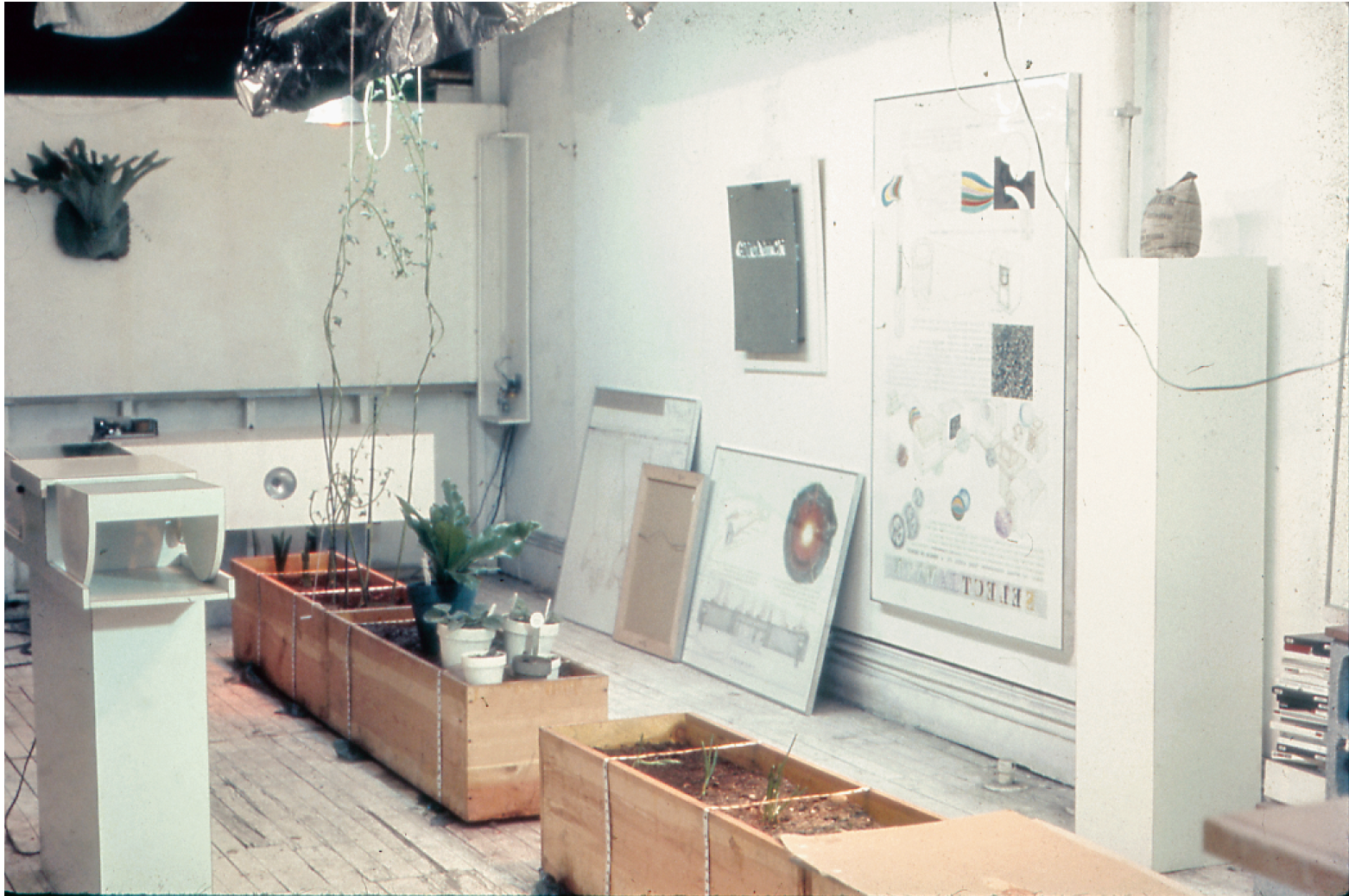
Reweaving Ourselves: Contemporary Ecology through the Ideas of Juan Downey is the second online conference organized by the Cisneros Institute at MoMA and conceived by guest curator Julieta González as part of a three-year research initiative on the relationships between art and the environment in Latin America.
The conference takes as a point of departure a series of technological, anthropological, and political issues raised by work and writings created between the mid-1960s and the early ’80s by the late Chilean artist Juan Downey, in order to generate a discussion on the way artists, theoreticians, feminist thinkers, ecologists, and climate change activists, among many others, are rethinking Latin America today.
Looking back at Downey’s conception of ecology from the perspectives of cybernetics, anthropology, and the ways in which his work and thought posed challenges to the onto-epistemic formations of capitalist modernity, the conference aims to assess the shifts that have taken place and are currently shaping the relations between technology and ecology, the political space constituted by the natural environment of indigenous communities, and the epistemologies of the South as alternatives to development and modernity.
Starting with an introductory session on the work and thought of Juan Downey, with the participation of guest curator Julieta González and scholar Javier Rivero Ramos, the conference will gather an interdisciplinary group of practitioners: architectural historian Felicity Scott, artists Eduardo Kac, Minerva Cuevas, and Beatriz Santiago Muñoz, architect Paulo Tavares, Sarayaku activist Franco Viteri Gualinga, curator María Belén Sáez de Ibarra, and anthropologist Arturo Escobar.
Through the dialogue between the participants, the conference aims to give continuity to the avenues of thought and inquiry opened up by Juan Downey decades ago, untapping the cultural and social resources and forms of knowledge and relationality that have been historically suppressed in Western thought in order to reweave ourselves in a more integrated way with our environment.
The participants will engage in a series of three online conversations: “Technology for a Disoriented Humanity,” “The Cosmopolitics of the Forest,” and “Beyond Technology and Development: How Can We Envision Solutions for the ‘Latin American Problem’ Today?”
The legacies of Juan Downey
Juan Downey’s pioneering work and writings are acutely prescient of the discussions taking place today on ecology, post-development, and anthropology, especially in the Global South. Initially trained as an architect, Downey worked at the intersection of architecture, technology, anthropology, culture, and the environment, to name just a few fields engaged by his heterogenous practice, which spanned different mediums (painting, printmaking, drawing, sculpture, video), writing, and teaching architecture at the Pratt Institute for over two decades. It is possible to identify in cybernetics, as the epistemology of a then-nascent information society, the discursive connecting thread throughout Downey’s multiple bodies of work. His cybernetic utopia proposed a radical reformulation of the relations between man, environment, and technology.
Downey grasped the essence of cybernetics, in its systems-based view and dissolution of subject and object positions, as an ontology of becoming. It is perhaps this aspect of his work and thought that connects the three axes of this discussion around the environment and ecological thinking in Latin America today.
On the one hand, an ontology of becoming allowed him to think of interspecies communication and posthuman alliances between the human and the machine, of being able to reweave the chasm between nature and culture through technology. On the other, in the Yanomami people’s expanded view of the self he identified an ontology of becoming that transcended the self/other duality, and included animals and the forest as beings endowed with human attributes. His experience traveling and living among the indigenous cultures in the Americas confirmed his deep-seated conviction that other ways of being and knowing, which superseded the Western notions of state and capital, were possible. He came to the realization that, beyond technology, what would enable a disoriented humanity to close this “man/nature” chasm resided in the relational, communal and ecological forms of organization of the indigenous peoples, silenced and obliterated not only by centuries of colonial rule but, in modern times, by the rhetoric of development and progress.
In the past decade or so, the intersecting concerns that guided Downey’s work in the 1970s have gained renewed currency among Latin American artists and thinkers, many of whom have sought to form alliances with and give visibility to indigenous communities and activist groups working in this direction. The impending global ecological crisis that Downey and his contemporaries foresaw in the 1960s and ’70s has significantly worsened. The neural network of communications he imagined is a reality today and shapes our world in myriad ways, but it has not been instrumental in the struggle against ecological disaster. In the field of anthropology, Downey’s dismantling of the ethnographic gaze and his identification of an ontology of becoming as characteristic of indigenous peoples prefigured the concept of Amerindian Perspectivism and the contemporary revisions of the notion of animism in anthropology, which have in fact had significant bearing on the ecological front. One important example of this is the 2013 lawsuit on behalf of the rights of nature filed by indigenous and environmental activist groups against the Ecuadorian state for allowing mining and oil extraction in the Cordillera and Amazonian regions of the country. Today, Latin America is witness to the failed promises of development and the shortcomings of an imposed modernity, which have led to a vicious cycle of dependency, corruption, and foreign debt, which corrupt governments are paying with concessions to Western countries but also Russia and China, giving them free rein to exploit natural resources in forest and mountain regions, and gravely damaging ecosystems and the peoples who inhabit them, further intensifying the cycle of dependency, structural poverty, and exploitation.
Such is the context in which the participants in this conference are working today, and each of them, through their respective practice, is addressing one or several of these challenges.
Guest curator, Julieta González
Session One
Juan Downey: Cybernetics, Ecology, and an Ontology of Becoming
A conversation between curator Julieta González and scholar Javier Rivero Ramos
November 10, 2020.
Juan Downey: Cybernetics, Ecology, and an Ontology of Becoming will present key aspects of Juan Downey’s work, focusing on the cybernetic inflection that runs throughout. Curator Julieta González and scholar Javier Rivero Ramos, co-editors of the recent monograph Juan Downey, 1940–1993 (Ediciones MP, Mexico, 2019), will discuss his specific approaches to ecology, interspecies communication, and sustainable architecture, and the self/other duality that permeates key works in Downey’s production, through a discussion of some of his most important projects.
Session Two
Technology for a Disoriented Humanity
A conversation between Eduardo Kac and Felicity Scott, moderated by Julieta González
November 18, 5-6 p.m.
In a 1973 essay published in Radical Software magazine, titled “Technology and Beyond,” Juan Downey stated that “cybernetic technology operating in synchrony with our nervous systems is the alternative life for a disoriented humanity.” Furthermore, Downey’s early drawings explored the possibilities of human-machine ensembles, an interest that led to experiments in interspecies communication, and the creation of self-organizing ecological systems in his home and gallery spaces, among many other projects.
In this session, artist Eduardo Kac will present his explorations of bio-art and his work in the context of an expanded conception of ecology. Architectural historian Felicity Scott will speak about the impact of cybernetics on the artistic production of the 1960s and 1970s, and her particular research on the work of Juan Downey and Les Levine. They will engage in a conversation on the present-day relations between art, architecture, technology, and ecology.
Session Three
The Cosmopolitics of the Forest
Presentations by Paulo Tavares, Franco Viteri Gualinga, and María Belén Sáez de Ibarra, followed by a conversation moderated by Julieta González
November 24, 2020.
Following the coup d’état against Chilean president Salvador Allende in 1973, artist Juan Downey intensified his critique of US intervention in foreign politics and turned his focus to the South, embarking on a video expedition throughout the American continent in which he sought to connect the indigenous cultures of the Americas through video feedback. Later, Downey and his family resided for a year among the Yanomami tribe in the Venezuelan Amazon. These experiences—central to his works Video Trans Americas (1973–76) and The Laughing Alligator 1979, both in MoMA’s collection—attuned Downey to other ways of relating to the environment and to indigenous forms of social and economic organization, which he saw as alternatives to Western notions of state and capital.
Today many indigenous groups, working in interdisciplinary alliances with artists, scholars, and activists, are working on that front, rehabilitating indigenous forms of knowledge that imply alternative conceptions of nature, and enabling a shift toward changing the legal status of the forest.
This session is organized around the events documented in the film Forest Law, made in 2014 by architect Paulo Tavares and filmmaker Ursula Biemann in collaboration with members of the Runa people of the Sarayaku in Ecuador. It will include a presentation by Franco Viteri Gualinga, a member of the Sarayaku community, and a conversation between Tavares, Viteri Gualinga, and curator María Belén Sáez de Ibarra, who was responsible for organizing a series of exhibitions on the “Cosmopolitical forest” at Museo de Arte de la Universidad Nacional de Colombia. Sáez is also currently collaborating with Ursula Biemann on the “Universidad Devenir” a project for an indigenous university with the Inga people of Colombia, which will also be discussed in this session.
Session Four
Beyond Technology and Development: How Can We Envision Solutions for the “Latin American Problem” Today?
Presentations by Arturo Escobar, Minerva Cuevas, and Beatriz Santiago Muñoz, followed by a conversation moderated by Julieta González
December 1, 2020.
Juan Downey’s production from the late 1960s onwards was guided by an agenda that sought to address what Argentine critic Jorge Glusberg described as “the Latin American problem”—the condition of dependency created by centuries of colonial occupation and maintained by the modern project of development. Downey’s works, such as Make Chile Rich (1970), The Imperialistic Octopus (1972), Anaconda Map of Chile (1973), and Chicago Boys (1983), are explicitly aimed in this direction.
In this session, anthropologist Arturo Escobar will speak about his influential research and writing on post-development, indigenous and grassroots epistemologies in Latin America, and relationality as an alternative to the “defuturing” modern/colonialist/capitalist world system. A conversation between Escobar and artists Minerva Cuevas and Beatriz Santiago Muñoz will revolve around a presentation of their respective practices as strategies of resistance to colonization and extractivism.
Speakers
Minerva Cuevas invites us to rethink the role corporations play in the management of natural resources. Her interdisciplinary projects combine aspects of anthropology and economics and discuss the condition of the individual under a capitalist regime: constant abuse, dispossession and estrangement from ancestral and cultural identity, but also the latent possibility of revolt implicit in the everyday.
Arturo Escobar is an activist-researcher and academic from Cali, Colombia, whose work focuses on territorial struggles against extractivism, postdevelopmentalist and post-capitalist transitions, and ontological design. His most well known book is Encountering Development: The Making and Unmaking of the Third World (1995). His most recent books are Designs for the Pluriverse: Radical Interdependence, Autonomy, and the Making of Worlds (2018) and Pluriversal Politics: The Real and the Possible (2020).
Javier Rivero Ramos is a PhD candidate at the Department of Art and Archeology of Princeton University. His research explores transnational networks of artistic exchange. He edited the first monograph devoted to Raphael Montañez Ortiz, published by El Museo del Barrio in 2020, and co-edited a monograph dedicated to Juan Downey in 2019.
Since 1980 artist Eduardo Kac has been making work that explores the poetic and philosophical connections between art, language, light, networking, biology, and communication. Heralded by many as the founder of the bio art movement, Kac recently created Inner Telescope, an artwork realized in outer space with the cooperation of an astronaut. Kac’s work is in the collections of such institutions as The Museum of Modern Art, New York, and Tate Modern, London.
Beatriz Santiago Muñoz is an artist based in San Juan, Puerto Rico. Her work combines aspects of ethnography and theater to create film and video projects that have touched on subjects including anarchist communities, the relationship between artwork and work, and post-military land.
María Belén Sáez de Ibarra is a lawyer and curator, and has been director of the Museo de Arte de la Universidad Nacional de Colombia (Bogotá) since 2010. Working across disciplines, she has commissioned and produced experimental projects—such as Cosmopolitics of the Forest—that challenge the roles within and borders between cultural/social practices and the arts.
Felicity Scott is professor of architecture, director of the PhD program in Architecture (History and Theory), and co-director of the program in Critical, Curatorial and Conceptual Practices in Architecture (CCCP) at the Graduate School of Architecture, Planning and Preservation, Columbia University. Her work as a historian and theorist focuses on articulating genealogies of political and theoretical engagement with questions of techno-scientific, environmental, and geopolitical transformation within modern and contemporary architecture, art, and media.
Paulo Tavares is an architect, researcher, and writer based in South America. His design and pedagogic practice spans different territories, social geographies, and media. He is the author of the books Forest Law (2014), Memória da terra (2018), and Des-Habitat (2019), and he co-curated the Chicago Architecture Biennial 2019.
Franco Tulio Viteri Gualinga is a Kichwa leader from Sarayaku, a community in the Ecuadorian Amazon most known for their ongoing struggle against oil extraction in their territory. He is an environmental and Indigenous rights activist and a member of the Confederación de Nacionalidades Indígenas de la Amazonía Ecuatoriana.
Guest curator
Julieta González is an independent curator and researcher who works at the intersection of anthropology, cybernetics, architecture, design, and the visual arts. She has written several essays, organized two exhibitions, and co-edited a monograph on the work of Juan Downey. More recently she has developed research and exhibitions addressing underdevelopment and decolonial aesthetics in Latin America. She has worked as curator at Tate Modern, Museo Tamayo, Bronx Museum of the Arts, and Museu de Arte de Sao Paulo.
August—September, 2020
Convened by the Cisneros Research Institute for the Study of Latin American Art at MoMA and conceived by guest curator Camila Marambio, Cumbre Aconcagua (the Aconcagua summit) looks at the history of water management in the Americas through the interdisciplinary work of artists, theorists, historians, lawyers, ecofeminists, scientists, and local communities.
The Cumbre comprises a series of conversations, or confabulations, and an experimental tribunal titled The Water Is the Law. With the term confabulations, Marambio describes the three public dialogues that she will moderate on August 11, 25, and September 8 between Carolina Caycedo and Ignacio Valero, Maria Thereza Alves and Denise Ferreira da Silva, and Cecilia Vicuña and Marisol de la Cadena, respectively. The intent of these confabulaciones is to reflect on strategies for de-extinction, solidarity between North and South, and an overall reorientation toward societies of care that include the more than human.
Initially, Cumbre Aconcagua was meant to be a research retreat in Chile, from April 28 to May 2, 2020. The summit was to be set along the shores of the Laguna del Inca, a glacial lake that rises 2,680 meters above sea level and is situated halfway up the Aconcagua, the tallest peak of the Andean Mountain Range. The name Aconcagua stems from the Quechua terms kawa (to see, to look) and kon (mother of life, the sea, chaos, transformation), and acknowledges the cycle of water from ocean to glacier and back. The Aconcagua basin has been the subject of a lifelong body of work by artist Cecilia Vicuña and, in reverence, Marambio had chosen this site as the meeting place for the first Cisneros Institute conference dedicated to the study of the relationship between the arts and the environment in Latin America.
Chile is the only country in the world were water is privatized, and though the original Cumbre’s agenda was set by the invited artists’ and theorists’ work on water-related issues around the Americas, the summit was timed to coincide with the Chilean election—offering a window of opportunity to conceive the return of water rights to the commons—and hopefully to water itself. The unexpected COVID-19 crisis brought the Chilean election cycle and Cumbre Aconcagua to a halt. However, the connective tissue that had already grown between the participants proved to be strong. Stories had begun to flow and their shared concerns and practices of care for bodies of water lead to an improvised atonement ritual, or pagamento, that took place online on May 1.
In keeping with these commitments, and with Cumbre Aconcagua’s initial, situated goals, the summit will culminate on September 28 with the screening of the performative trial The Water Is the Law, modeled on the International Rights of Nature Tribunal, in which four Chilean scholars who were originally going to act as local advisers to the Cumbre—anthropologist Francisca Fernández, ecologist Bárbara Saavedra, art historian Catalina Valdés, and attorney Nancy Yañez—will each offer a short testimony disclosing the state of Chilean waters. This interdisciplinary hearing will be chaired by the Argentinian sociologist Maristella Svampa, who will address the Chilean case study by scaling outward and opening the discussion up to the environmental state of affairs of Latin America.
Confabulaciones
For millennia, all along the Andes mountain range, people have spoken to each other using a dialogic technique that in Chile is called bailes chinos, a ritual form of call and response through which news is shared, the quotidian is revered, and differences are sorted. Similarly, Confabulaciones will be a dance of call and response between the different participants. Marambio has theorized confabulation as a curatorial tactic that prioritizes oral conversation and invites ethical, more-than-human fabrications of felt experiences as compensation for the memory loss caused by colonial oppressions.
Session One
Digna Rabia and Moral Hazard
A conversation between scholar Ignacio Valero and artist Carolina Caycedo, moderated by Camila Marambio
August 11, 2020
In a reexamination of the concept of EcoDomia—a combination of the aesthetic, the social, and the ecological that theorist Ignacio Valero has called “the aesthetic of the commons”—this intergenerational dialogue between Valero and Colombian artist Carolina Caycedo aims to help construct a common oral architecture that envisions what awaits future generations. The conversation will revolve around making art and meaning on the basis of the complex cluster that is feeling-being-body today. It will be grounded in a carnal history tied to Caycedo’s current research on the aesthetic of the first debt titles issued in the Americas, documents that attest to the subjugation of the Black body. The participants in the conversation will reflect on how to halt the splitting of the body understood as territory, as water, as sensuality, as (labor) force, and as monument to enslavement. The exchange will further explore the experiences Caycedo has conceived to entwine human bodies and geographies.
Session Two
El robo (Theft)
A conversation between artist Maria Thereza Alves and scholar Denise Ferreira da Silva, moderated by Camila Marabio
August 25, 2020
Extractivism is one the main causes of dispossession, exploitation, and even genocide and ecocide of the First Nations of colonized countries. El robo (theft) addresses this issue as seen through the lens of the Brazilian artist Maria Thereza Alves and scholar Denise Ferreira da Silva. Alves, who has devised an aesthetic research practice that “attempts to document as active agents those who are critically engaged with history,” has a longstanding commitment to the community of Mexico’s Xico Valley. Prevented from ecologically sustaining themselves, the Xico community’s struggle was first staged by Alves in a multimedia installation titled The Return of the Lake (2012), in which the artist elaborated upon a critique of the notion of “post-colonization” by investigating how colonial practices are still very much in place. Ferreira da Silva has written extensively on the ethical questions of the global present, and most recently she has begun experimenting with how to release the world from “the procedures and tools that presume that everything that exists or happens is an expression of the human.” Her poethical experiments with the elemental expose how colonial and racial violence is “vital to the accumulation of capital in its various (merchant, industrial and financial) moments.” By pointing to the objectification of personhood that leads to ecocrimes, Alves and Ferreira da Silva share a theorizing of racial power and a politico extractivist model that oppresses the Indigenous, Black, and impoverished communities of the Americas.
Session Three
La memoria del agua (The Memory of Water)
A conversation between anthropologist Marisol de la Cadena and artist and poet Cecilia Vicuña, moderated by Camila Marambio
September 9, 2020
The final confabulation of this dialogic series, titled La memoria del agua, will consist of an exchange between anthropologist Marisol de la Cadena and artist and poet Cecilia Vicuña. Vicuña’s concept of veroir and de la Cadena’s conceptualization of antropociego (the anthropo-not-seen) undermine the cultural beliefs that only humans speak. Both participants have specialized in similar forms—what de la Cadena terms “disobedient grammar” and what Vicuña calls palabrarmas—that perform the intra-relations between humans, land, language, and water. These oral technologies allow the formation of alliances between environmentalists, Indigenous peoples, and artists questioning modernity’s insistence on the divide between nature and culture.
The Water Is the Law is the title of the coda to the Cumbre Aconcagua. For this epilogue four Chileans—ecologist Bárbara Saavedra, anthropologist Francisca Fernandez, art historian Catalina Valdés, and attorney Nancy Yañez were invited to present an argument, as if to an oral tribunal, which would uncover the turbulent history of water management in Chile. Their arguments prompted a response by the Argentinian sociologist Maristella Svampa, who was invited to elaborate on the extremity of this case study, which gave rise to Cumbre. Her closing remarks offer a lucid summary of the environmental politics of Latin America and give a glimpse into the new Pacto Ecosocial del Sur (Ecosocial Pact of the South), with a special emphasis on the role of aesthetics and eco-activist art practices.
The arguments have been compiled into a libretto which can be read and download. We invite you to gather virtually amongst friends or adversaries and read this coda out loud.
Artists
Cecilia Vicuña is an artist-poet who creates songs, performances, installations, paintings, films, books, lectures, and sculptures. She lives and works in New York and Santiago, Chile.
Maria Thereza Alves is a Brazil-born artist, a cofounder of the Green Party of São Paulo, and a former member of the International Indian Treaty Council.
Carolina Caycedo is a multidisciplinary artist. Her performances, videos, artist’s books, sculptures, and installations examine environmental and social issues. She is a member of the Los Angeles Tenants Union and the Ríos Vivos Colombia Social Movement.
Participants
Marisol de la Cadena has worked as an anthropologist in Peru, England, France, and the US. Her most recent is book Earth Beings: Ecologies of Practice Across Andean Worlds (2015), for which she worked with Mariano and Nazario Turpo, Andean runakuna from Cuzco, Peru. With Mario Blaser she co-edited A World of Many Worlds (2018). She currently works on what she calls “cow-forming landscapes and labscapes” in Colombia.
Denise Ferreira da Silva is a Brazilian professor and director of the Social Justice Institute-GRSJ at the University of British Columbia, Canada.
Francisca Fernández Droguett is an anthropologist with an MA in social psychology and a PhD in American studies from the Institute of Advance Studies from Universidad de Santiago de Chile. She is an Andean dancer, a participant in the Movement for Water and Territories, and a member of the Socio-Ambiental Committee Coordinadora Feminista 8 de marzo.
Bárbara Saavedra is an ecologist working in the field of biodiversity conservation. She is project leader of the science-based conservation model Karukinka – Tierra del Fuego and other conservation initiatives in Chile.
Maristella Svampa is an Argentine sociologist, writer, and researcher. She holds a PhD in sociology from École des Hautes Etudes en Sciences Sociales, Paris. She is a senior researcher at CONICET and a titular professor at Universidad Nacional de La Plata, Argentina.
Catalina Valdés holds a PhD in art history from Ecole des Hautes Etudes en Sciences Sociales, Paris, and Universidad Nacional de San Martín, Buenos Aires. She is currently conducting independent research in projects about art and nature.
Ignacio Valero is an associate professor of humanities and sciences at California College of the Arts. He has taught and lectured at TU Wien, Goldsmiths, University of London, University of Madrid Carlos III, University of Lisbon, University of the Andes, and Xavier University, Colombia. He holds a PhD from the University of California, Berkeley.
Nancy Yañez holds a BA in judicial and social science from Universidad de Chile, an MA in international law with a mention on indigenous peoples’ rights from Notre Dame University, and a doctorate in law from Universidad de Chile.
Guest curator Camila Marambio is the founder and artistic director of the collective research practice Ensayos. She has a PhD in curatorial practice from Monash University, Australia, an MA in modern art from Columbia University, and a Master of Experiments in Arts and Politics from Sciences Po, Paris.
The Cisneros Institute’s programs are conducted in conjunction with Contemporary and Modern Art Perspectives (C-MAP), MoMA’s global research initiative, which is supported by The International Council of The Museum of Modern Art.
The Cisneros Institute’s programs are conducted in conjunction with Contemporary and Modern Art Perspectives (C-MAP), MoMA’s global research initiative, which is supported by The International Council of The Museum of Modern Art.