Medium-density fiberboard (MDF) and Plexiglas
Not on view
Eisenman conceived this project shortly after the fall of the Berlin Wall in 1991. Its site—just north of the intersection of two of Berlin's most prominent and historically rich thoroughfares, the Unter den Linden and the Friedrichstrasse—had been previously occupied by the fantastic Expressionist playhouse of Max Reinhardt, a prominent theater producer in Germany in the early decades of the twentieth century.
In order to capture Reinhardt's legendary energy and vision, Eisenman devised a prismatic form that is a world unto itself but also reflects the constantly changing and multifaceted character of the city. In Eisenman's design (which was never built), the thirty-four-story building vertically folds on its core to create a structure that separates, transforms, and rejoins itself horizontally at the roof level.
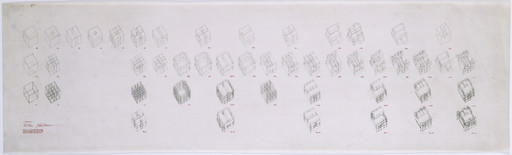
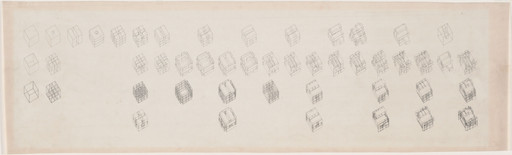
The form was generated by three operations performed on a Möbius strip, a three-dimensional geometric form with a single continuous surface. In the first operation, planes were generated from the triangulation of surfaces, which permitted the development of a surface order for exterior cladding and a trussed structure for vertical and lateral support. The second operation inverted the strip, triangulated the surfaces again, and imprinted the outlines of these surfaces on the initial form. The third step folded large public spaces between the grid and floor plates of an already folded structure. The building, whose height and creased form create an imposing presence, reflects a continually shifting urban paradigm.
The Museum of Modern Art, MoMA Highlights since 1980, New York: The Museum of Modern Art, 2007, p. 134.
Explore more

From MoMA Design Store


Installation views
We have identified this work in the following photos from our exhibition history.
Licensing
Artwork or archival images
If you would like to reproduce an image of a work of art in MoMA's collection, or an image of a MoMA publication or archival material (including installation views, checklists, and press releases), please contact Art Resource (publication in North America) or Scala Archives (publication in all other geographic locations).
Audio and film clips
MoMA licenses archival audio and select out of copyright film clips from our film collection. At this time, MoMA produced video cannot be licensed by MoMA/Scala. All requests to license archival audio or out of copyright film clips should be addressed to Scala Archives at [email protected]. Motion picture film stills cannot be licensed by MoMA/Scala. For access to motion picture film stills for research purposes, please contact the Film Study Center at [email protected]. For more information about film loans and our Circulating Film and Video Library, please visit Circulating Film and Video Library.
Text from a publication or the archives
If you would like to reproduce text from a MoMA publication, please email [email protected]. If you would like to publish text from MoMA's archival materials, please fill out this permission form and send to [email protected].
Feedback
This record is a work in progress. If you have additional information or spotted an error, please fill out this feedback form.