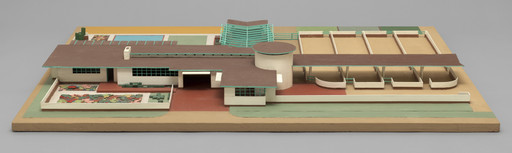
In the early 1930s, Wright began working on a suburban development of family-run farms organized around a central market. His collaborator Walter V. Davidson was a retail and warehouse management consultant with expertise in conducting “motion studies.” These studies analyzed the repetitive movements of industrial workers in order to identify ways to increase their efficiency. Here, Wright applied this methodology to optimize the layout of a farm’s livestock pens, greenhouses, silos, and packing areas. Although none were ever built, Wright later incorporated these streamlined farm units and markets into his model for Broadacre City.
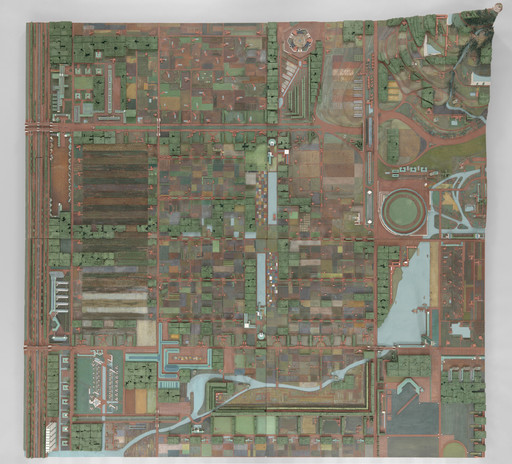
The Broadacre City model was first exhibited during the Great Depression, and its aim of revitalizing nonurban areas was shared by New Deal agencies like the Resettlement Administration (RA), which sponsored the housing and livelihoods of semirural residents. In fact, while the model was touring Washington, DC, Wright sought an audience with Eleanor and Franklin D. Roosevelt, hoping to secure a commission to design a suburban development as part of the Greenbelt Towns program. Funded by the RA, the venture was intended to build ground-up communities on the outskirts of major cities. In recent years, however, historians have highlighted the program’s exclusion of African Americans. Wright’s attempt to enact Broadacre through such a project prompts the question of what he imagined the racial makeup of his dream city to be.
2024
Explore more
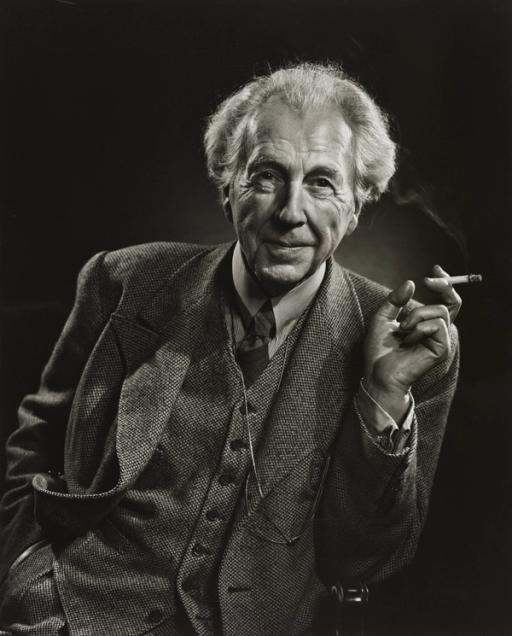
Frank Lloyd Wright
American, 1867–1959 124 works onlineA pragmatist, technical innovator, and independent thinker, Frank Lloyd Wright designed cities and buildings and their interior furnishings across a prolific 72-year career, reflecting his vision of an ideal American society.
Learn more →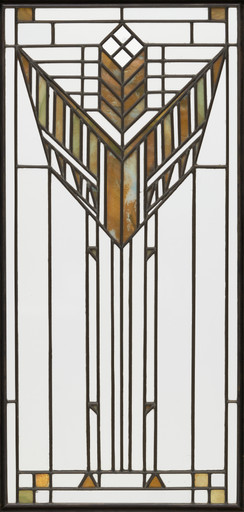

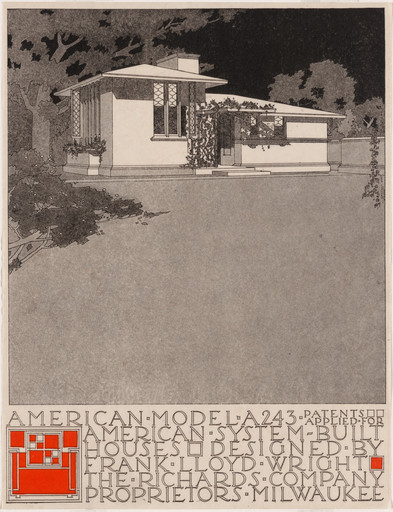
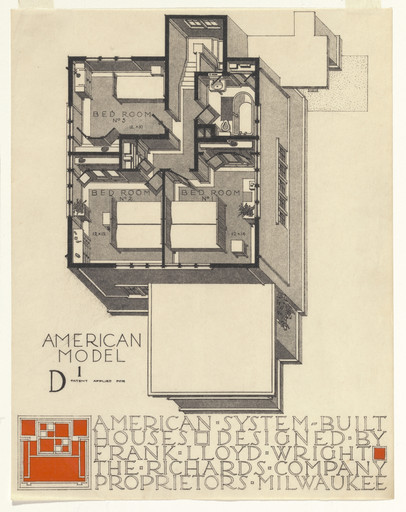
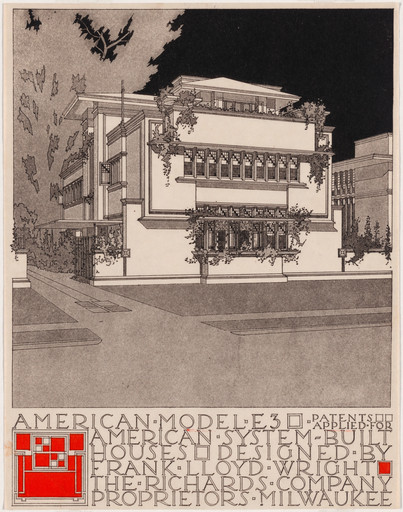
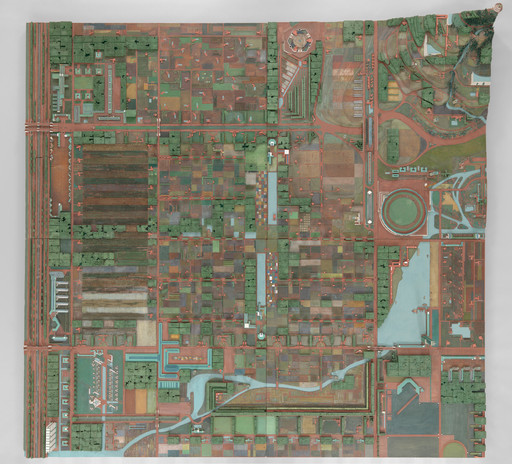
The City May Now Scatter
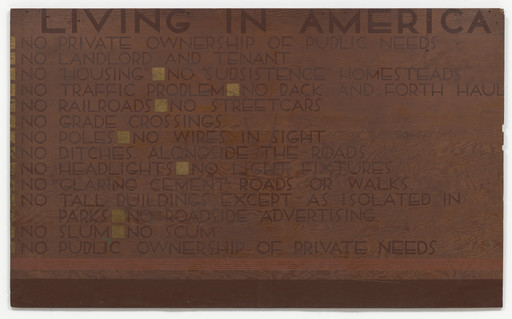
Gallery 519Frank Lloyd Wright’s Broadacre City, proposed in the 1930s, was both technologically forward-looking and socially nostalgic. The development concept revived an 18th-century political project that seemingly advanced widespread landownership, but was exclusionary in practice.
Learn more →
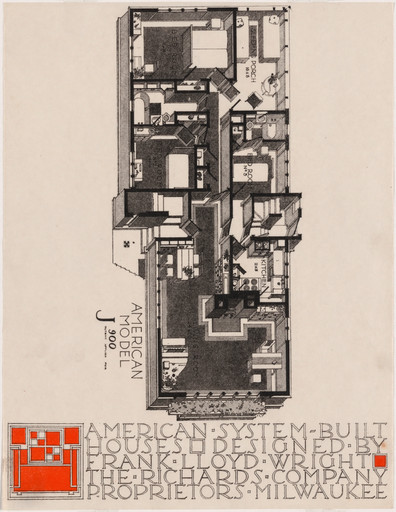
From MoMA Design Store


Licensing
Artwork or archival images
If you would like to reproduce an image of a work of art in MoMA's collection, or an image of a MoMA publication or archival material (including installation views, checklists, and press releases), please contact Art Resource (publication in North America) or Scala Archives (publication in all other geographic locations).
Audio and film clips
MoMA licenses archival audio and select out of copyright film clips from our film collection. At this time, MoMA produced video cannot be licensed by MoMA/Scala. All requests to license archival audio or out of copyright film clips should be addressed to Scala Archives at [email protected]. Motion picture film stills cannot be licensed by MoMA/Scala. For access to motion picture film stills for research purposes, please contact the Film Study Center at [email protected]. For more information about film loans and our Circulating Film and Video Library, please visit Circulating Film and Video Library.
Text from a publication or the archives
If you would like to reproduce text from a MoMA publication, please email [email protected]. If you would like to publish text from MoMA's archival materials, please fill out this permission form and send to [email protected].
Feedback
This record is a work in progress. If you have additional information or spotted an error, please fill out this feedback form.