One from a portfolio of eight lithographs
Not on view
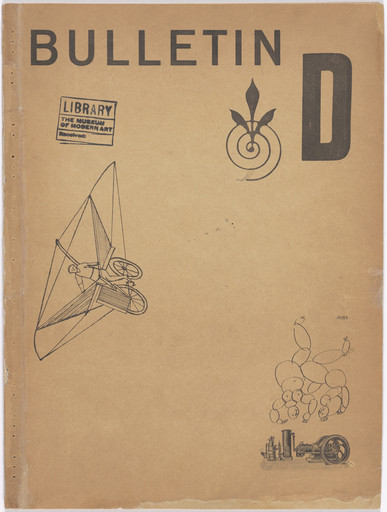
Let There Be Fashion, Down with Art ironically inverts the Latin saying “Let there be art, down with fashion,” thus announcing the end of traditional art. Here the rational world of science and industry have gone awry: the prints display diagrammatic, nonsensical equations, ineffectual measuring instruments, and a dysfunctional system of plumbs and weights. The portfolio also marks the first appearance of the artist’s assumed Dada identity, “Dadamax ERNST,” which supplants his signature on the second sheet.
Max Ernst: Beyond Painting, September 23, 2017-January 1, 2018.
Publication excerpt from an essay by Harper Montgomery, in Deborah Wye, Artists & Prints: Masterworks from The Museum of Modern Art , New York: The Museum of Modern Art, 2004, p. 96.
A major figure in both the German Dada and French Surrealist movements, Max Ernst was a prolific and experimental printmaker who used printing as a means of going beyond painting. Between 1912 and 1974, he made more than five hundred lithographs, etchings, and linoleum cuts, many of which appeared as book illustrations.
In Let There Be Fashion, Down with Art, Ernst's first major print project, he mapped out many of the motifs of his later work and also paid homage to the imaginary tableaux of Giorgio de Chirico. In a revolt against Expressionist printmaking, Ernst drew elements culled from commonplace printed advertisements onto a lithographic stone using a gestureless mechanical line. The anti-art sentiment reflected in this style, and the phrase "Down with Art," express the spirit of both nihilism and nonsense that was a pervasive aspect of Dada activities in Cologne at the time. Encouraged by Surrealist poet Paul Éluard, Ernst moved from Cologne to Paris in 1922. Exploring the practice of many painters and poets who wished to plumb the unconscious as a source for their art, Ernst experimented with the semiautomatic process of frottage—rubbings made from textured objects or surfaces. The patterns and textures generated by such rubbings were the starting point for his images, as seen in the portfolio Histoire Naturelle.
Ernst also collaborated with poets, including André Breton, Tristan Tzara, and others, by providing illustrations for their texts. In 1929 he made his first "collage novel," incorporating a technique central to his experiments with the effects of chance. He created a series of collages with imagery culled from nineteenth- and early-twentieth-century pulp novels, scientific journals, and natural-history magazines and arranged them in a sequence as pages. He then printed these collages by photomechanical means to transform them into the seamless images he desired. Like popular serial stories, Ernst released Une Semaine de bonté in the form of five consecutive volumes that evoke erotic violence and intrigue, as well as humor.
an essay by Harper Montgomery, in Deborah Wye, Artists & Prints: Masterworks from The Museum of Modern Art, New York: The Museum of Modern Art, 2004, p. 96.
Gallery label from Dada , June 18–September 11, 2006.
Let There Be Fashion, Down with Art ironically inverts the Latin saying: "Let there be art, down with fashion," thus announcing the end of traditional art. Here the rational world of science and industry have gone awry: the prints display a diagrammatic drawing technique, nonsensical equations, ineffectual measuring instruments, and a dysfunctional system of plumbs and weights. The portfolio also marks the first appearance of the artist’s assumed Dada identity, "Dadamax ERNST," which supplants the artist’s signature on the second sheet. The fourth image in the sequence is inscribed with the words "DaDa NoBis," and below, "PACIS" written backwards—a play on the Latin hymn Dona Nobis Pacem (Give us peace).
Dada, June 18–September 11, 2006.
Explore more
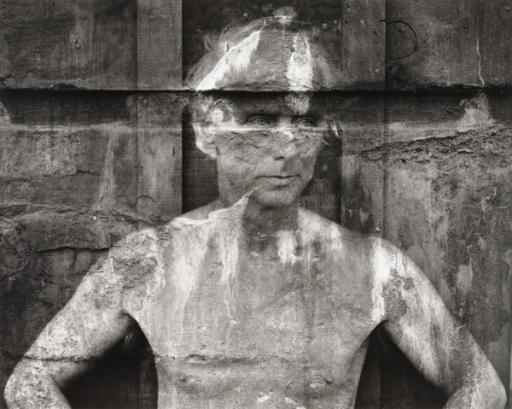
Max Ernst
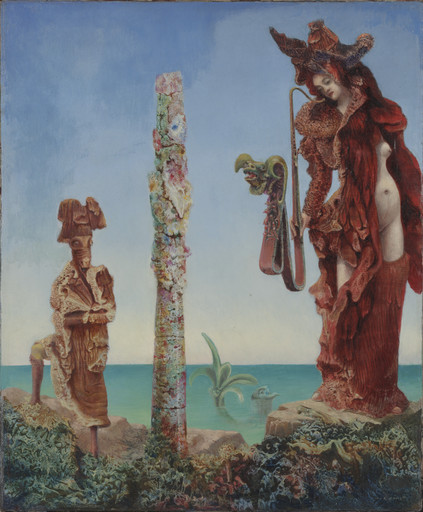
French and American, born Germany. 1891–1976 234 works onlineA key member of first Dada and then Surrealism in Europe in the 1910s and 1920s, Max Ernst used a variety of mediums—painting, collage, printmaking, sculpture, and various unconventional drawing methods—to give visual form to both personal memory and collective myth.
Learn more →

From MoMA Design Store


Installation views
We have identified this work in the following photos from our exhibition history.
Licensing
Artwork or archival images
If you would like to reproduce an image of a work of art in MoMA's collection, or an image of a MoMA publication or archival material (including installation views, checklists, and press releases), please contact Art Resource (publication in North America) or Scala Archives (publication in all other geographic locations).
Audio and film clips
MoMA licenses archival audio and select out of copyright film clips from our film collection. At this time, MoMA produced video cannot be licensed by MoMA/Scala. All requests to license archival audio or out of copyright film clips should be addressed to Scala Archives at [email protected]. Motion picture film stills cannot be licensed by MoMA/Scala. For access to motion picture film stills for research purposes, please contact the Film Study Center at [email protected]. For more information about film loans and our Circulating Film and Video Library, please visit Circulating Film and Video Library.
Text from a publication or the archives
If you would like to reproduce text from a MoMA publication, please email [email protected]. If you would like to publish text from MoMA's archival materials, please fill out this permission form and send to [email protected].
Feedback
This record is a work in progress. If you have additional information or spotted an error, please fill out this feedback form.