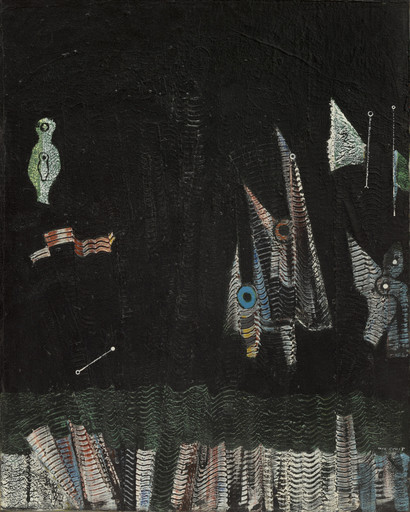
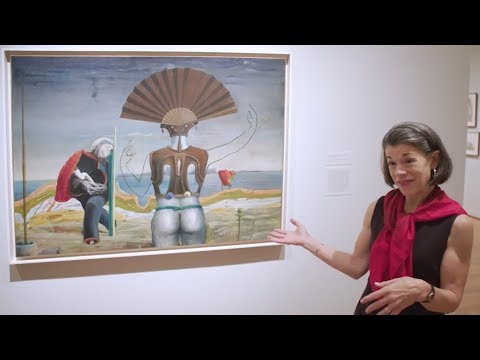
Ernst began this painting in France but completed it in Santa Monica, California, soon after escaping war-torn Europe. For the base layer he used decalcomania, a semi-automatic technique in which paint is applied with a sheet of glass or paper to create unexpected textures. He subsequently inverted the composition and used the same process to manipulate the landscape and its strange inhabitants, which evoke a world of flux and decay. The finished painting, Ernst wrote, was “possibly an unconscious expression of my feelings at the time; for its central figure is not a triumphant Napoleon but a Napoleon in the wilderness on St. Helena in exile and defeat.”
Max Ernst: Beyond Painting, September 23, 2017-January 1, 2018.
Explore more
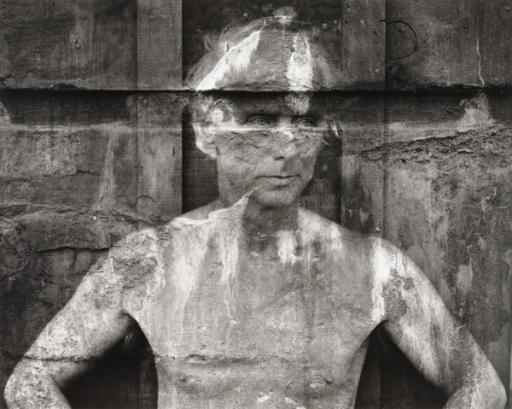
Max Ernst
French and American, born Germany. 1891–1976 243 works onlineA key member of first Dada and then Surrealism in Europe in the 1910s and 1920s, Max Ernst used a variety of mediums—painting, collage, printmaking, sculpture, and various unconventional drawing methods—to give visual form to both personal memory and collective myth.
Learn more →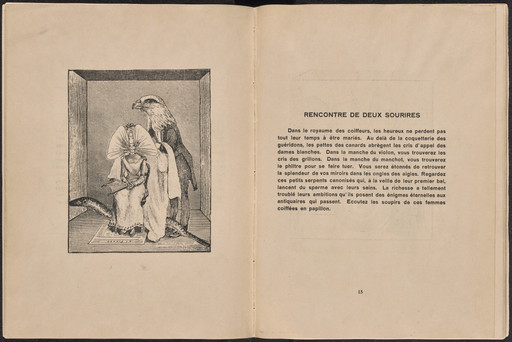
Art of This Century
Gallery 522In the 1940s the New York City art world expanded with the arrival of European émigrés escaping World War II.
Learn more →
Articles and videos
From MoMA Design Store


Installation views
We have identified this work in the following photos from our exhibition history.
Provenance Research Project
This work is included in the Provenance Research Project, which investigates the ownership history of works in MoMA's collection.
The artist
Peggy Guggenheim, Venice. Acquired from the artist.
The Museum of Modern Art, New York. Acquired from Peggy Guggenheim by exchange, 1942
Provenance research is a work in progress, and is frequently updated with new information. If you have any questions or information to provide about the listed works, please email [email protected] or write to:
Provenance Research Project
The Museum of Modern Art
11 West 53 Street
New York, NY 10019
Licensing
Artwork or archival images
If you would like to reproduce an image of a work of art in MoMA's collection, or an image of a MoMA publication or archival material (including installation views, checklists, and press releases), please contact Art Resource (publication in North America) or Scala Archives (publication in all other geographic locations).
Audio and film clips
MoMA licenses archival audio and select out of copyright film clips from our film collection. At this time, MoMA produced video cannot be licensed by MoMA/Scala. All requests to license archival audio or out of copyright film clips should be addressed to Scala Archives at [email protected]. Motion picture film stills cannot be licensed by MoMA/Scala. For access to motion picture film stills for research purposes, please contact the Film Study Center at [email protected]. For more information about film loans and our Circulating Film and Video Library, please visit Circulating Film and Video Library.
Text from a publication or the archives
If you would like to reproduce text from a MoMA publication, please email [email protected]. If you would like to publish text from MoMA's archival materials, please fill out this permission form and send to [email protected].
Feedback
This record is a work in progress. If you have additional information or spotted an error, please fill out this feedback form.