Not on view
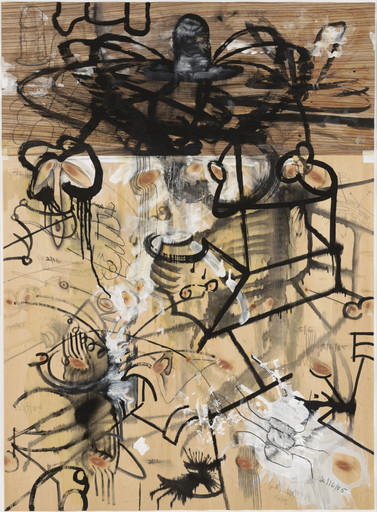
Carroll Dunham's marvelous, eyeless, tooth-filled, libidinal shapes in this Untitled work are representative of the figures populating his personal visual universe. He has said that such images are, on some level, "pictures of oneself." The absence of a margin on this print emphasizes the fact that Dunham's shapes cannot be contained and are part of the artist's endless theater of evolution, suggesting multiple possibilities and interpretations well beyond their comic simplicity. With such works, Dunham enriches the long tradition of expressionist abstraction by returning to the irrational world of Surrealism and expanding on the imaginary universes of such figures as artist Philip Guston.
Dunham began making prints in 1985 at Universal Limited Art Editions (ULAE) at the invitation of Bill Goldston, who followed Tatyana Grosman as director there in 1982. Dunham was part of a new generation of painters for whom printmaking would assume a major creative role. This is confirmed by his statement that printmaking is now "a part of the way I think." To date, he has made approximately sixty prints, at ULAE and at several other workshops.
This print owes its unusual Braille-like surface to a technique pioneered at Two Palms Press by printer David Lasry. The technique uses a 750-ton hydraulic press, formerly employed commercially for molding rubber. Rather than simply printing on paper that is laid over a woodblock, the press molds the paper under enormous pressure, creating deep, sculptural relief. The wood-grain markings seen here are a descendant of Dunham's painted abstractions on wood veneers in the 1980s. In fact, his biomorphic figures emerged from those earlier tangles of lines and shapes. Tactility and surface projections also find precedence in Dunham's paintings, as in works of the 1990s that include Styrofoam balls adhered to their surfaces.
an essay by Raimond Livasgani, in Deborah Wye, Artists and Prints: Masterworks from The Museum of Modern Art, New York: The Museum of Modern Art, 2004, p. 252.
Explore more
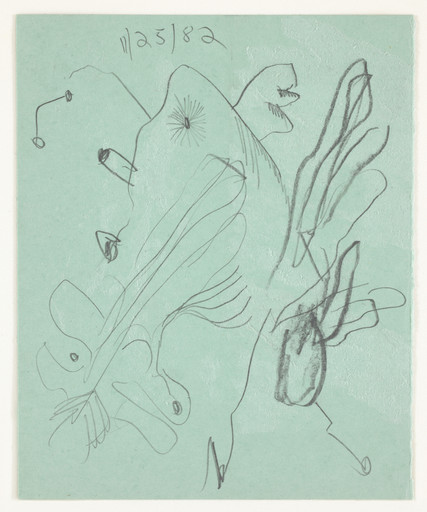
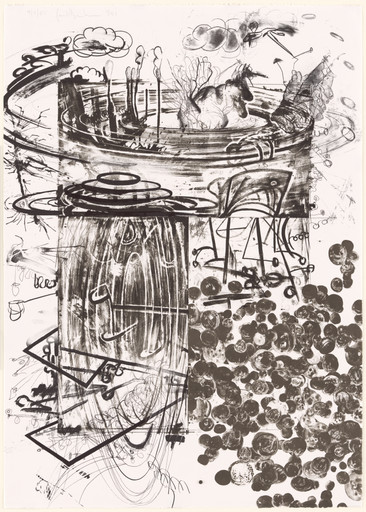
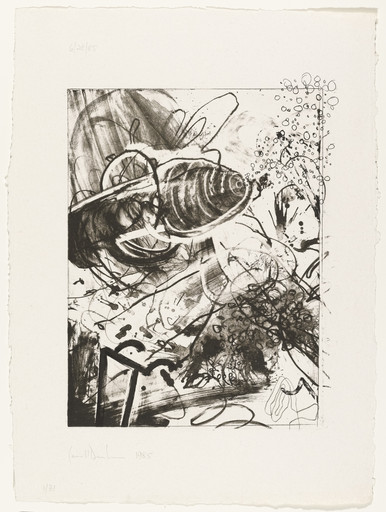

Engraving
An intaglio printmaking technique that creates a crisp, precise line that swells in the middle and tapers at the end.
Learn more →
From MoMA Design Store


Licensing
Artwork or archival images
If you would like to reproduce an image of a work of art in MoMA's collection, or an image of a MoMA publication or archival material (including installation views, checklists, and press releases), please contact Art Resource (publication in North America) or Scala Archives (publication in all other geographic locations).
Audio and film clips
MoMA licenses archival audio and select out of copyright film clips from our film collection. At this time, MoMA produced video cannot be licensed by MoMA/Scala. All requests to license archival audio or out of copyright film clips should be addressed to Scala Archives at [email protected]. Motion picture film stills cannot be licensed by MoMA/Scala. For access to motion picture film stills for research purposes, please contact the Film Study Center at [email protected]. For more information about film loans and our Circulating Film and Video Library, please visit Circulating Film and Video Library.
Text from a publication or the archives
If you would like to reproduce text from a MoMA publication, please email [email protected]. If you would like to publish text from MoMA's archival materials, please fill out this permission form and send to [email protected].
Feedback
This record is a work in progress. If you have additional information or spotted an error, please fill out this feedback form.