Not on view
With visionary zeal and unflinching energy, Stanley William Hayter did much to foster intaglio printmaking as an innovative technique. In 1927, after moving from London to Paris and studying engraving with the artist Joseph Hecht, he founded his own workshop, which he named Atelier 17 in 1933 after its new street address. In 1940, with the outbreak of war, Atelier 17 moved to New York and became a meeting place for exiled European artists and American artists working in various styles. The workshop was transplanted back to Paris in the 1950s.
Hayter's induction into Surrealist practice in the late 1920s established the unconscious as a source of his art. His noteworthy contributions to printmaking include an expressive and flexible engraved line that was influenced by automatism; a textural depth created through etching; and innovations in color printing on a single plate. Although Hayter also worked as a painter, it was his printed oeuvre, consisting of some four hundred fifty works, and his celebrated Atelier 17 that influenced countless artists who then disseminated his methods of intaglio printmaking.
The plate for Combat was one of the few that Hayter brought from Paris to New York in 1939, prior to opening his Atelier 17 there a year later. Not only was it the largest plate he made in the 1930s, but it also went through ten states, a large number for Hayter. Engraved in 1936, Combat takes as its subject the Spanish Civil War, an event reflected in the work of many artists at the time. Although not immediately discernible, figures constructed from sinuous lines fill the composition, and the etching and engraving processes are exploited to suggest a sense of depth. According to Hayter, the print depicts a violent encounter of combatants, with leaping horses and a plethora of weapons.
an essay by Raimond Livasgani, in Deborah Wye, Artists and Prints: Masterworks from The Museum of Modern Art, New York: The Museum of Modern Art, 2004, p. 101.
Explore more
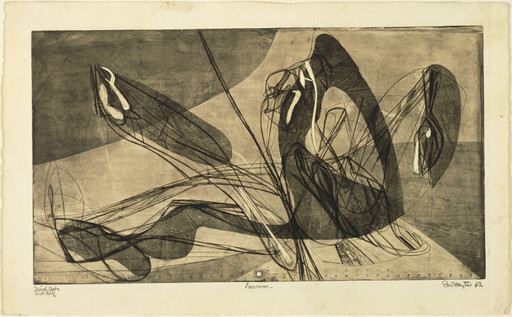
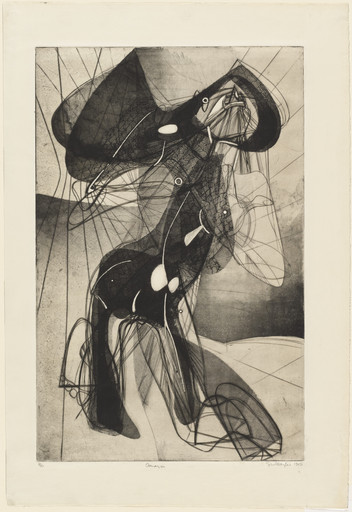
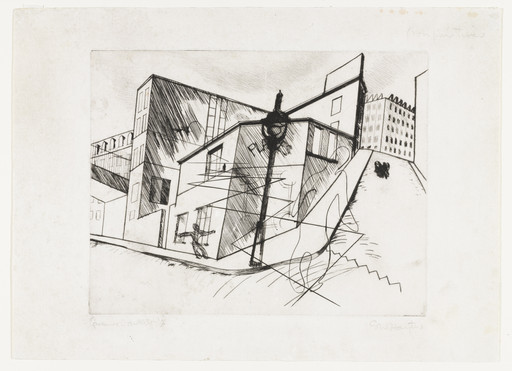
Engraving
An intaglio printmaking technique that creates a crisp, precise line that swells in the middle and tapers at the end.
Learn more →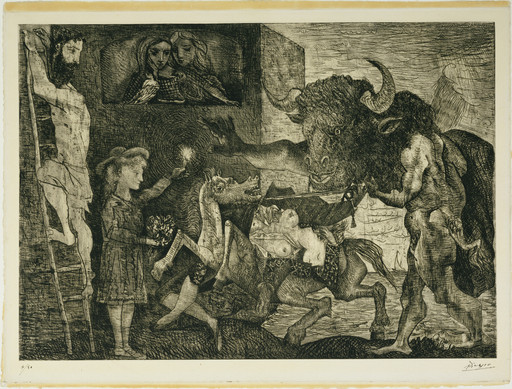
From MoMA Design Store


Installation views
We have identified this work in the following photos from our exhibition history.
Licensing
Artwork or archival images
If you would like to reproduce an image of a work of art in MoMA's collection, or an image of a MoMA publication or archival material (including installation views, checklists, and press releases), please contact Art Resource (publication in North America) or Scala Archives (publication in all other geographic locations).
Audio and film clips
MoMA licenses archival audio and select out of copyright film clips from our film collection. At this time, MoMA produced video cannot be licensed by MoMA/Scala. All requests to license archival audio or out of copyright film clips should be addressed to Scala Archives at [email protected]. Motion picture film stills cannot be licensed by MoMA/Scala. For access to motion picture film stills for research purposes, please contact the Film Study Center at [email protected]. For more information about film loans and our Circulating Film and Video Library, please visit Circulating Film and Video Library.
Text from a publication or the archives
If you would like to reproduce text from a MoMA publication, please email [email protected]. If you would like to publish text from MoMA's archival materials, please fill out this permission form and send to [email protected].
Feedback
This record is a work in progress. If you have additional information or spotted an error, please fill out this feedback form.