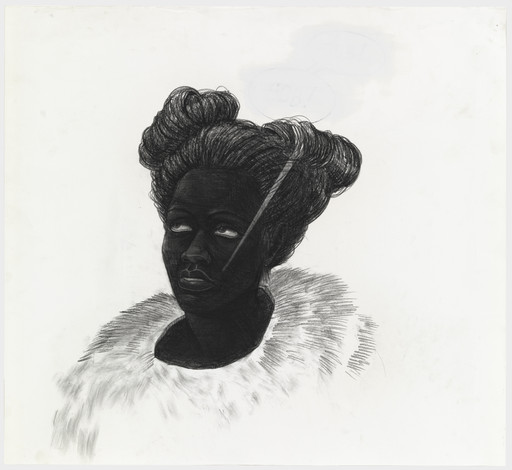
Conté crayon and acrylic on paper
Not on view
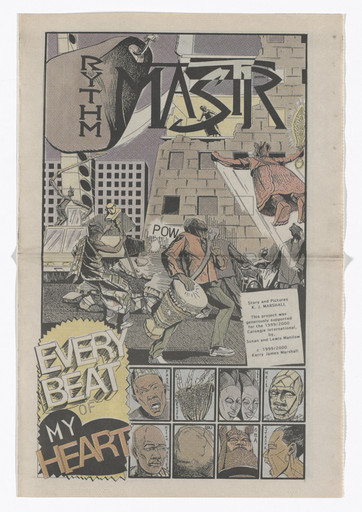
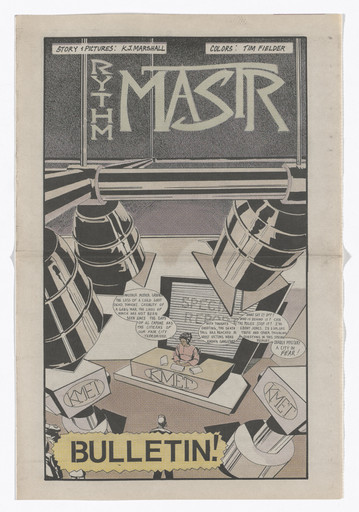
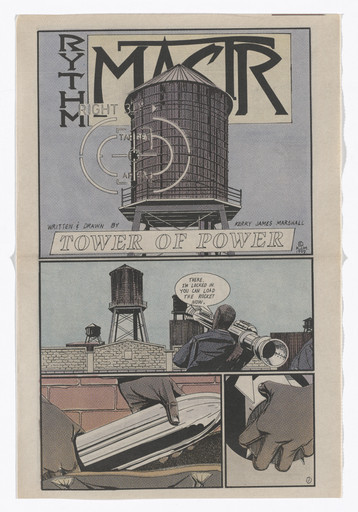
Although Marshall is known primarily as a painter, his work encompasses drawing, printmaking, sculpture, and installation. All of his production is characterized by hybridity; he weaves together elements from Western and African art history, classical mythology, film history, comic books, and civil rights monuments and events. If his strategies are hybrid, his aim is focused: "to articulate the cultural, social, and political history of black people in America." Marshall's own relationship to the civil rights movement may account for his commitment. He lived in Birmingham, Alabama, at the time of the 1963 church bombing and near the Watts area of Los Angeles during the 1965 riots, and he went to junior high school a few short blocks from the Black Panthers headquarters in L.A.
Marshall has often turned his attention to conflicting conceptions of black beauty. In this study Marshall critiques conventions of femininity while revealing his interest in tradition—particularly that of European modernism, from Paul Gauguin to Odilon Redon. This large, dense, and carefully worked drawing depicts a dark-skinned mermaid half immersed in a pool of shimmering water. She looks boldly and directly at the viewer, catching us with her gaze in our own acts of voyeurism. Typically, the figure of a mermaid evokes a mythic ideal of white beauty. Challenging preconceptions, Marshall offers "a stylized representation of a beauty that [is] unequivocally black."
The Museum of Modern Art, MoMA Highlights since 1980, New York: The Museum of Modern Art, 2007, p. 132.
Explore more


From MoMA Design Store


Installation views
We have identified this work in the following photos from our exhibition history.
Licensing
Artwork or archival images
If you would like to reproduce an image of a work of art in MoMA's collection, or an image of a MoMA publication or archival material (including installation views, checklists, and press releases), please contact Art Resource (publication in North America) or Scala Archives (publication in all other geographic locations).
Audio and film clips
MoMA licenses archival audio and select out of copyright film clips from our film collection. At this time, MoMA produced video cannot be licensed by MoMA/Scala. All requests to license archival audio or out of copyright film clips should be addressed to Scala Archives at [email protected]. Motion picture film stills cannot be licensed by MoMA/Scala. For access to motion picture film stills for research purposes, please contact the Film Study Center at [email protected]. For more information about film loans and our Circulating Film and Video Library, please visit Circulating Film and Video Library.
Text from a publication or the archives
If you would like to reproduce text from a MoMA publication, please email [email protected]. If you would like to publish text from MoMA's archival materials, please fill out this permission form and send to [email protected].
Feedback
This record is a work in progress. If you have additional information or spotted an error, please fill out this feedback form.