Diller + Scofidio, Elizabeth Diller, Ricardo Scofidio
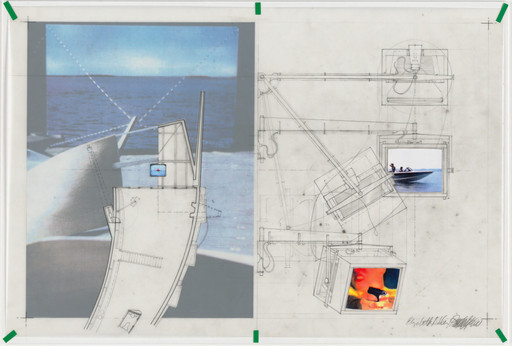
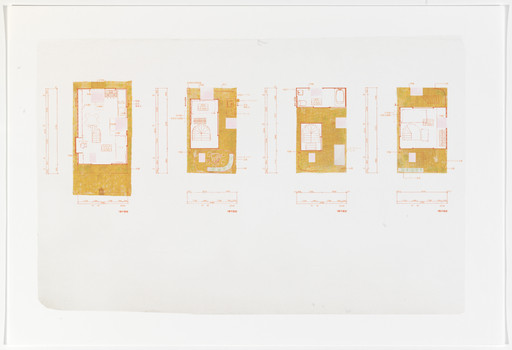
Slow House Project, North Haven, New York (Plan of lower-level and sections)
1989
Not on view
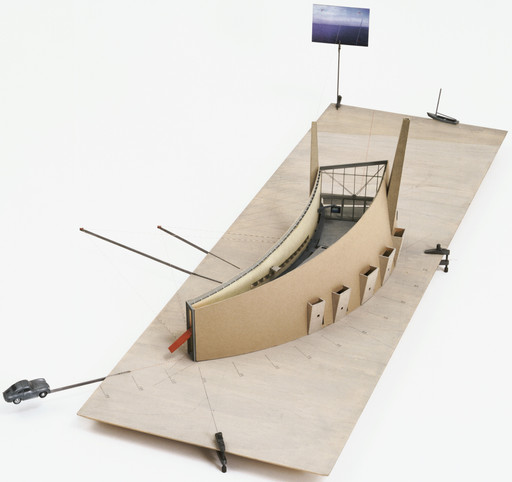
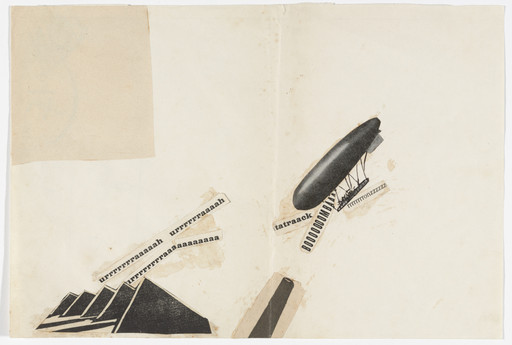
Elizabeth Diller and Ricardo Scofidio's Slow House project explores the vacation home as a place that offers escape from a fast-paced urban environment and the ability to reconnect with the city at any time. This drawing shows a series of transverse sections extending from a plan of the building's lower level, tracing the path from the car's rearview mirror (symbolizing travel away from the city) to the house’s cherished water view. The section images show how the house arcs from the entry facade, which is just wider than the front door, to the double-height picture window framing the view. The split passage between the first and second levels, the building's horizontal curve, and the torqued outer wall of the house thwart direct visual access to this view at the structure's southwest end, slowing the visitor's approach to it. The architects have explained that the house "is conceived as a passage, a door that leads to a window . . . a physical entry to an optical departure."
Challenging the conventions of architectural representation, Diller and Scofidio executed this drawing on a translucent sheet mounted on a wooden board and left drawing equipment attached to the final product.
The Museum of Modern Art, MoMA Highlights since 1980, New York: The Museum of Modern Art, 2007, p. 79.
Publication excerpt from an essay by Melanie Domino, in Matilda McQuaid, ed., Envisioning Architecture: Drawings from The Museum of Modern Art , New York: The Museum of Modern Art, 2002, p. 234.
Elizabeth Diller and Ricardo Scofidio's Slow House is an oceanfront vacation home designed for an art collector and entrepreneur. The project explores the idea of the vacation house as a place offering both an escape from a fast-paced urban environment and the ability to reconnect with the city at any time; in (this) drawing..., in fact, a series of transverse sections extending from a plan of the lower level trace the path from the city to the house, with its cherished ocean view. (Challenging the conventions of architectural representation, Diller and Scofidio have executed this drawing on a sheet of vellum mounted on a wooden board, leaving drawing equipment attached to the final product.) The split passage between the first and the second levels, the curved plan, and the torqued outer wall of the house thwart direct visual access to this view, at the structure's southwest end, "slowing" the visitor's approach to it. The architects have explained that the house "is conceived as a passage, a door that leads to a window . . . a physical entry to an optical departure."
Originally from TextEntryID 73726 (TextTypeID 133)
(See 377.1994 for the remainder of this essay)
an essay by Melanie Domino, in Matilda McQuaid, ed., Envisioning Architecture: Drawings from The Museum of Modern Art, New York: The Museum of Modern Art, 2002, p. 234.
Explore more
Plan drawing
Plans or plan drawings are used to illustrate the layout and orientations of a structure. Plans typically depict a building or project site from an aerial view.
Learn more →



From MoMA Design Store


Installation views
We have identified this work in the following photos from our exhibition history.
Licensing
Artwork or archival images
If you would like to reproduce an image of a work of art in MoMA's collection, or an image of a MoMA publication or archival material (including installation views, checklists, and press releases), please contact Art Resource (publication in North America) or Scala Archives (publication in all other geographic locations).
Audio and film clips
MoMA licenses archival audio and select out of copyright film clips from our film collection. At this time, MoMA produced video cannot be licensed by MoMA/Scala. All requests to license archival audio or out of copyright film clips should be addressed to Scala Archives at [email protected]. Motion picture film stills cannot be licensed by MoMA/Scala. For access to motion picture film stills for research purposes, please contact the Film Study Center at [email protected]. For more information about film loans and our Circulating Film and Video Library, please visit Circulating Film and Video Library.
Text from a publication or the archives
If you would like to reproduce text from a MoMA publication, please email [email protected]. If you would like to publish text from MoMA's archival materials, please fill out this permission form and send to [email protected].
Feedback
This record is a work in progress. If you have additional information or spotted an error, please fill out this feedback form.