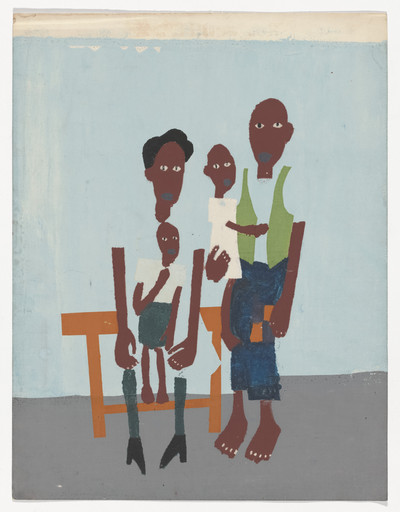
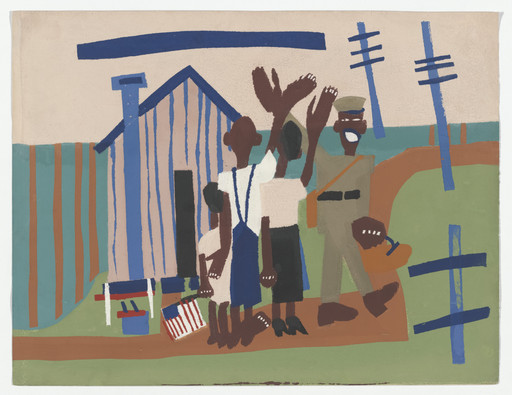
William H. Johnson was among the foremost painters of African-American life during the Harlem Renaissance. Born in South Carolina and educated in fine arts in New York and Provincetown, Johnson spent most of his time from the mid-1920s to the late 1930s in Europe, where he was influenced by Post-Impressionism and Expressionism. After achieving critical acclaim abroad, he returned to New York permanently in 1938 under the threat of war and with a desire to reconnect to his roots. The move produced a dramatic change in his work. Assigned by the government's Works Progress Administration to teach at the Harlem Community Art Center, Johnson became immersed in the sights, sounds, and people of New York's African-American community, which he captured in compositions of flat shapes, patterned designs, and brilliant colors that were distinctly modernist in their simplicity and directness.
During his lifetime, Johnson created more than seventy-five prints. While in Europe he produced woodcuts and linoleum cuts, usually with hand coloring, inspired by the raw power of German Expressionism. After returning to New York, he took up screenprint and pochoir, techniques that suited his new embrace of simplified forms and bold colors. He printed these works on assorted found papers and often completed his images by hand with tempera, making each print slightly different from the next. He frequently experimented with subjects by printing compositional variants and also rendering them in drawing and painting, each format enriching the other, but with the printed versions the most simplified of all.
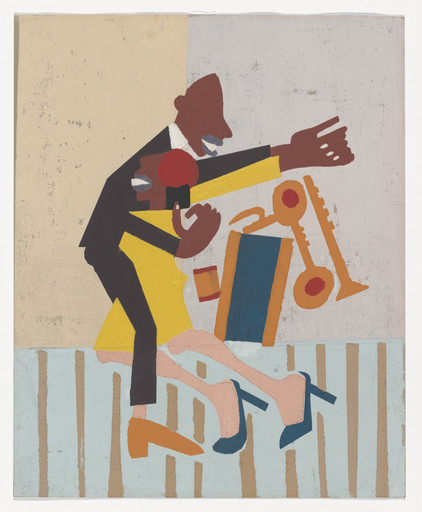
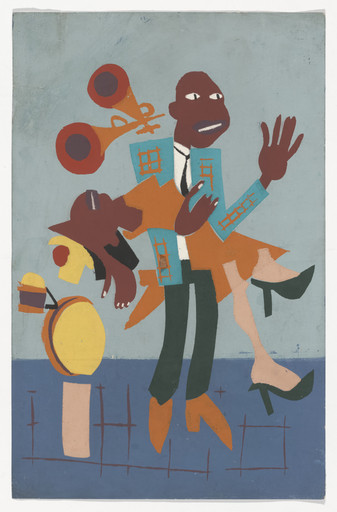
Notable among Johnson's New York prints are those that capture the essence of Harlem's fashion, music, and dance. This print, entitled Blind Singer, shows a pair of musicians in an open-air performance that was common on the city's bustling streets. The composition's flatness, pure color, and orchestrated angularity endow this still image with a sense of rhythmic motion and dynamic energy.
an essay by Judy Hecker, in Deborah Wye, Artists and Prints: Masterworks from The Museum of Modern Art, New York: The Museum of Modern Art, 2004, p. 220.
Explore more
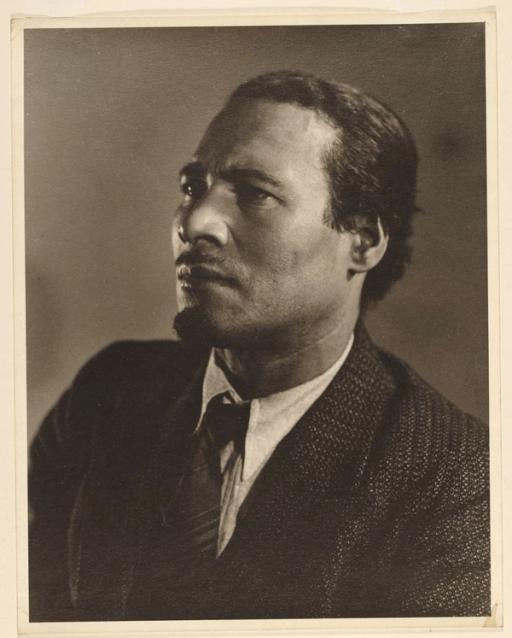
William H. Johnson
American, 1901–1970 9 works onlineWilliam Henry Johnson, one of the great painter/poets of American experience, left South Carolina, the state of his birth, in 1917, when he was only 17, and found a place in the Harlem home of an uncle who made a good living as a porter on the trains that ran north and south.
Learn more →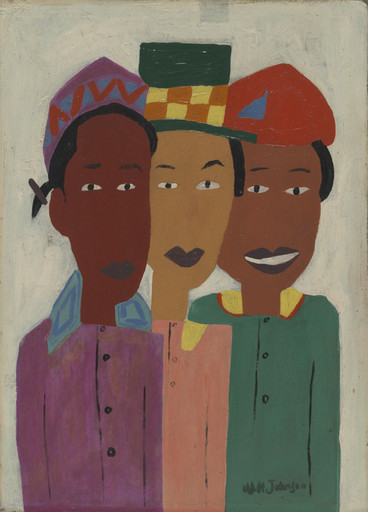
Great Migration
A historic mass movement of over six million African Americans between 1910 and 1970, as migrants sought to escape the racial violence and limited economic mobility in the Southern United States under Jim Crow laws.
Learn more →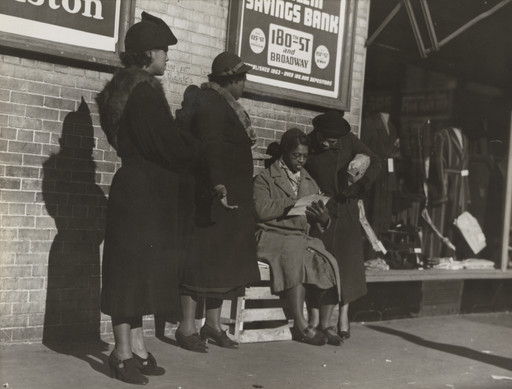
Tempera
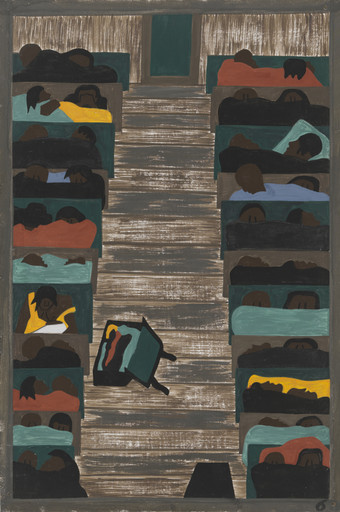
A painting medium in which colored pigment is mixed with a water-soluble binder, such as egg yolk; a painting done in this medium.
Learn more →

From MoMA Design Store


Installation views
We have identified this work in the following photos from our exhibition history.
Licensing
Artwork or archival images
If you would like to reproduce an image of a work of art in MoMA's collection, or an image of a MoMA publication or archival material (including installation views, checklists, and press releases), please contact Art Resource (publication in North America) or Scala Archives (publication in all other geographic locations).
Audio and film clips
MoMA licenses archival audio and select out of copyright film clips from our film collection. At this time, MoMA produced video cannot be licensed by MoMA/Scala. All requests to license archival audio or out of copyright film clips should be addressed to Scala Archives at [email protected]. Motion picture film stills cannot be licensed by MoMA/Scala. For access to motion picture film stills for research purposes, please contact the Film Study Center at [email protected]. For more information about film loans and our Circulating Film and Video Library, please visit Circulating Film and Video Library.
Text from a publication or the archives
If you would like to reproduce text from a MoMA publication, please email [email protected]. If you would like to publish text from MoMA's archival materials, please fill out this permission form and send to [email protected].
Feedback
This record is a work in progress. If you have additional information or spotted an error, please fill out this feedback form.