Not on view
Take turns sharing what you notice about the children in this painting. How are their clothes and expressions similar? How are they different? Johnson was a teacher at the Harlem Community Art Center when he made this painting. Inspired by the children he taught there, he made art with children in it. Their art also influenced how he painted, including the flat, 2D way he chose to show these children.
2022
Publication excerpt from MoMA Highlights: 375 Works from The Museum of Modern Art, New York (New York: The Museum of Modern Art, 2019)
Born in Florence, South Carolina, Johnson moved to France at age twenty-six and lived intermittently in Europe over the following twelve years. During this period, his output consisted largely of expressionistic landscapes made with impasto strokes of bold pigment. Upon returning to the United States in 1938, the artist changed course and began to develop a uniquely personal style, explicitly reflecting upon his ancestry through references to African American culture. Children is an example of Johnson’s explorations in this realm.
The three girls in Children—depicted from the waist up and tightly grouped in a row—embody the artist’s deliberately simplified visual vocabulary. Deploying stylized, nonillusionistic techniques, he rendered them not only flat, but also as nearly identical in their frontal stances, outward gazes, and jewel-toned outfits. Despite the ostensible directness of these subjects and their placement in this nondescript space, however, Johnson clearly tackled a political consideration in Children: the varied skin tones among these three figures remind us of the discriminatory practice, common at the time of this painting’s creation, of determining an individual’s legal (and social) status on the basis of skin pigmentation. In paintings like Children, Johnson—who identified as “both a primitive and a cultured painter”—offered a subtle repudiation of accepted standards of race in the United States.
MoMA Highlights: 375 Works from The Museum of Modern Art, New York (New York: The Museum of Modern Art, 2019)
Explore more
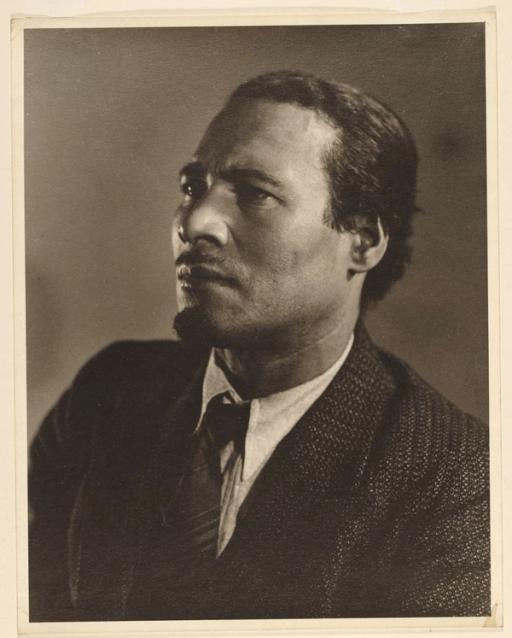
William H. Johnson
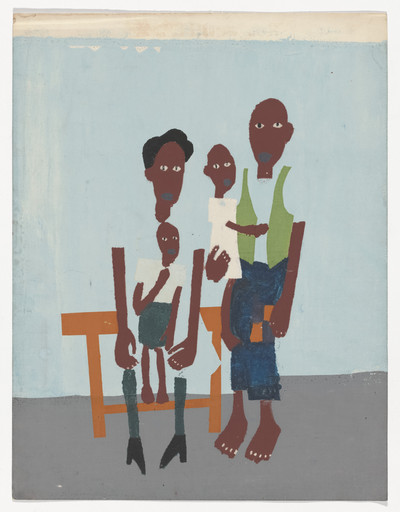
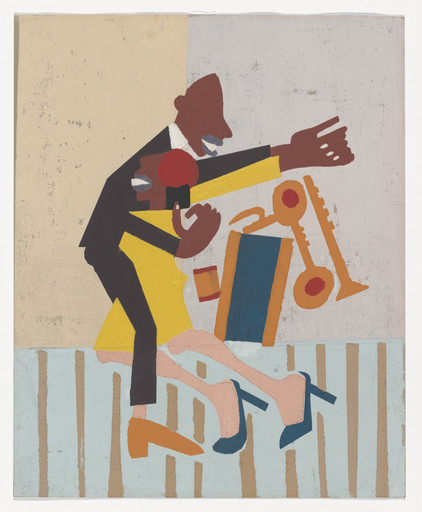
American, 1901–1970 9 works onlineWilliam Henry Johnson, one of the great painter/poets of American experience, left South Carolina, the state of his birth, in 1917, when he was only 17, and found a place in the Harlem home of an uncle who made a good living as a porter on the trains that ran north and south.
Learn more →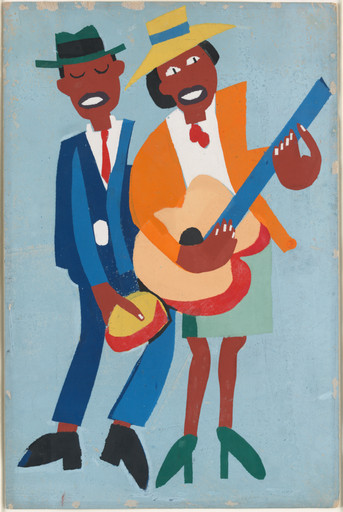
Audio
Audio from the playlist Kids
Audio from the playlist 1880–1950: Works from the Collection
From MoMA Design Store


Installation views
We have identified this work in the following photos from our exhibition history.
Licensing
Artwork or archival images
If you would like to reproduce an image of a work of art in MoMA's collection, or an image of a MoMA publication or archival material (including installation views, checklists, and press releases), please contact Art Resource (publication in North America) or Scala Archives (publication in all other geographic locations).
Audio and film clips
MoMA licenses archival audio and select out of copyright film clips from our film collection. At this time, MoMA produced video cannot be licensed by MoMA/Scala. All requests to license archival audio or out of copyright film clips should be addressed to Scala Archives at [email protected]. Motion picture film stills cannot be licensed by MoMA/Scala. For access to motion picture film stills for research purposes, please contact the Film Study Center at [email protected]. For more information about film loans and our Circulating Film and Video Library, please visit Circulating Film and Video Library.
Text from a publication or the archives
If you would like to reproduce text from a MoMA publication, please email [email protected]. If you would like to publish text from MoMA's archival materials, please fill out this permission form and send to [email protected].
Feedback
This record is a work in progress. If you have additional information or spotted an error, please fill out this feedback form.