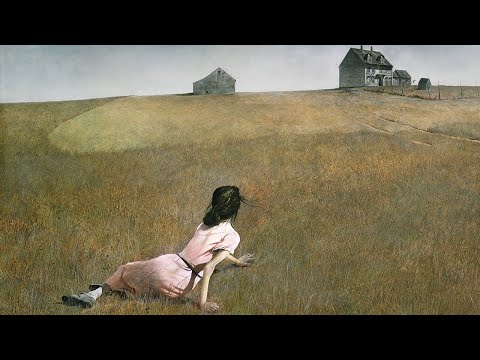
Set in the stark landscape of coastal Maine, Christina’s World depicts a young woman seen from behind, wearing a pink dress and lying in a grassy field. Although she appears to be in a position of repose, her torso, propped on her arms, is strangely alert; her silhouette is tense, almost frozen, giving the impression that she is fixed to the ground. She stares at a distant farmhouse and a group of outbuildings, ancient and grayed in harmony with the dry grass and overcast sky.
Wyeth’s neighbor Anna Christina Olson inspired the composition, which is one of four paintings by Wyeth in which she appears. As a young girl, Olson developed a degenerative muscle condition—possibly polio—that left her unable to walk. She refused to use a wheelchair, preferring to crawl, as depicted here, using her arms to drag her lower body along. “The challenge to me,” Wyeth explained, “was to do justice to her extraordinary conquest of a life which most people would consider hopeless.”
The high level of detail Wyeth gave to every object in his paintings encourages intense inspection, but his titles reveal the inner significance of their outwardly straightforward subjects. The title Christina’s World, courtesy of Wyeth’s wife, indicates that the painting is more a psychological landscape than a portrait, a portrayal of a state of mind rather than a place.
MoMA Highlights: 375 Works from The Museum of Modern Art, New York (New York: The Museum of Modern Art, 2019)
Explore more
Modern art
Art made from the 1880s to the 1970s—a time marked by the growth of cities, the rise of industry, a surge in technologies, and the development of mass media.
Learn more →
Tempera
A painting medium in which colored pigment is mixed with a water-soluble binder, such as egg yolk; a painting done in this medium.
Learn more →
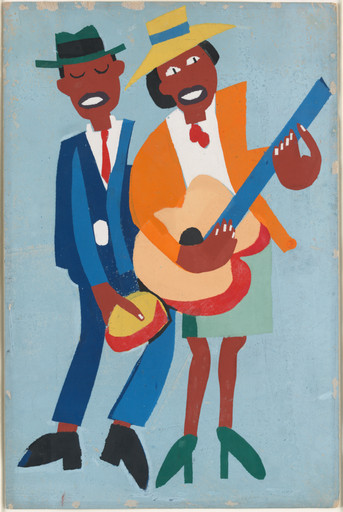
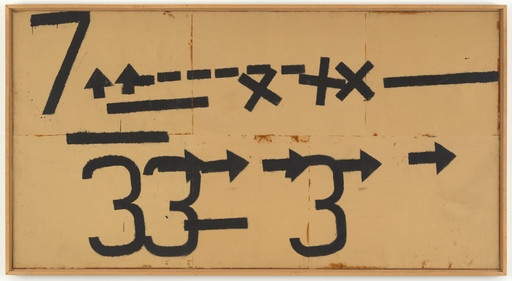
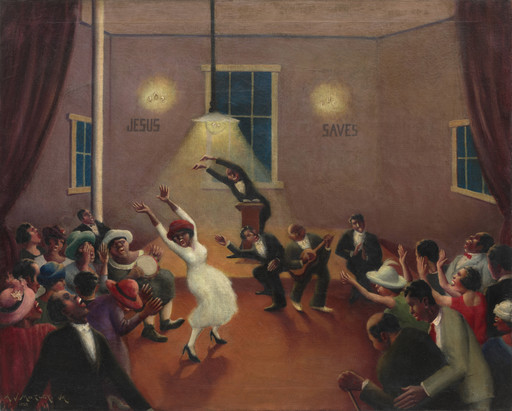
American Idioms
Gallery 521From the Great Depression through World War II, the United States experienced a period of turbulence and transformation. Informed by shifting social and economic dynamics at home and abroad, artists developed unique approaches to narrative art in diverse styles and mediums.
Learn more →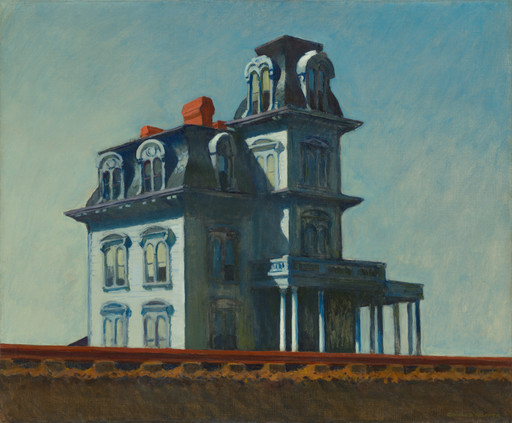
Articles and videos
From MoMA Design Store


Installation views
We have identified this work in the following photos from our exhibition history.
Licensing
Artwork or archival images
If you would like to reproduce an image of a work of art in MoMA's collection, or an image of a MoMA publication or archival material (including installation views, checklists, and press releases), please contact Art Resource (publication in North America) or Scala Archives (publication in all other geographic locations).
Audio and film clips
MoMA licenses archival audio and select out of copyright film clips from our film collection. At this time, MoMA produced video cannot be licensed by MoMA/Scala. All requests to license archival audio or out of copyright film clips should be addressed to Scala Archives at [email protected]. Motion picture film stills cannot be licensed by MoMA/Scala. For access to motion picture film stills for research purposes, please contact the Film Study Center at [email protected]. For more information about film loans and our Circulating Film and Video Library, please visit Circulating Film and Video Library.
Text from a publication or the archives
If you would like to reproduce text from a MoMA publication, please email [email protected]. If you would like to publish text from MoMA's archival materials, please fill out this permission form and send to [email protected].
Feedback
This record is a work in progress. If you have additional information or spotted an error, please fill out this feedback form.