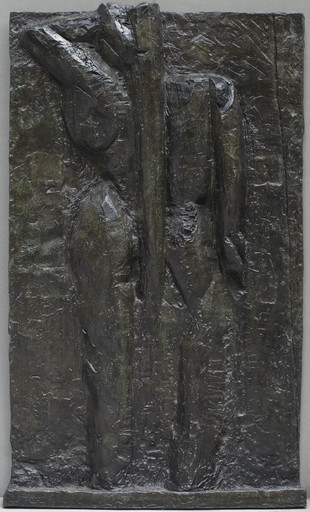
The daring instability and torsion of The River are rare in Maillol's sculpture. Instead of trying to emulate the dynamism of twentieth-century life, as did so many artists of his time, Maillol usually sought an art of serenity and stillness, of classical nobility and simplicity. As late as 1937, in fact, he remarked, "For my taste, there should be as little movement as possible in sculpture." Yet within a year or so afterward he had conceived The River, a work in which the movement is almost reckless.
Commissioned to create a monument to a notable pacifist, the French writer Henri Barbusse, Maillol conceived the sculpture as a work on the theme of war: a woman stabbed in the back, and falling. When the commission fell through, he transformed the idea into The River. In a departure from the usual conventions of monumental sculpture, the figure lies low to the ground and rests apparently precariously on the pedestal, even hanging below its edge. Twisting and turning, her raised arms suggesting the pressure of some powerful current, this woman is the personification of moving water.
The Museum of Modern Art, MoMA Highlights, New York: The Museum of Modern Art, revised 2004, originally published 1999, p. 169.
Explore more
Lead
A soft, malleable, dense metallic element with many different applications and uses, especially in the marking substance in pencils or as a material for sculpture.
Learn more →

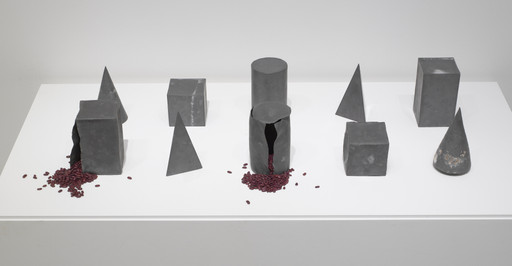

UUmwelt
Sculpture GardenAt a time when AI is dramatically changing how we see, what does it mean to visualize a world that’s no longer centered on the human mind?
Learn more →
Audio
Audio from the playlist Sculpture Garden
From MoMA Design Store


Installation views
We have identified this work in the following photos from our exhibition history.
Licensing
Artwork or archival images
If you would like to reproduce an image of a work of art in MoMA's collection, or an image of a MoMA publication or archival material (including installation views, checklists, and press releases), please contact Art Resource (publication in North America) or Scala Archives (publication in all other geographic locations).
Audio and film clips
MoMA licenses archival audio and select out of copyright film clips from our film collection. At this time, MoMA produced video cannot be licensed by MoMA/Scala. All requests to license archival audio or out of copyright film clips should be addressed to Scala Archives at [email protected]. Motion picture film stills cannot be licensed by MoMA/Scala. For access to motion picture film stills for research purposes, please contact the Film Study Center at [email protected]. For more information about film loans and our Circulating Film and Video Library, please visit Circulating Film and Video Library.
Text from a publication or the archives
If you would like to reproduce text from a MoMA publication, please email [email protected]. If you would like to publish text from MoMA's archival materials, please fill out this permission form and send to [email protected].
Feedback
This record is a work in progress. If you have additional information or spotted an error, please fill out this feedback form.