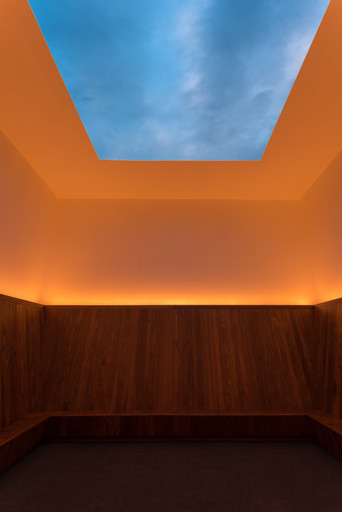
Throughout history, the artist has been a shaper of matter, whether the pigment of an image or the solid substance of sculpture. A Frontal Passage, like other works by Turrell, breaks from those ancient traditions in that it has no mass. Instead, Turrell shapes light.
An interest in a dematerialized art object appears in a range of work from the 1960s and 1970s—in Conceptual art, for example, which posits art more as language and idea than as visual form. But Turrell differs from the Conceptualists in the absorbing sensual power his work commands. He is closer to the Minimalist sculptor Dan Flavin, who also worked with light; but where Flavin would incorporate not only the light of fluorescent tubes but the tubes themselves into his art's appearance, the fluorescents in A Frontal Passage are obscured. The spec-tacle is light itself, given the illusion of palpable shape.
To view A Frontal Passage, the visitor passes through a darkened entryway into a chamber, also dark—but divided diagonally by a radiant yet crisply defined wall of red light. Instead of diffusing freely from one side of this wall to the other, the light ends abruptly in space, as if it had density. The power of the work lies in this paradox, in which nothingness gains physical presence.
The Museum of Modern Art, MoMA Highlights, New York: The Museum of Modern Art, revised 2004, originally published 1999, p. 343.
Explore more
Installation
An art form that comprises visual elements in any medium and the space they inhabit.
Learn more →




From MoMA Design Store


Installation views
We have identified this work in the following photos from our exhibition history.
Licensing
Artwork or archival images
If you would like to reproduce an image of a work of art in MoMA's collection, or an image of a MoMA publication or archival material (including installation views, checklists, and press releases), please contact Art Resource (publication in North America) or Scala Archives (publication in all other geographic locations).
Audio and film clips
MoMA licenses archival audio and select out of copyright film clips from our film collection. At this time, MoMA produced video cannot be licensed by MoMA/Scala. All requests to license archival audio or out of copyright film clips should be addressed to Scala Archives at [email protected]. Motion picture film stills cannot be licensed by MoMA/Scala. For access to motion picture film stills for research purposes, please contact the Film Study Center at [email protected]. For more information about film loans and our Circulating Film and Video Library, please visit Circulating Film and Video Library.
Text from a publication or the archives
If you would like to reproduce text from a MoMA publication, please email [email protected]. If you would like to publish text from MoMA's archival materials, please fill out this permission form and send to [email protected].
Feedback
This record is a work in progress. If you have additional information or spotted an error, please fill out this feedback form.