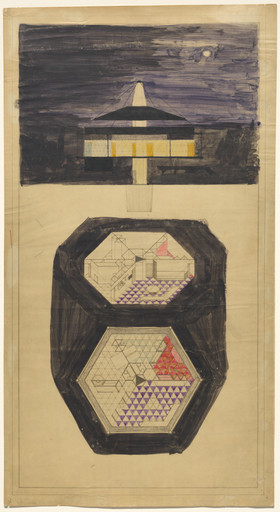
Pencil, watercolor, and metallic ink on tracing paper
Not on view
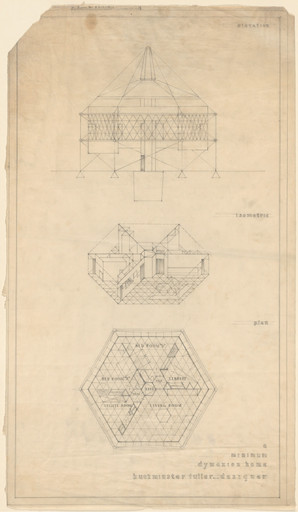
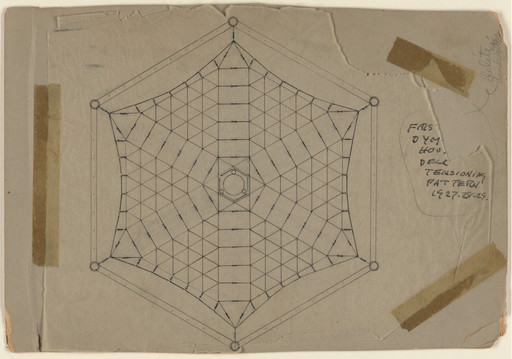
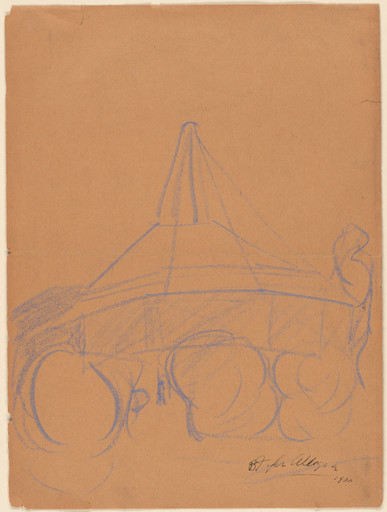
With the Dymaxion House project, Fuller sought to apply assembly-line production to residential design in order to create widely available low-cost housing. This hexagonal house was to be clad with double-panel vacuum-glazed walls and fully air-conditioned, construction-technology innovations that did not yet exist when the house was designed. The triangular grid of the geometric plan divides the interior into wedge-shaped modular rooms. Only one modified postwar version of the house was produced, but the project has exerted enormous influence as a radical reimagining of the single-family home’s technical and aesthetic possibilities.
2020
Publication excerpt from an essay by Peter Reed, in Matilda McQuaid, ed., Envisioning Architecture: Drawings from The Museum of Modern Art , New York: The Museum of Modern Art, 2002, p. 64–65.
"How much does your house weigh?" This typical provocation by Buckminster Fuller was aimed at critics of his Dymaxion House, a radically new environment for dwelling introduced in 1927 and so named for its "maximum gain of advantage from minimal energy input." This 1,600-square-foot house weighed only three tons; its cost was about the same as the price of a car. The dream of a low-cost factory-built house captured the attention of many socially conscious architects in the twentieth century: if the automobile industry could mass-produce their products quickly, efficiently, and relatively cheaply, why couldn't a similar system be applied to housing? Perhaps no one pushed this idea as far as Fuller, an extraordinary genius, inventor, philosopher, architect, and engineer.
In the Dymaxion House, a central aluminum mast contains all the mechanical elements of the building in its core. Two hexagonal decks are suspended from this mast by triangulated tension cables. The house is enclosed within walls of double-panel vacuum glazing and is a fully air-conditioned environment. One of Fuller's students called the Dymaxion House a "metallurgical pound cake", and indeed the rooms are divided into wedge shapes, seen most clearly in the color-coded plan.
The unconventional shape, structure, and materials of the Dymaxion House stood in sharp contrast to buildings by leading modernists such as Le Corbusier and Mies van der Rohe. Le Corbusier had described his own mass-produced housing as a "machine for living in," and the Dymaxion House was unabashedly machinelike, but Fuller was highly critical of modern European architects, who he felt were preoccupied with cosmetic concerns that merely symbolized or aestheticized functional elements without a clear and honest display of function and efficiency.
The Dymaxion House never went into production, but after World War II, Fuller introduced a new version, the aluminum Wichita House, to be manufactured by the aircraft industry. Although several thousand advance orders were received, only one was built; the enterprise collapsed under bureaucratic delays. Fuller went on to design the famous Geodesic Dome, which applied some of the same principles of efficiency, shape, system, and materials that he had explored in the Dymaxion House. His work inspired many architects, but he was also accused of being overly technical at the expense of aesthetic merit, a charge to which he responded, "I never work with aesthetic considerations in mind, but I have a test: if something isn't beautiful when I get finished with it, it's no good."
an essay by Peter Reed, in Matilda McQuaid, ed., Envisioning Architecture: Drawings from The Museum of Modern Art, New York: The Museum of Modern Art, 2002, p. 64–65.
Explore more

Plan drawing
Plans or plan drawings are used to illustrate the layout and orientations of a structure. Plans typically depict a building or project site from an aerial view.
Learn more →

Prefabrication
In architecture, the assembly of buildings or their component parts at a location other than the construction site. Prefabricated units may include doors, stairs, window walls, wall panels, floor panels, roof trusses, room-sized components, and even entire buildings.
Learn more →




From MoMA Design Store


Installation views
We have identified this work in the following photos from our exhibition history.
Licensing
Artwork or archival images
If you would like to reproduce an image of a work of art in MoMA's collection, or an image of a MoMA publication or archival material (including installation views, checklists, and press releases), please contact Art Resource (publication in North America) or Scala Archives (publication in all other geographic locations).
Audio and film clips
MoMA licenses archival audio and select out of copyright film clips from our film collection. At this time, MoMA produced video cannot be licensed by MoMA/Scala. All requests to license archival audio or out of copyright film clips should be addressed to Scala Archives at [email protected]. Motion picture film stills cannot be licensed by MoMA/Scala. For access to motion picture film stills for research purposes, please contact the Film Study Center at [email protected]. For more information about film loans and our Circulating Film and Video Library, please visit Circulating Film and Video Library.
Text from a publication or the archives
If you would like to reproduce text from a MoMA publication, please email [email protected]. If you would like to publish text from MoMA's archival materials, please fill out this permission form and send to [email protected].
Feedback
This record is a work in progress. If you have additional information or spotted an error, please fill out this feedback form.