Oil on canvas with aluminum, twenty-three sections
Rosenquist created F-111 for his first solo show at New York’s Leo Castelli Gallery: the dimensions of its fifty-nine interlocking panels were determined by the four walls of that particular space, so that the work, once hung, would surround and enclose the viewer. An F-111 fighter-bomber stretches the length of the painting, enveloped and overtaken by oversize images culled mostly from photographs and printed advertisements, including a wallpaper-like floral pattern, an angel food cake, a Firestone tire, light bulbs, a fork stuck in spaghetti, and a beach umbrella superimposed on an atomic blast. With its jumps in scale, its collage-style juxtaposition of image fragments, and its vivid palette, the painting exemplifies Rosenquist’s singular contribution to Pop art.
F-111 was painted in the middle of one of the most turbulent decades in US history. The fighter-bomber it depicts was, at the time, in the planning stages, and Rosenquist understood its mission to be as economic as it was military—to create jobs for Americans and support the country’s gross national product. He characterized the imagery of the painting as “a plane flying through the flak of an economy,” with the little girl under the metallic hairdryer as its pilot; he described its underwater diver in more ominous terms, as evocative of humans gasping for air during an atomic holocaust.
MoMA Highlights: 375 Works from The Museum of Modern Art, New York (New York: The Museum of Modern Art, 2019)
Kids label from 2025
Larger than Life
This gallery has one giant painting. Start at one end of the room and follow the painting from one end to another. What images stand out to you?
James Rosenquist was inspired by the colorful magazines and advertisements of the 1960s. Here, he added images of everyday things—like a hair dryer and cake. Then he layered those with images related to the Vietnam War, including an F-111 warplane.
2025
Explore more
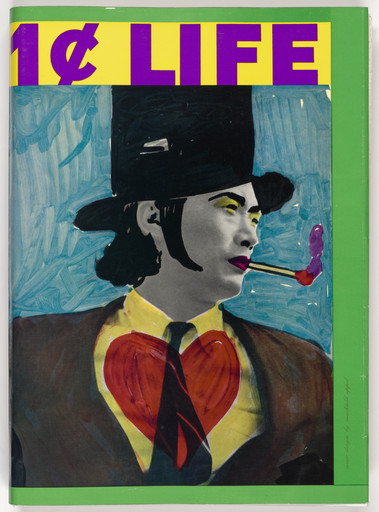
Mural
A large painting applied to a wall or ceiling, especially in a public space.
Learn more →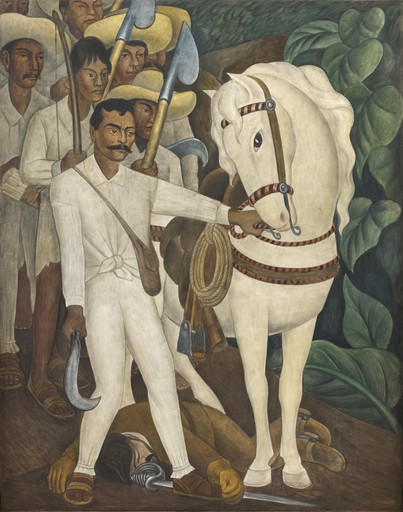
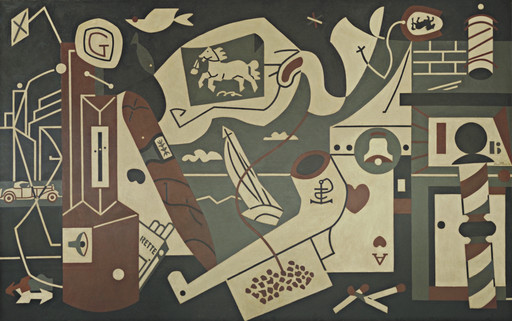
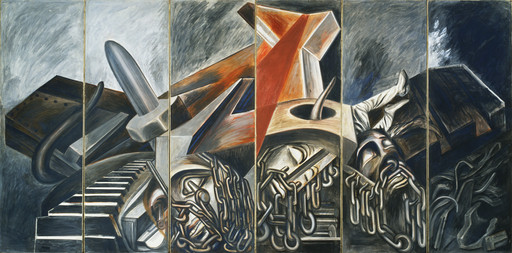
Pop art
A movement comprising initially British, then American artists in the 1950s and 1960s. Pop artists borrowed imagery from popular culture—from sources including television, comic books, and print advertising—often to challenge conventional values propagated by the mass media, from notions of femininity and domesticity to consumerism and patriotism.
Learn more →
Audio
Audio from the playlist Collection 1950s–1970s
From MoMA Design Store


Installation views
We have identified this work in the following photos from our exhibition history.
Licensing
Artwork or archival images
If you would like to reproduce an image of a work of art in MoMA's collection, or an image of a MoMA publication or archival material (including installation views, checklists, and press releases), please contact Art Resource (publication in North America) or Scala Archives (publication in all other geographic locations).
Audio and film clips
MoMA licenses archival audio and select out of copyright film clips from our film collection. At this time, MoMA produced video cannot be licensed by MoMA/Scala. All requests to license archival audio or out of copyright film clips should be addressed to Scala Archives at [email protected]. Motion picture film stills cannot be licensed by MoMA/Scala. For access to motion picture film stills for research purposes, please contact the Film Study Center at [email protected]. For more information about film loans and our Circulating Film and Video Library, please visit Circulating Film and Video Library.
Text from a publication or the archives
If you would like to reproduce text from a MoMA publication, please email [email protected]. If you would like to publish text from MoMA's archival materials, please fill out this permission form and send to [email protected].
Feedback
This record is a work in progress. If you have additional information or spotted an error, please fill out this feedback form.