Silkscreen ink and acrylic on canvas
Marilyn Monroe was a legend when she died of a drug overdose in August of 1962, but in retrospect her life seems a gradual martyrdom to the media and to her public. After her death, Andy Warhol based many works on the same photograph of her—a publicity still for the 1953 movie Niagara. He would paint the canvas with a single color—turquoise, green, blue, lemon yellow—then silkscreen Monroe's face on top, sometimes alone, sometimes doubled, sometimes multiplied in a grid. As the surround for a face, the golden field in Gold Marilyn Monroe (the only one of Warhol's Marilyns to use this color) recalls the religious icons of Christian art history—a resonance, however, that the work suffuses with a morbid allure.
In reduplicating this photograph of a heroine shared by millions, Warhol denied the sense of the uniqueness of the artist's personality that had been implicit in the gestural painting of the 1950s. He also used a commercial technique—silkscreening—that gives the picture a crisp, artificial look; even as Warhol canonizes Monroe, he reveals her public image as a carefully structured illusion. Redolent of 1950s glamour, the face in Gold Marilyn Monroe is much like the star herself—high gloss, yet transient; bold, yet vulnerable; compelling, yet elusive. Surrounded by a void, it is like the fadeout at the end of a movie.
The Museum of Modern Art, MoMA Highlights, New York: The Museum of Modern Art, revised 2004, originally published 1999, p. 241.
Explore more
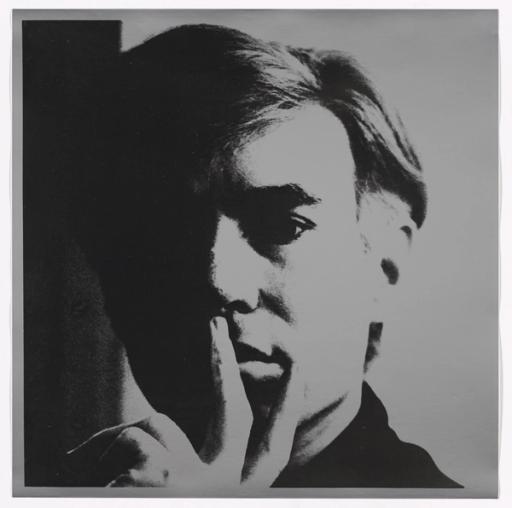
Andy Warhol
American, 1928–1987 271 works onlineTwo exhibitions in 1962 announced Andy Warhol’s dramatic entry into the art world. In July, at the Ferus Gallery in Los Angeles, he exhibited his now-iconic Campbell’s Soup Cans .
Learn more →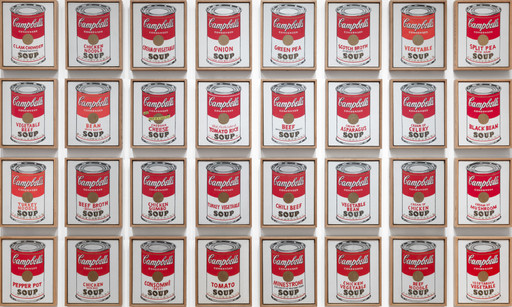
![Andy Warhol. Untitled ([Early Work] Woman)](https://www.moma.org/media/W1siZiIsIjI2ODkwOCJdLFsicCIsImNvbnZlcnQiLCItcXVhbGl0eSA5MCAtcmVzaXplIDUxMng1MTJcdTAwM2UiXV0.jpg?sha=3a19f0596d819514)
![Andy Warhol. Untitled ([Early Work] Woman)](https://www.moma.org/media/W1siZiIsIjI2ODkwOSJdLFsicCIsImNvbnZlcnQiLCItcXVhbGl0eSA5MCAtcmVzaXplIDUxMng1MTJcdTAwM2UiXV0.jpg?sha=9a7a22b249a25d4b)
Picturing History
Gallery 420Her response to this omission was to create American People Series #20: Die. For the mural-sized painting, Ringgold depicted contemporary events using a figurative visual language—at a time when the art world celebrated abstraction.
Learn more →

Audio
Audio from the playlist 1950–1980: Works from the Collection
From MoMA Design Store


Installation views
We have identified this work in the following photos from our exhibition history.
Licensing
Artwork or archival images
If you would like to reproduce an image of a work of art in MoMA's collection, or an image of a MoMA publication or archival material (including installation views, checklists, and press releases), please contact Art Resource (publication in North America) or Scala Archives (publication in all other geographic locations).
Audio and film clips
MoMA licenses archival audio and select out of copyright film clips from our film collection. At this time, MoMA produced video cannot be licensed by MoMA/Scala. All requests to license archival audio or out of copyright film clips should be addressed to Scala Archives at [email protected]. Motion picture film stills cannot be licensed by MoMA/Scala. For access to motion picture film stills for research purposes, please contact the Film Study Center at [email protected]. For more information about film loans and our Circulating Film and Video Library, please visit Circulating Film and Video Library.
Text from a publication or the archives
If you would like to reproduce text from a MoMA publication, please email [email protected]. If you would like to publish text from MoMA's archival materials, please fill out this permission form and send to [email protected].
Feedback
This record is a work in progress. If you have additional information or spotted an error, please fill out this feedback form.