In the early 1960s, Celmins began making paintings of objects in her studio: lamps, a hot plate, an eraser, even the empty six-cylinder revolver a friend had left with her for safekeeping. Her starting point for this work was a series of photographs she took of another friend posing with the revolver. Those pictures captured a moment of potential—the trigger might be pulled—but the painting instead shows the moment after a loaded gun has been fired, depicting the smoke that fills the air after a bullet has been discharged. This shift infuses the stark, deadpan image with narrative, inviting questions about the scene beyond the painting’s frame.
“This was one of the first paintings I did that has a touch of violence,” Celmins has recalled of Gun with Hand #1. She soon turned to imagery of warplanes, burning houses, and explosions, basing her next series of works on photographs she found in books and magazines. Made in the late 1960s, during the height of the Vietnam War, these works conjure Celmins’s experience of growing up in Germany and Latvia during World War II. In the decades since, Celmins has continued to represent the world around her but has shifted to natural imagery: working across mediums, she renders subjects such as night skies and oceans with a precision and exquisite sensitivity to detail that are the hallmarks of her art.
MoMA Highlights: 375 Works from The Museum of Modern Art, New York (New York: The Museum of Modern Art, 2019)
Explore more
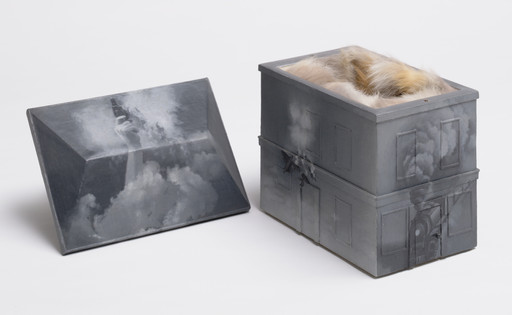
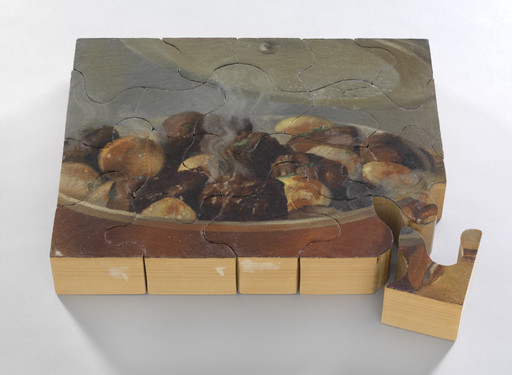
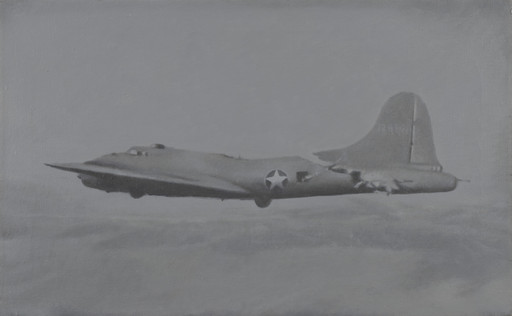
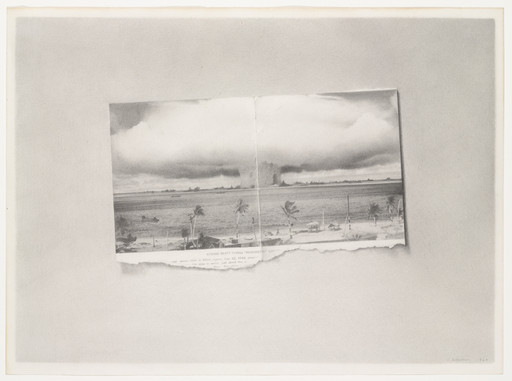

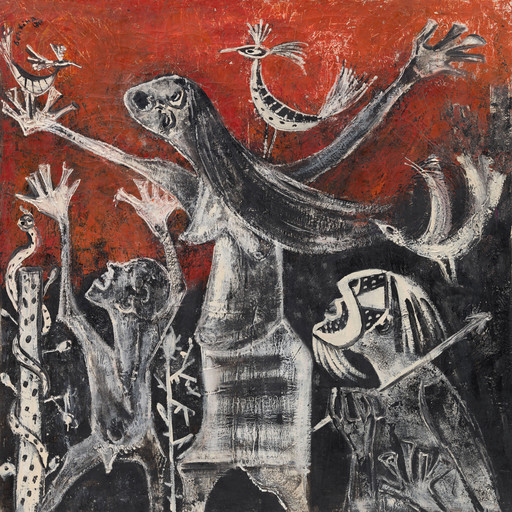
Picturing History
Gallery 420Her response to this omission was to create American People Series #20: Die. For the mural-sized painting, Ringgold depicted contemporary events using a figurative visual language—at a time when the art world celebrated abstraction.
Learn more →

Audio
Audio from the playlist 1950–1980: Works from the Collection
From MoMA Design Store


Installation views
We have identified this work in the following photos from our exhibition history.
Licensing
Artwork or archival images
If you would like to reproduce an image of a work of art in MoMA's collection, or an image of a MoMA publication or archival material (including installation views, checklists, and press releases), please contact Art Resource (publication in North America) or Scala Archives (publication in all other geographic locations).
Audio and film clips
MoMA licenses archival audio and select out of copyright film clips from our film collection. At this time, MoMA produced video cannot be licensed by MoMA/Scala. All requests to license archival audio or out of copyright film clips should be addressed to Scala Archives at [email protected]. Motion picture film stills cannot be licensed by MoMA/Scala. For access to motion picture film stills for research purposes, please contact the Film Study Center at [email protected]. For more information about film loans and our Circulating Film and Video Library, please visit Circulating Film and Video Library.
Text from a publication or the archives
If you would like to reproduce text from a MoMA publication, please email [email protected]. If you would like to publish text from MoMA's archival materials, please fill out this permission form and send to [email protected].
Feedback
This record is a work in progress. If you have additional information or spotted an error, please fill out this feedback form.