Marcel Duchamp
To Be Looked at (from the Other Side of the Glass) with One Eye, Close to, for Almost an Hour
Buenos Aires 1918
Oil, silver leaf, lead wire, and magnifying lens on glass (cracked), mounted between panes of glass in a standing metal frame, 20 1/8 x 16 1/4 x 1 1/2" (51 x 41.2 x 3.7 cm), on painted wood base, 1 7/8 x 17 7/8 x 4 1/2" (4.8 x 45.3 x 11.4 cm)
Not on view
This exploration of optics is Duchamp’s final study on glass for the Bachelor Apparatus that comprises the lower pane of The Large Glass (1915–23). If a viewer follows the title’s teasing instruction (meant “to sound like an oculist’s prescription”) and looks through the convex lens embedded in the work’s glass pane, the surrounding environment appears inverted. Duchamp created the silver pattern of radiating lines seen here based on an optician’s vision test; the motif, which he called the Oculist Witness, would later appear in The Large Glass. Like that of The Large Glass, this work’s final appearance was determined by accident, in patterns of extensive cracking caused by breakage.
Marcel Duchamp, April 12–August 22, 2026
Gallery label from 2020
The words forming this work’s title are inscribed (in French) on a strip of metal glued across the composition’s approximate center and appearing to invite viewers to look through a lens haloed by concentric circles and mounted between two panes of glass. Peering through the convex lens “for almost an hour” is supposed to have a hallucinatory effect as the view is dwarfed, flipped, and otherwise distorted. Duchamp delighted in the fact that the glass shattered while being transported, welcoming the mechanics of chance into the work.
2020
Explore more
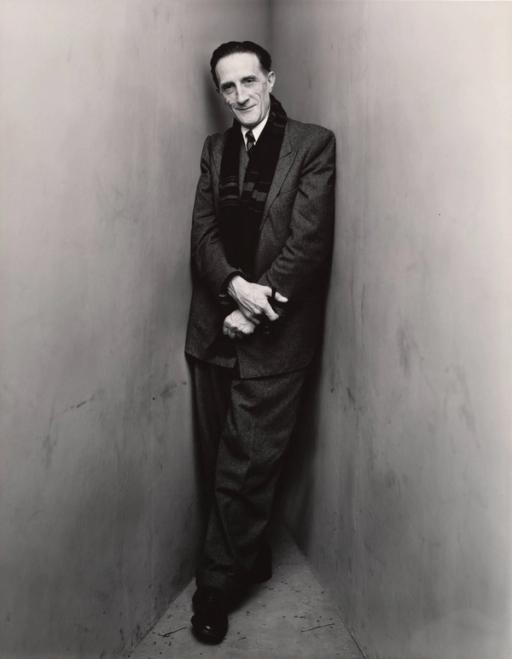
Marcel Duchamp
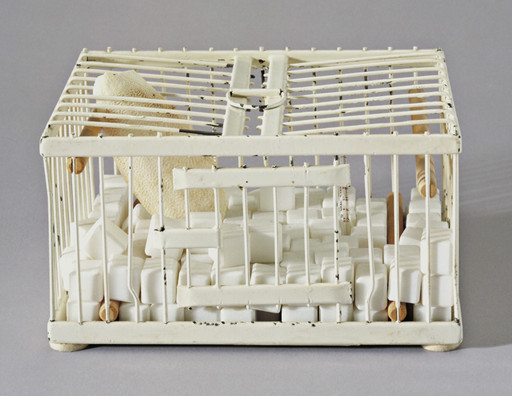
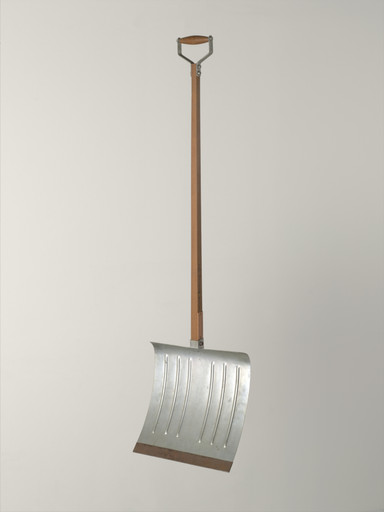
American, born France. 1887–1968 190 works onlineWhen Marcel Duchamp created his most famous work—the industrially produced urinal Fountain —it was largely ignored. Fountain was the high point of Duchamp’s campaign to dismantle and expand the boundaries of what constitutes a work of art; it had begun four years earlier, when he asked, “Can one make works that are not ‘of art’?
Learn more →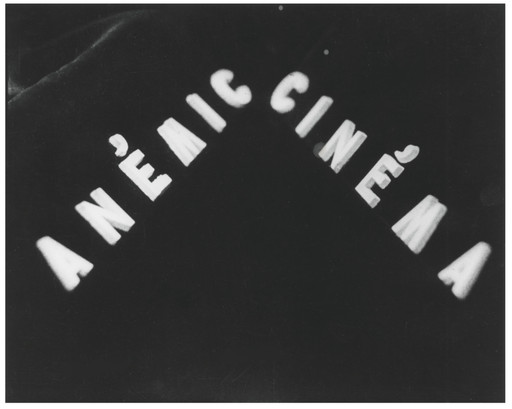
Lead
A soft, malleable, dense metallic element with many different applications and uses, especially in the marking substance in pencils or as a material for sculpture.
Learn more →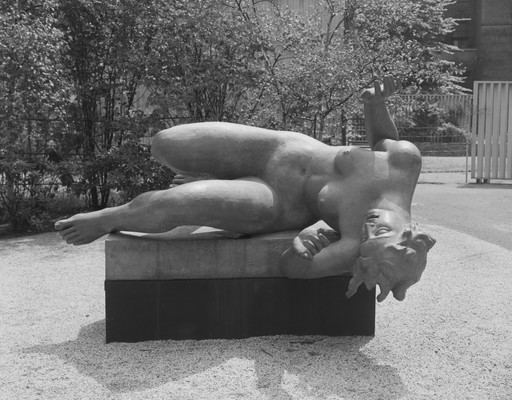


Audio
Audio from the playlist Collection 1880s–1940s
From MoMA Design Store


Installation views
We have identified this work in the following photos from our exhibition history.
Provenance Research Project
This work is included in the Provenance Research Project, which investigates the ownership history of works in MoMA's collection.
The artist
Katherine S. Dreier (d. 1952), West Redding, Connecticut. [Purchased from Duchamp], by 1936
The Museum of Modern Art, New York. Katherine S. Dreier Bequest, 1953
Provenance research is a work in progress, and is frequently updated with new information. If you have any questions or information to provide about the listed works, please email [email protected] or write to:
Provenance Research Project
The Museum of Modern Art
11 West 53 Street
New York, NY 10019
Licensing
Artwork or archival images
If you would like to reproduce an image of a work of art in MoMA's collection, or an image of a MoMA publication or archival material (including installation views, checklists, and press releases), please contact Art Resource (publication in North America) or Scala Archives (publication in all other geographic locations).
Audio and film clips
MoMA licenses archival audio and select out of copyright film clips from our film collection. At this time, MoMA produced video cannot be licensed by MoMA/Scala. All requests to license archival audio or out of copyright film clips should be addressed to Scala Archives at [email protected]. Motion picture film stills cannot be licensed by MoMA/Scala. For access to motion picture film stills for research purposes, please contact the Film Study Center at [email protected]. For more information about film loans and our Circulating Film and Video Library, please visit Circulating Film and Video Library.
Text from a publication or the archives
If you would like to reproduce text from a MoMA publication, please email [email protected]. If you would like to publish text from MoMA's archival materials, please fill out this permission form and send to [email protected].
Feedback
This record is a work in progress. If you have additional information or spotted an error, please fill out this feedback form.