Oil and plastic cap on canvas and wood, two parts
Not on view
Great blue ovals collide against stiff trapezoids, and twining yellow tendrils tie them all together: as abstract form, Dis Pair has a springy rhythmic dynamism. Yet it also applies the stylistic vocabulary of the comic strip to depicting a pair of shoes. Besides being wittily distorted and distended, these shoes are over ten feet high, using a strategy of enlargement prefigured in Claes Oldenburg’s Pop sculpture; and Pop art also anticipated Murray’s interest in the commonplaces of domestic life, which she painted on an undomestic, even heroic, scale. Murray dramatized the beautiful ordinariness of familiar objects. “I paint about the things that surround me,” she said, “things that I pick up and handle every day. That’s what art is. Art is an epiphany in a coffee cup.”
Standing out from the wall in relief, the surface of Dis Pair suggests a stretched and rounded skin—perhaps these curving forms humorously recall heads and faces, and their visual relationship that of a human couple. Its title puns on the word “despair,” playfully evoking a strained household bond.
MoMA Highlights: 375 Works from The Museum of Modern Art, New York (New York: The Museum of Modern Art, 2019)
Publication excerpt from The Museum of Modern Art, MoMA Highlights since 1980 , New York: The Museum of Modern Art, 2007, p. 69.
Great blue ovals collide against stiff trapezoids, twining yellow tendrils tie them all together: as abstract form, Dis Pair has a springy rhythmic dynamism. Yet it also applies the stylistic vocabulary of the comic strip to depicting a pair of shoes. Besides being wittily distorted and distended, these shoes are over ten feet high, using a strategy of enlargement prefigured in Claes Oldenburg's Pop sculpture; and Pop art also anticipated Murray's interest in the commonplaces of domestic life, which she paints on an undomestic, even heroic, scale. Murray dramatizes the beautiful ordinariness of familiar objects. "I paint about the things that surround me," she says, "things that I pick up and handle every day. That's what art is. Art is an epiphany in a coffee cup."
Standing out from the wall in relief, the surface of Dis Pair suggests a stretched and rounded skin—perhaps these curving forms humorously evoke heads and faces, and their visual relationship the relationship of a human couple. The title of the work certainly puns on the slang word "dis," or "dis-respect," and also, more gravely, on "despair." The household bond described here must be strained, but the tension seems more everyday than tragic: the suspense in the airborne lift of these grand swelling forms, and in their taut interaction, is subverted by their humor and their clunky domesticity.
Dis Pair. 1989-90
The Museum of Modern Art, MoMA Highlights since 1980, New York: The Museum of Modern Art, 2007, p. 69.
Explore more

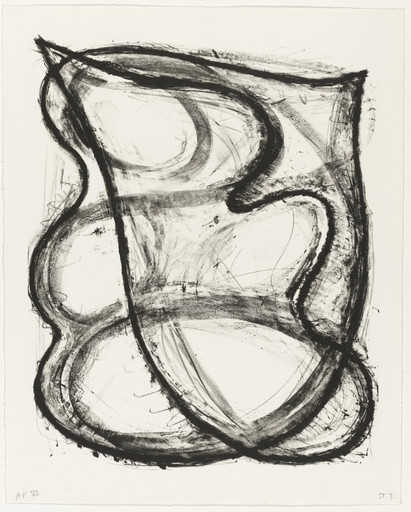
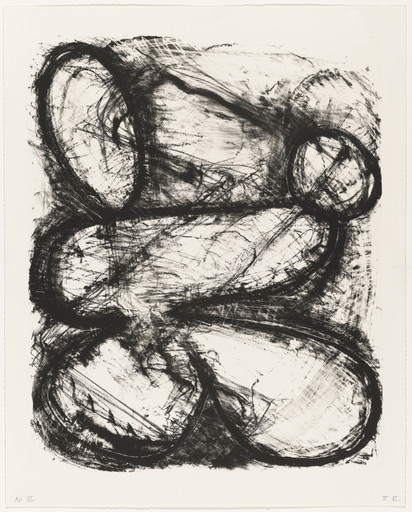
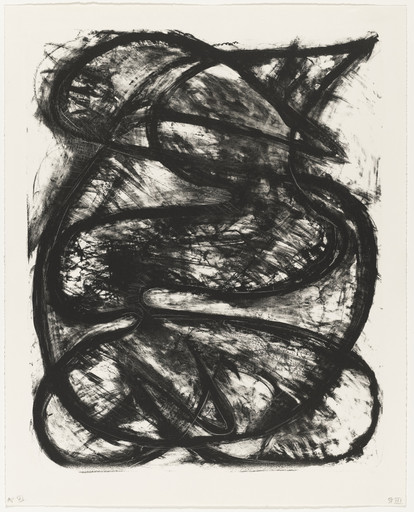
Relief
Figures or forms carved or molded so as to project from a flat surface, as in sculpture, or the apparent projection of such shapes in a painting or drawing.
Learn more →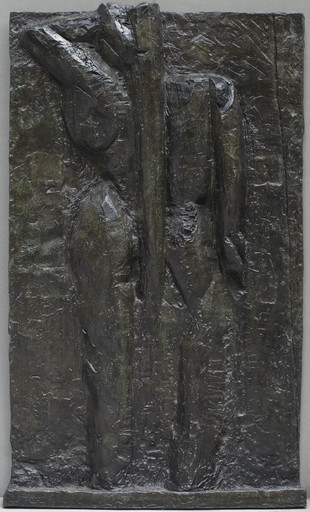

Audio
Audio from the playlist Elizabeth Murray: Painters Progress
From MoMA Design Store


Installation views
We have identified this work in the following photos from our exhibition history.
Licensing
Artwork or archival images
If you would like to reproduce an image of a work of art in MoMA's collection, or an image of a MoMA publication or archival material (including installation views, checklists, and press releases), please contact Art Resource (publication in North America) or Scala Archives (publication in all other geographic locations).
Audio and film clips
MoMA licenses archival audio and select out of copyright film clips from our film collection. At this time, MoMA produced video cannot be licensed by MoMA/Scala. All requests to license archival audio or out of copyright film clips should be addressed to Scala Archives at [email protected]. Motion picture film stills cannot be licensed by MoMA/Scala. For access to motion picture film stills for research purposes, please contact the Film Study Center at [email protected]. For more information about film loans and our Circulating Film and Video Library, please visit Circulating Film and Video Library.
Text from a publication or the archives
If you would like to reproduce text from a MoMA publication, please email [email protected]. If you would like to publish text from MoMA's archival materials, please fill out this permission form and send to [email protected].
Feedback
This record is a work in progress. If you have additional information or spotted an error, please fill out this feedback form.