Oil on canvas
“I decided to start anew,” Georgia O’Keeffe wrote to a friend in 1915, “to strip away what I had been taught—to accept as true my own thinking.” O’Keeffe’s statement reflects her transition from the naturalistic mode of representation she had been taught to abstraction in her painting. The development of this new style is evident in Abstraction Blue, completed twelve years later. The painting is dominated by undulating swirls and curves of blue tones emanating from the lower half of the canvas, bisected by a lighter crevice of paint that cuts the canvas vertically.
2020
Publication excerpt from MoMA Highlights: 375 Works from The Museum of Modern Art, New York (New York: The Museum of Modern Art, 2019)
O’Keeffe decided as a child that she was going to be an artist when she grew up. Although she was unsure of what kind of art she would make, she later recalled, “I hadn’t a desire to make anything like the pictures I had seen.” Indeed, O’Keeffe’s long career was marked by ceaseless invention for which she received near constant acclaim, starting with her earliest paintings, which debuted in 1916 at New York’s famous 291 gallery, and continuing until her death, seven decades later, in 1986. In 1946 O’Keeffe was the subject of The Museum of Modern Art’s first retrospective exhibition devoted to a woman artist.
Although O’Keeffe is best known for figurative paintings of flowers, skulls, and the desert landscape of New Mexico, where she settled in 1946, the artist focused on abstract representation during the first phase of her career, from the 1910s into the ’30s. Abstraction Blue, from this period, exemplifies the freedom O’Keeffe felt and the possibilities she explored at this time through art’s most basic building blocks: “I found that I could say things with color and shapes that I couldn’t say in any other way—things I had no words for,” she explained.
MoMA Highlights: 375 Works from The Museum of Modern Art, New York (New York: The Museum of Modern Art, 2019)
Kids label from 2025
Zoom in on these swirly lines.
Georgia O’Keeffe decided that she wanted to be an artist when she was ten years old. She liked to paint things from nature—like flowers—“big enough so that others would see what I see.”
Look closely at this painting. What shapes and colors do you see?
2025
Explore more
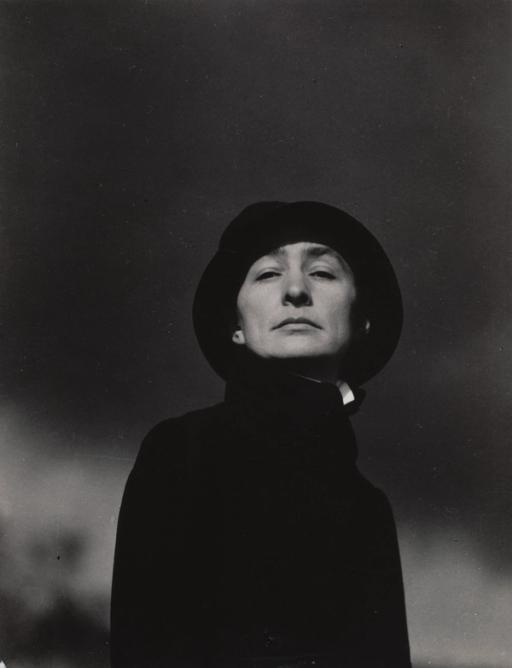
Georgia O'Keeffe
American, 1887–1986 13 works onlineIn 1959, the artist Georgia O’Keeffe boarded an airplane in the United States and proceeded to travel for several months.
Learn more →
Nature Symbolized
Gallery 509Applying the formal techniques and stylistic features of European avant-gardes to distinctively homegrown subjects resulted in a fresh approach to modernism in which the natural environment appeared as central yet was often abstracted.
Learn more →

Audio
Audio from the playlist Collection 1880s–1940s
From MoMA Design Store


Installation views
We have identified this work in the following photos from our exhibition history.
Licensing
Artwork or archival images
If you would like to reproduce an image of a work of art in MoMA's collection, or an image of a MoMA publication or archival material (including installation views, checklists, and press releases), please contact Art Resource (publication in North America) or Scala Archives (publication in all other geographic locations).
Audio and film clips
MoMA licenses archival audio and select out of copyright film clips from our film collection. At this time, MoMA produced video cannot be licensed by MoMA/Scala. All requests to license archival audio or out of copyright film clips should be addressed to Scala Archives at [email protected]. Motion picture film stills cannot be licensed by MoMA/Scala. For access to motion picture film stills for research purposes, please contact the Film Study Center at [email protected]. For more information about film loans and our Circulating Film and Video Library, please visit Circulating Film and Video Library.
Text from a publication or the archives
If you would like to reproduce text from a MoMA publication, please email [email protected]. If you would like to publish text from MoMA's archival materials, please fill out this permission form and send to [email protected].
Feedback
This record is a work in progress. If you have additional information or spotted an error, please fill out this feedback form.