Not on view
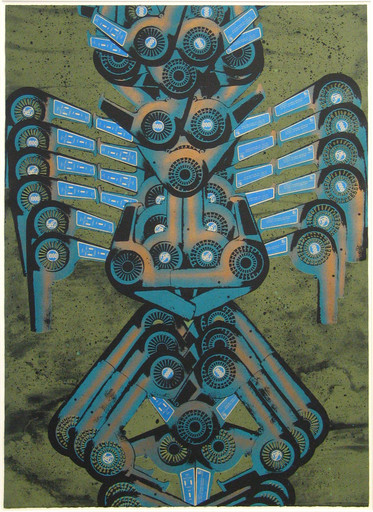
Willie Cole constructs his assemblage sculptures from found everyday objects and imbues them with spiritual power through allusion and metaphor. With an ironic and frequently humorous edge, he consistently fuses elements drawn from his African-American heritage with those of contemporary consumer culture. In the mid-1980s he became preoccupied with the steam iron as a domestic, symbolic, and artistic object and began assembling irons into iconic figural forms reminiscent of tribal art. The idea for the scorch came out of his search for ways to infuse his art with the potency of its African sources.
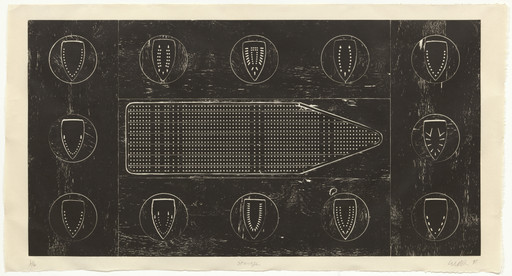
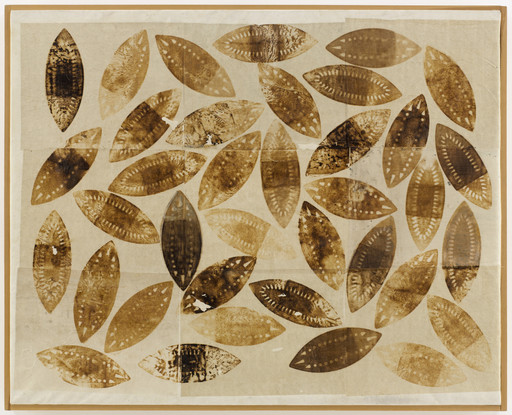
Cole is a sporadic printmaker who has completed editions in lithography, woodcut, and digital techniques. His most common printmaking practice, scorching, reflects a sculptor's uniquely physical perspective. In a transfer branding process that constitutes the essence of printmaking, he imprints hot irons in minimal rows, decorative patterns, and figurative shapes on surfaces ranging from canvas and paper to mattress padding and plaster. The scorched "faces" of the irons take on masklike appearances while concurrently suggesting the African ritual of scarification and endowing many of these images with an almost mythic presence. The iron also alludes to Cole's own background, growing up in Newark, New Jersey, with a mother and a grandmother who worked as housekeepers and regularly asked him to repair their broken irons.
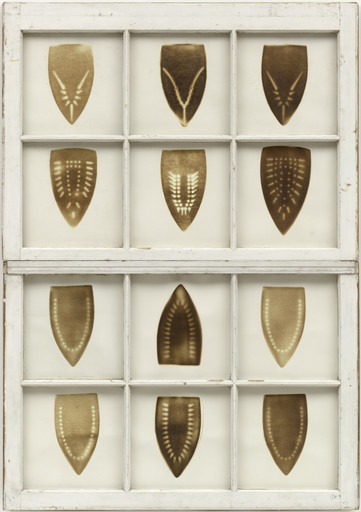
In the early 1990s, Cole began incorporating a variety of irons in one work to allude to distinct tribal associations. In Domestic I.D. IV, he labels each scorch with a commercial brand name to encourage this interpretation, ironically suggesting the tribes of Silex, General Electric, or Sunbeam. The window frame reinforces the domestic references, and the buckling paper calls attention to the searing heat and violence in the work's creation, adding an overall ominous and poignant overtone.
an essay by Wendy Weitman, in Deborah Wye, Artists and Prints: Masterworks from The Museum of Modern Art, New York: The Museum of Modern Art, 2004, p. 235.
Gallery label from 2023
With an often humorous edge, Cole’s assemblage sculptures combine elements drawn from African American history with contemporary consumer culture. In the mid-1980s the artist began to use the steam iron as a printmaking device, stamping decorative patterns onto surfaces ranging from canvas and paper to mattress padding and plaster. In early 1990s works like Domestic ID IV, Cole incorporated a variety of irons that, in their identifying branding, evoke distinct tribal associations. He then labeled each scorch with a commercial brand name to encourage this interpretation, ironically suggesting the “tribes” of Silex, General Electric, or Sunbeam.
2023
Explore more

Audio
Audio from the playlist Studio Visit: Selected Gifts from Agnes Gund
Audio from the playlist 1980–Today: Works from the Collection
From MoMA Design Store


Installation views
We have identified this work in the following photos from our exhibition history.
Licensing
Artwork or archival images
If you would like to reproduce an image of a work of art in MoMA's collection, or an image of a MoMA publication or archival material (including installation views, checklists, and press releases), please contact Art Resource (publication in North America) or Scala Archives (publication in all other geographic locations).
Audio and film clips
MoMA licenses archival audio and select out of copyright film clips from our film collection. At this time, MoMA produced video cannot be licensed by MoMA/Scala. All requests to license archival audio or out of copyright film clips should be addressed to Scala Archives at [email protected]. Motion picture film stills cannot be licensed by MoMA/Scala. For access to motion picture film stills for research purposes, please contact the Film Study Center at [email protected]. For more information about film loans and our Circulating Film and Video Library, please visit Circulating Film and Video Library.
Text from a publication or the archives
If you would like to reproduce text from a MoMA publication, please email [email protected]. If you would like to publish text from MoMA's archival materials, please fill out this permission form and send to [email protected].
Feedback
This record is a work in progress. If you have additional information or spotted an error, please fill out this feedback form.