The paintings of Elizabeth Murray embrace both abstraction and Neo-Expressionism, and her cartoonish forms often depict objects from her everyday life, both professional (paintbrush and easel) and domestic (cups and chairs). Murray dabbled in printmaking at every step in her early career, from drawing on lithographic stones as a student, to a graduate assistantship, to her first teaching job, which involved establishing a printmaking studio. Although she enjoyed the creative aspects of printmaking, she was frustrated and discouraged by the technical expertise required. She feared that the delicacy of the printing process did not fit with her own creative style: large, boisterous, colorful paintings that seemed ready to jump off the walls, executed on shaped, sometimes three-dimensional, canvases. Thus it took several years and much cajoling to convince her to resume printmaking.
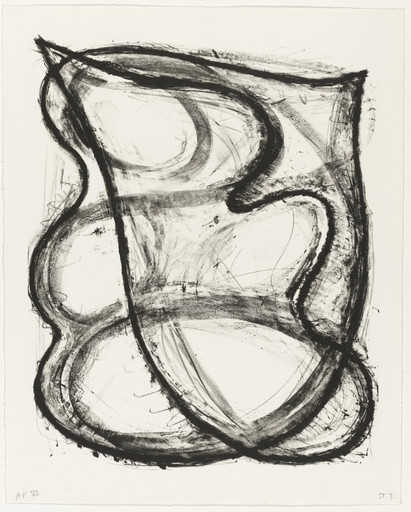
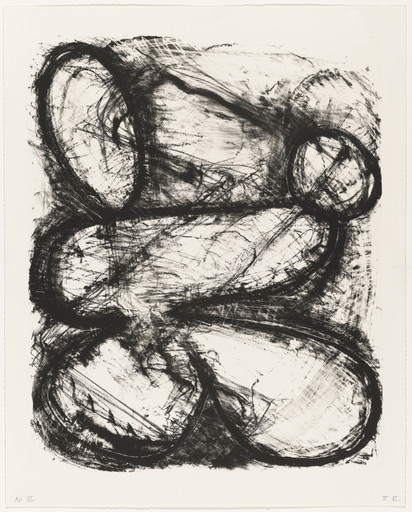
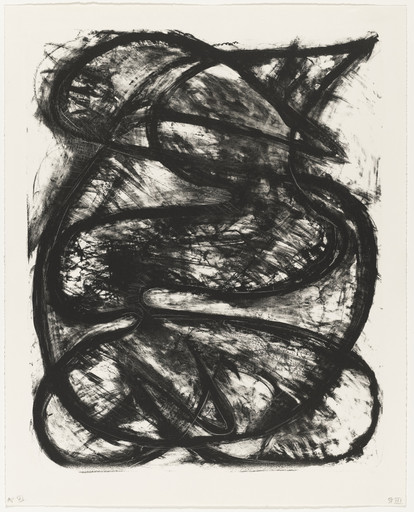
In 1979 Murray finally accepted an offer from art dealers Brooke Alexander and Paula Cooper to make prints, and she has now made more than one hundred forty editions in a variety of mediums. Initially inspired by seeing an installation of the various states of Picasso's lithographic series The Bull, Murray began an exploration of her own working process in her first prints. She issued a series of five states of a single lithograph intended to be viewed together as one work. Later, collaborating with master printers at Universal Limited Art Editions and Gemini G.E.L., who rose to the technical challenges she presented to them, Murray expanded her printmaking practice to include complex experiments incorporating the shaped forms and three-dimensionality of her paintings. Cracking Cup is one of several such prints that defy the traditional boundaries of printmaking with cut and folded elements that assert themselves into the space of the viewer.
an essay by Sarah Suzuki, in Deborah Wye, Artists and Prints: Masterworks from The Museum of Modern Art, New York: The Museum of Modern Art, 2004, p. 231.
Explore more

From MoMA Design Store


Installation views
We have identified this work in the following photos from our exhibition history.
Licensing
Artwork or archival images
If you would like to reproduce an image of a work of art in MoMA's collection, or an image of a MoMA publication or archival material (including installation views, checklists, and press releases), please contact Art Resource (publication in North America) or Scala Archives (publication in all other geographic locations).
Audio and film clips
MoMA licenses archival audio and select out of copyright film clips from our film collection. At this time, MoMA produced video cannot be licensed by MoMA/Scala. All requests to license archival audio or out of copyright film clips should be addressed to Scala Archives at [email protected]. Motion picture film stills cannot be licensed by MoMA/Scala. For access to motion picture film stills for research purposes, please contact the Film Study Center at [email protected]. For more information about film loans and our Circulating Film and Video Library, please visit Circulating Film and Video Library.
Text from a publication or the archives
If you would like to reproduce text from a MoMA publication, please email [email protected]. If you would like to publish text from MoMA's archival materials, please fill out this permission form and send to [email protected].
Feedback
This record is a work in progress. If you have additional information or spotted an error, please fill out this feedback form.