Chromogenic print
Not on view
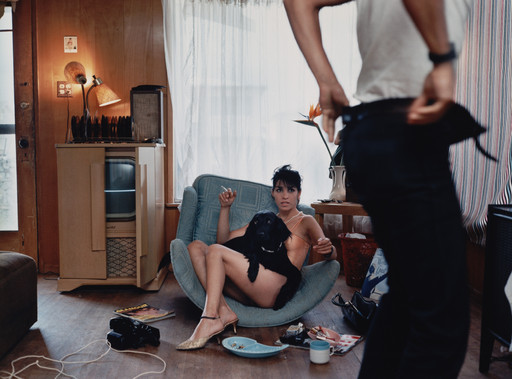
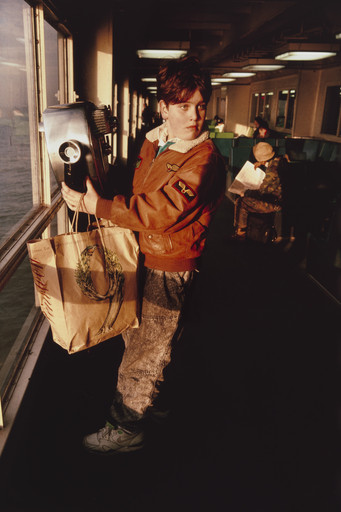
It is no accident that this picture has the slick feel of a Hollywood production or a magazine ad. DiCorcia casts, poses, lights, and frames his photographs with the same attention to detail that is lavished on a scene in a movie. The key difference is that his still dramas have no beginnings or endings, only middles, for which we are invited to write the scripts.
In diCorcia's earlier work the protagonists were mainly friends, deployed in familiar domestic settings; this picture belongs to a later series made in a Hollywood neighborhood frequented by male prostitutes, drug addicts, and drifters, whom the photographer hired to pose. The photographer asked each man for his name, age, and place of birth, and titled the picture with the answer, followed by the amount he paid the subject to pose.
The high artifice of diCorcia's photographs keeps us from reading the series as a straightforward record of a Hollywood street culture. In this sense, his work is representative of a widespread contemporary sensibility that has become weary or suspicious of the earnest realism of documentary photography. Nevertheless, the series gives us a picture of a world as persuasive as any we know from a traditional documentary project—and as moving.
The Museum of Modern Art, MoMA Highlights, New York: The Museum of Modern Art, revised 2004, originally published 1999.
Explore more
Philip-Lorca diCorcia
American, born 1951 50 works onlinePhilip-Lorca diCorcia’s photographs straddle truth and fiction by combining real people and places—but not necessarily people and places that naturally go together.
Learn more →
From MoMA Design Store


Installation views
We have identified this work in the following photos from our exhibition history.
Licensing
Artwork or archival images
If you would like to reproduce an image of a work of art in MoMA's collection, or an image of a MoMA publication or archival material (including installation views, checklists, and press releases), please contact Art Resource (publication in North America) or Scala Archives (publication in all other geographic locations).
Audio and film clips
MoMA licenses archival audio and select out of copyright film clips from our film collection. At this time, MoMA produced video cannot be licensed by MoMA/Scala. All requests to license archival audio or out of copyright film clips should be addressed to Scala Archives at [email protected]. Motion picture film stills cannot be licensed by MoMA/Scala. For access to motion picture film stills for research purposes, please contact the Film Study Center at [email protected]. For more information about film loans and our Circulating Film and Video Library, please visit Circulating Film and Video Library.
Text from a publication or the archives
If you would like to reproduce text from a MoMA publication, please email [email protected]. If you would like to publish text from MoMA's archival materials, please fill out this permission form and send to [email protected].
Feedback
This record is a work in progress. If you have additional information or spotted an error, please fill out this feedback form.