Although Trockel is known for utilizing a diverse range of sometimes unorthodox media, drawing is the format she consistently uses to explore her key themes of personal identity and public symbolism. This untitled work, like most of her graphic artworks, is figurative, a classic portrait head shown in profile—although her treatment of the subject is anything but classical. In contrast to Trockel's sculptures, which are designed by her but executed by machine, this work seems to bear out the historical assumption that drawing is the most direct form of expression for an artist. As in a child's finger painting, the exaggerated form reveals every mark, and the artist’s interaction with ink and paper becomes as much the subject of the work as its anonymous model.
Trockel's artwork often deals with the effects of societal norms on women and the idea of "women’s work," but it is hard not to see this figure, with its long, pointy nose, as male. This leads to a variety of questions: Is he the innocent storybook character Pinocchio, whose nose grows longer the more he lies? Or is he more sinister, offering something grotesque and vaguely sexual? The artist gives no hints, but her emphasis on her own creative process makes clear who, ultimately, is in control.
The Museum of Modern Art, MoMA Highlights since 1980, New York: The Museum of Modern Art, 2007, p. 129.
Explore more
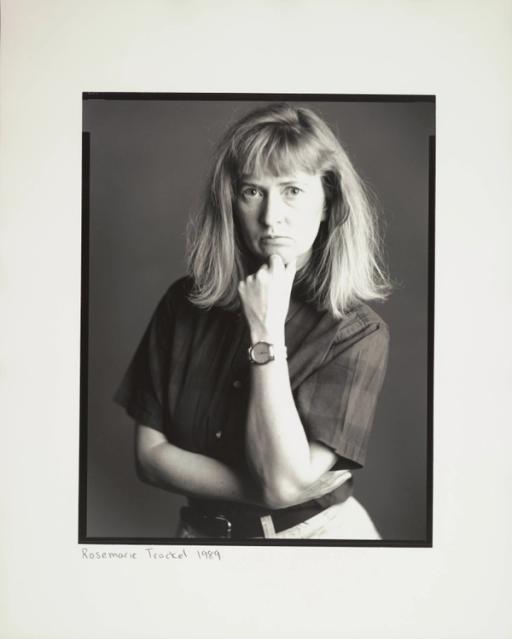
Rosemarie Trockel
German, born 1952 105 works onlineGerman artist Rosemarie Trockel resists easy categorization. Throughout her more than four-decade career, she has worked in a variety of mediums, including sculpture , photography , ceramics , drawings , and the large-scale knitted pictures that brought her fame in the male-dominated art world of the 1980s.
Learn more →


From MoMA Design Store


Installation views
We have identified this work in the following photos from our exhibition history.
Licensing
Artwork or archival images
If you would like to reproduce an image of a work of art in MoMA's collection, or an image of a MoMA publication or archival material (including installation views, checklists, and press releases), please contact Art Resource (publication in North America) or Scala Archives (publication in all other geographic locations).
Audio and film clips
MoMA licenses archival audio and select out of copyright film clips from our film collection. At this time, MoMA produced video cannot be licensed by MoMA/Scala. All requests to license archival audio or out of copyright film clips should be addressed to Scala Archives at [email protected]. Motion picture film stills cannot be licensed by MoMA/Scala. For access to motion picture film stills for research purposes, please contact the Film Study Center at [email protected]. For more information about film loans and our Circulating Film and Video Library, please visit Circulating Film and Video Library.
Text from a publication or the archives
If you would like to reproduce text from a MoMA publication, please email [email protected]. If you would like to publish text from MoMA's archival materials, please fill out this permission form and send to [email protected].
Feedback
This record is a work in progress. If you have additional information or spotted an error, please fill out this feedback form.