Gouache, pencil, oil, and ink on cut-and-pasted printed paper on board
Not on view
Ernst’s appreciation for visual and linguistic puns was likely fostered by Sigmund Freud’s book Jokes and Their Relation to the Unconscious (1905). Here, Ernst overpainted a page from a millinery catalogue showing women’s hats printed in an orderly grid. He added more cut-and-pasted hats to form the phallic tower at the left. This visual pun relates to Freud’s identification of the hat—the requisite accessory of the bourgeois man—as a common symbol representing repressed desire, adding new meaning and gender ambiguity to the cliché inscribed on the work, “C’est le chapeau qui fait l’homme” (The hat makes the man).
Max Ernst: Beyond Painting, September 23, 2017-January 1, 2018.
Gallery label from Dada , June 18–September 11, 2006.
Ernst's appreciation for visual and linguistic puns was likely fostered by Freud’s book Jokes and Their Relation to the Unconscious. Here, Ernst cut, pasted, and stacked photographs of men’s hats clipped from a sales catalogue to make phallic towers. This visual pun relates to Freud's identification of the hat—the requisite accessory of the bourgeois man—as a common symbol representing repressed desire, adding new meaning to the cliché inscribed on the work, "C'est le chapeau qui fait l'homme" ("The hat makes the man").
Dada, June 18–September 11, 2006.
Publication excerpt from MoMA Highlights: 375 Works from The Museum of Modern Art, New York (New York: The Museum of Modern Art, 2019)
Of his encounters with images from magazines and brochures, Ernst once wrote, “I discovered the elements of a figuration so remote that its very absurdity provoked in me a sudden intensification of my faculties of sight.” He began to incorporate printed matter into his work, making adjustments and modifications to create hallucinatory, often erotic visions; in Ernst’s words, “these changes . . . transformed the banal pages of advertisement into dramas that revealed my most secret desires.” Here he painted over a page from a millinery catalogue featuring women’s hats in an orderly grid, adding other cutout hats to create organic, plantlike forms and anthropomorphic phalluses.
Ernst was a major figure in the Dada group, an informal movement that embraced irrationality and critiqued cultural conformity as a reaction against the bourgeois capitalism and nationalism that, Dadaists felt, had led to World War I. Ernst slyly commented on gender norms in this work, which includes a nonsense inscription in German and French that reads, “seed-covered stacked-up man seedless waterformer (‘edelformer’) well-fitting nervous system also tightly fitted nerves! (the hat makes the man) (style is the tailor).” The artist often made use of both linguistic and visual puns. In juxtaposing the clichéd expression “the hat makes the man” with phallic towers of women’s hats, Ernst was likely riffing on Sigmund Freud’s identification of the hat—the requisite accessory of the bourgeois man—as a symbol of repressed desire.
MoMA Highlights: 375 Works from The Museum of Modern Art, New York (New York: The Museum of Modern Art, 2019)
Publication excerpt from John Elderfield, The Modern Drawing: 100 Works on Paper from The Museum of Modern Art , New York: The Museum of Modern Art, 1983, p. 130.
"One rainy day in 1919," Ernst wrote, "my excited gaze was provoked by the pages of a printed catalogue. The advertisements illustrated objects relating to anthropological, microscopical, psychological, mineralogical, and paleontological research. Here I discovered the elements of a figuration so remote that its very absurdity provoked in me a sudden intensification of my faculties of sight..." All that was necessary, he realized, was subtly to modify and rearrange these images. "These changes, no more than docile reproductions of what was visible within me, recorded a faithful and fixed image of my hallucination. They transformed the banal pages of advertisement into dramas that revealed my most secret desires."
Like Man Ray's use of machine images as a way of musing on the loss of instinctive sexuality, or [George] Grosz's giving his friend a machine heart, Ernst's use of mechanical illustrations to tell of autobiographical fantasies and hallucinations reveals that characteristic Dada duality in which modern and instinctive worlds collide. Inscribed on this image of anthropomorphic eroticism is the legend: "Seed-covered stacked-up man, seedless waterformer, ('edelformer'), well-fitting nervous system also tightly fitted nerves! (The hat makes the man, style is the tailor.)"...Ernst, that most iconographically inventive—and literary—of the Dadaists, erects from the subject of hats a phallic fantastic construction in combined human and plant-life form. He had been a student of psychology before the First World War, and had indeed read [Sigmund] Freud. But if we see in his work the obsessive self-regard of a Freudian age, we also, I think, see that when he inspected his fantasies, he found them drolly humorous. At least, that is the impression provided by this massive set of perambulating phalli, satirically sexual mutations of [Giorgio] de Chirico's cold mannequins, transparently blundering about their little stage.
John Elderfield, The Modern Drawing: 100 Works on Paper from The Museum of Modern Art, New York: The Museum of Modern Art, 1983, p. 130.
Explore more
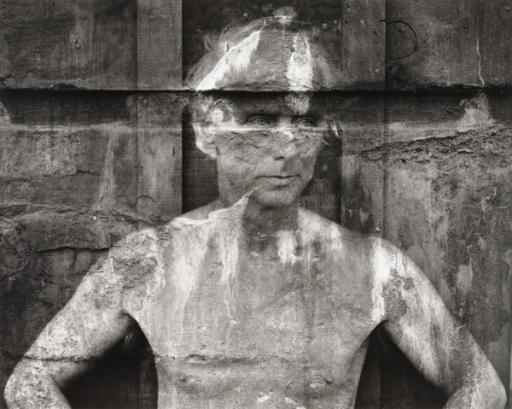
Max Ernst
French and American, born Germany. 1891–1976 234 works onlineA key member of first Dada and then Surrealism in Europe in the 1910s and 1920s, Max Ernst used a variety of mediums—painting, collage, printmaking, sculpture, and various unconventional drawing methods—to give visual form to both personal memory and collective myth.
Learn more →


From MoMA Design Store


Installation views
We have identified this work in the following photos from our exhibition history.
Provenance Research Project
This work is included in the Provenance Research Project, which investigates the ownership history of works in MoMA's collection.
Paul Eluard, Paris. Acquired from the artist
The Museum of Modern Art, New York. Purchased from Paul Eluard, 1935
Provenance research is a work in progress, and is frequently updated with new information. If you have any questions or information to provide about the listed works, please email [email protected] or write to:
Provenance Research Project
The Museum of Modern Art
11 West 53 Street
New York, NY 10019
Licensing
Artwork or archival images
If you would like to reproduce an image of a work of art in MoMA's collection, or an image of a MoMA publication or archival material (including installation views, checklists, and press releases), please contact Art Resource (publication in North America) or Scala Archives (publication in all other geographic locations).
Audio and film clips
MoMA licenses archival audio and select out of copyright film clips from our film collection. At this time, MoMA produced video cannot be licensed by MoMA/Scala. All requests to license archival audio or out of copyright film clips should be addressed to Scala Archives at [email protected]. Motion picture film stills cannot be licensed by MoMA/Scala. For access to motion picture film stills for research purposes, please contact the Film Study Center at [email protected]. For more information about film loans and our Circulating Film and Video Library, please visit Circulating Film and Video Library.
Text from a publication or the archives
If you would like to reproduce text from a MoMA publication, please email [email protected]. If you would like to publish text from MoMA's archival materials, please fill out this permission form and send to [email protected].
Feedback
This record is a work in progress. If you have additional information or spotted an error, please fill out this feedback form.