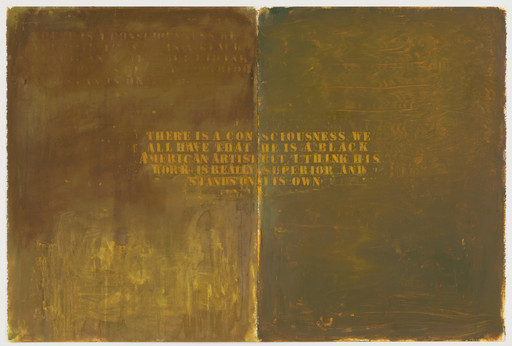
Ligon’s work is often simple in means and almost minimal in expression, but this restraint masks a sweeping ambition to engage and reflect the American experience, which is bookended by the promises of freedom and the legacies of slavery. For Ligon these conditions give rise to existential questions that result in a fundamental sense of not belonging. “Lack of location is my location,” he has declared. “I’m always shifting positions and changing my mind.”
Here Ligon has extracted a passage from the prologue to the 1952 novel Invisible Man, by the American writer Ralph Ellison, the story of a young African American growing up in the South in the mid-twentieth century. It begins, “I am an invisible man. No, I am not a spook like those who haunted Edgar Allan Poe; nor am I one of your Hollywood-movie ectoplasms. I am a man of substance, of flesh and bone, fiber and liquids—and I might even be said to possess a mind. I am invisible, understand, simply because people refuse to see me.” Ligon has filled the entire composition with this text, smearing the black oilstick to render it increasingly illegible. Importantly, at the bottom of the drawing he has left the word “not” clearly visible, reversing the words of the title and reiterating his (and Ellison’s) claim for visibility and respect.
MoMA Highlights: 375 Works from The Museum of Modern Art, New York (New York: The Museum of Modern Art, 2019)
Gallery label from 2022
Here, Ligon extracts a passage from Ralph Ellison’s 1952 novel Invisible Man, a contemporaneous story of a young African American growing up in the South. “I am an invisible man,” it begins. “I am a man of substance, of flesh and bone . . . and I might even be said to possess a mind. I am invisible, understand, simply because people refuse to see me.” Ligon smeared black oilstick on the text to render it increasingly unreadable. At the bottom he left the word “not” clearly visible, responding to the words of the title and thus insisting on visibility and respect.
2022
Explore more
![Glenn Ligon. Untitled (Well, I am one who doesn't believe in deluding myself. [Malcolm X])](https://www.moma.org/media/W1siZiIsIjEyODYxMyJdLFsicCIsImNvbnZlcnQiLCItcXVhbGl0eSA5MCAtcmVzaXplIDUxMng1MTJcdTAwM2UiXV0.jpg?sha=709472c0568ca282)




From MoMA Design Store


Installation views
We have identified this work in the following photos from our exhibition history.
Licensing
Artwork or archival images
If you would like to reproduce an image of a work of art in MoMA's collection, or an image of a MoMA publication or archival material (including installation views, checklists, and press releases), please contact Art Resource (publication in North America) or Scala Archives (publication in all other geographic locations).
Audio and film clips
MoMA licenses archival audio and select out of copyright film clips from our film collection. At this time, MoMA produced video cannot be licensed by MoMA/Scala. All requests to license archival audio or out of copyright film clips should be addressed to Scala Archives at [email protected]. Motion picture film stills cannot be licensed by MoMA/Scala. For access to motion picture film stills for research purposes, please contact the Film Study Center at [email protected]. For more information about film loans and our Circulating Film and Video Library, please visit Circulating Film and Video Library.
Text from a publication or the archives
If you would like to reproduce text from a MoMA publication, please email [email protected]. If you would like to publish text from MoMA's archival materials, please fill out this permission form and send to [email protected].
Feedback
This record is a work in progress. If you have additional information or spotted an error, please fill out this feedback form.