Cut-and-pasted colored and printed paper, cloth, wood, metal, cork, oil, pencil, and ink on board
Not on view
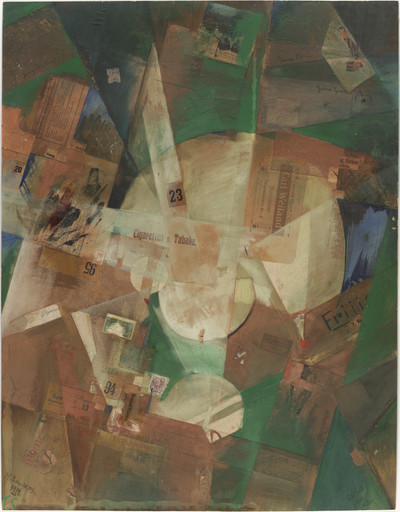
Kurt Schwitters made this work from scraps and objects he collected from the streets of his hometown of Hanover, Germany. Although he scavenged the fragments, Schwitters carefully composed and affixed them with glue and nails to a painted board to make this collage. Merz Picture 32A. The Cherry Picture has many layers: light and dark paint on the board form the base of the collage and give an illusion of depth; affixed to the board are various fabrics, an image of kittens, candy wrappers, newspaper clippings, and a flashcard of cherries, onto which Schwitters penciled “Ich liebe dir!” (“I love you!” in ungrammatical German). Three-dimensional objects, including a broken pipe, protrude from the surface.
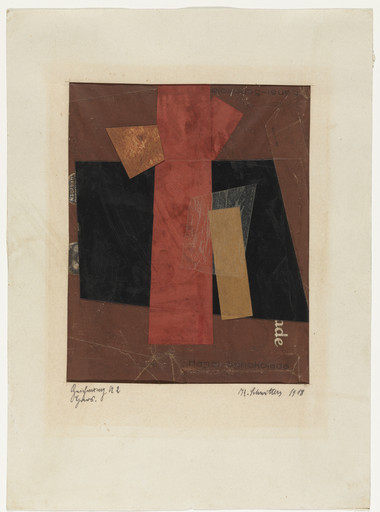
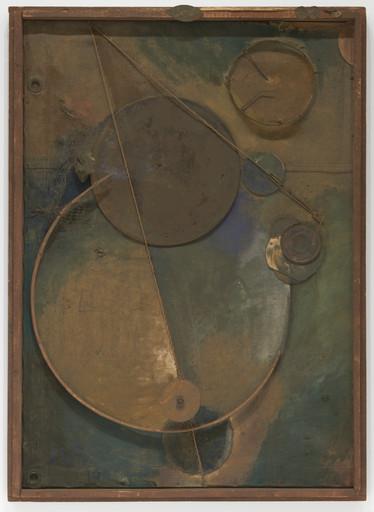
Merz Picture 32A belongs to the so-called Merz series, a term Schwitters made up by cutting a scrap from the second syllable of the German word “Kommerz” (commerce), which he included in one of his early collage paintings. Schwitters was trained as a painter, but as World War I came to an end he adopted collage as his preferred process, saying, “Everything had broken down in any case and new things had to be made out of the fragments.” With his Merz project he aimed “to create connections, preferably between everything in this world.”
Publication excerpt from MoMA Highlights: 375 Works from The Museum of Modern Art, New York (New York: The Museum of Modern Art, 2019)
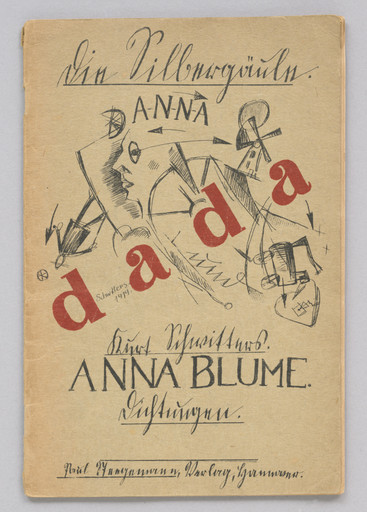
At the center of this large-scale assemblage sits a vocabulary card printed with a cluster of orange cherries and the German and French words for the fruit. Above, scrawled in pencil, floats the phrase Ich liebe Dir!: faulty German for “I love you” (Ich liebe dich). The words invoke Schwitters’s 1919 poem “To Anna Blume,” which first established his fame.
Schwitters constructed this assemblage from scraps of modern life collected on the streets of Hannover: commercial labels, newspaper clippings, printed and handwritten text, bits of fabric and wood, and two corks, among other items. In arranging the topmost layer along a perpendicular grid, however, Schwitters imposed a sense of order on the material cacophony. The objects were pasted and hammered onto what appears to be an earlier oil painting, its moody greens and blues still partly visible. The reworking testifies to a conceptual shift: from the work of art as picture to the work of art as surface for the accumulation of matter. This move, from an optical model of art-making to a tactile one, was revolutionary.
The term Merz was Schwitters’s invention. Partly derived from the German word Kommerz (commerce), it designated his collage process. In his Hannover home, which he called the Merzbau (Merz-building), the idea became architectural: it is an abstract, walk-in collage environment, a repository for memory and matter.
MoMA Highlights: 375 Works from The Museum of Modern Art, New York (New York: The Museum of Modern Art, 2019)
Explore more

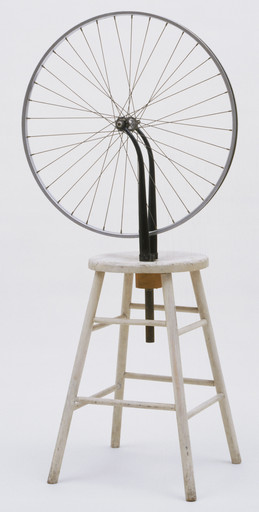
Found object
An object—often utilitarian, manufactured, or naturally occurring—that was not originally designed for an artistic purpose, but has been repurposed in an artistic context.
Learn more →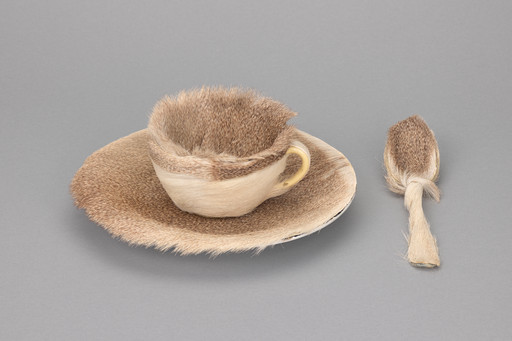
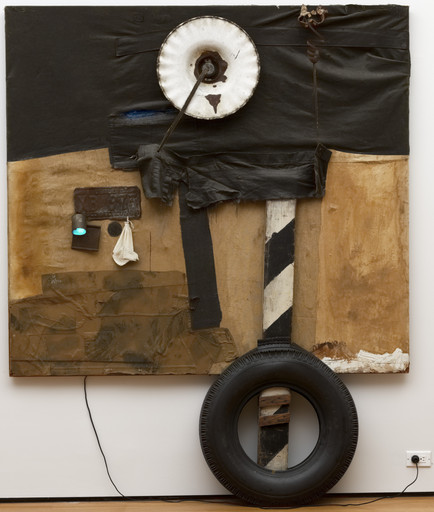
Merz
A term invented by Dadaist Kurt Schwitters to describe collage and assemblage works he made from scavenged scrap materials. He took the word Merz from the name Commerz Bank, which appeared on a piece of paper he cut up and included in one of his collages.
Learn more →


From MoMA Design Store


Installation views
We have identified this work in the following photos from our exhibition history.
Provenance Research Project
This work is included in the Provenance Research Project, which investigates the ownership history of works in MoMA's collection.
Hjalmar Gabrielson, Göteborg, Sweden. Purchased from Schwitters, by 1922 [1923]
Brita (Gretzer) Holmquist, New York. Inherited from her grandfather, Hjalmar Gabrielson
The Museum of Modern Art, New York. Purchased from Mrs. Brita Holmquist, 1954
Provenance research is a work in progress, and is frequently updated with new information. If you have any questions or information to provide about the listed works, please email [email protected] or write to:
Provenance Research Project
The Museum of Modern Art
11 West 53 Street
New York, NY 10019
Licensing
Artwork or archival images
If you would like to reproduce an image of a work of art in MoMA's collection, or an image of a MoMA publication or archival material (including installation views, checklists, and press releases), please contact Art Resource (publication in North America) or Scala Archives (publication in all other geographic locations).
Audio and film clips
MoMA licenses archival audio and select out of copyright film clips from our film collection. At this time, MoMA produced video cannot be licensed by MoMA/Scala. All requests to license archival audio or out of copyright film clips should be addressed to Scala Archives at [email protected]. Motion picture film stills cannot be licensed by MoMA/Scala. For access to motion picture film stills for research purposes, please contact the Film Study Center at [email protected]. For more information about film loans and our Circulating Film and Video Library, please visit Circulating Film and Video Library.
Text from a publication or the archives
If you would like to reproduce text from a MoMA publication, please email [email protected]. If you would like to publish text from MoMA's archival materials, please fill out this permission form and send to [email protected].
Feedback
This record is a work in progress. If you have additional information or spotted an error, please fill out this feedback form.