Among The Museum of Modern Art's holdings is a rich collection of contemporary Japanese textiles. Sublime and surprising, solidly anchored in material culture and at the same time representative of the latest technological innovations, these textiles are revolutionary in the way that they alter the habitual relationship between the shape of the body and the light and air around it.
The collection includes the production of several notable designers, from Junichi Arai and Hideko Takahashi to Osamu Mita. None, however, is featured as often as Sudo, a disciple of Arai and a virtuoso in her own right. In 1984, Arai and Sudo cofounded Nuno Corporation, in Tokyo, and Arai introduced his new partner to the use of scanners and computers, providing her with a fresh palette of artistic possibilities. The Origami Pleat Scarf, which Sudo designed in collaboration with Mizue Okada, is just one example of the company's unique production.
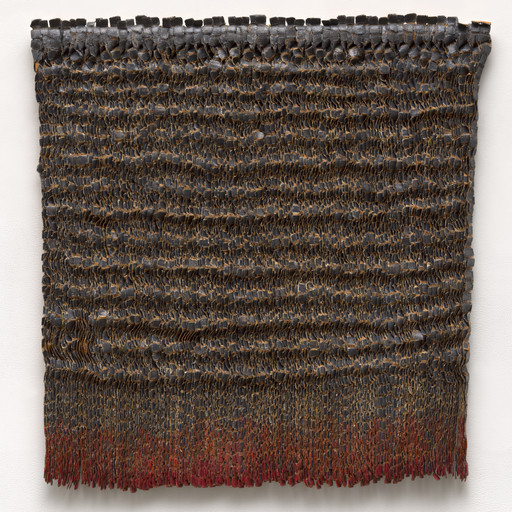
Emulating the Japanese art of folding paper, this delicate-looking scarf is creased repeatedly at sharp angles and then permanently pressed in a special heat-transfer pleating procedure. Its color gradation is achieved by sandwiching colored dye-transfer paper between the fabric and the outer paper during the heat-transfer process. The polyester retains memory of the pleats to such an extent that the three-dimensional scarf folds perfectly flat onto itself when dropped. The scarf represents the ideal balance between functionality, technological innovation, and art that the Museum seeks in its collection of design objects.
The Museum of Modern Art, MoMA Highlights, New York: The Museum of Modern Art, revised 2004, originally published 1999, p. 365.
Explore more

Hue
A particular gradation of color; a shade or tint. Hue can also simply mean “color.
Learn more →




From MoMA Design Store


Licensing
Artwork or archival images
If you would like to reproduce an image of a work of art in MoMA's collection, or an image of a MoMA publication or archival material (including installation views, checklists, and press releases), please contact Art Resource (publication in North America) or Scala Archives (publication in all other geographic locations).
Audio and film clips
MoMA licenses archival audio and select out of copyright film clips from our film collection. At this time, MoMA produced video cannot be licensed by MoMA/Scala. All requests to license archival audio or out of copyright film clips should be addressed to Scala Archives at [email protected]. Motion picture film stills cannot be licensed by MoMA/Scala. For access to motion picture film stills for research purposes, please contact the Film Study Center at [email protected]. For more information about film loans and our Circulating Film and Video Library, please visit Circulating Film and Video Library.
Text from a publication or the archives
If you would like to reproduce text from a MoMA publication, please email [email protected]. If you would like to publish text from MoMA's archival materials, please fill out this permission form and send to [email protected].
Feedback
This record is a work in progress. If you have additional information or spotted an error, please fill out this feedback form.