Painted cast iron, glazed lava, and glass
To help make the newly constructed Paris Métro subway system and the mode of transportation it introduced appealing to Parisians, the Compagnie du Métropolitain (which managed the Métro) launched a design competition for the system’s entrance gates. Parisian architect and designer Hector Guimard won, with his vision for gates shaped like sinuous tropical flowers. Slender, curvilinear components evoke vines and tendrils, which seem to grow up and out of the two anchoring stems to hold the Métro sign and help position the illuminating floral lights.
Guimard’s gate design typifies the Art Nouveau style, which emerged in France and Belgium in the late 19th century and was characterized by its references to nature and organic forms. Much like subway travel itself, Art Nouveau was unfamiliar to most Parisians, who responded hesitantly at first to this novel visual vocabulary. Installed throughout the city, the gates soon brought Art Nouveau into the realm of popular culture. In their merging of design, architecture, urbanism, and advertisement, Guimard’s gates exemplify the modern spirit.
Publication excerpt from MoMA Highlights: 375 Works from The Museum of Modern Art, New York (New York: The Museum of Modern Art, 2019)
The emergence of the Art Nouveau style toward the end of the nineteenth century resulted from a search for a new aesthetic that was not based on historical or classical models. The sinuous, organic lines of Guimard’s design and the stylized, giant stalks drooping under the weight of what seem to be swollen tropical flowers, but are actually amber glass lamps, make this a quintessentially Art Nouveau piece. Guimard’s designs for this famous entrance arch and two others were intended to visually enhance the experience of underground travel on the new subway system for Paris.
Paris was not the first city to implement an underground train system (London already had one), but the approaching Paris Exposition of 1900 accelerated the need for an efficient and attractive means of mass transportation. Although Guimard never formally entered the competition for the design of the system’s entrance gates, launched in 1898 by the Compagnie du Métropolitain, he won the commission with his avant-garde schemes, which all employed standardized cast-iron components to facilitate manufacture, transport, and assembly.
While Parisians were at first hesitant in their response to Guimard’s use of a vocabulary associated with luxury jewelry and domestic furnishings, the Métro gates, installed throughout the city, effectively brought the Art Nouveau style into the realm of popular culture.
MoMA Highlights: 375 Works from The Museum of Modern Art, New York (New York: The Museum of Modern Art, 2019)
Explore more
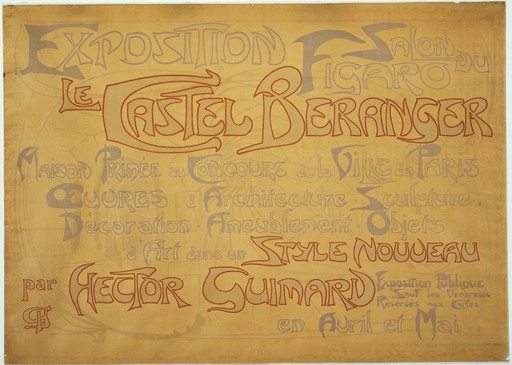
Art Nouveau (New Art)
An international artistic movement of the late 19th and early 20th centuries that emphasized the unity of the arts and sought to reflect the intensive psychic and sensory stimuli of the modern city.
Learn more →
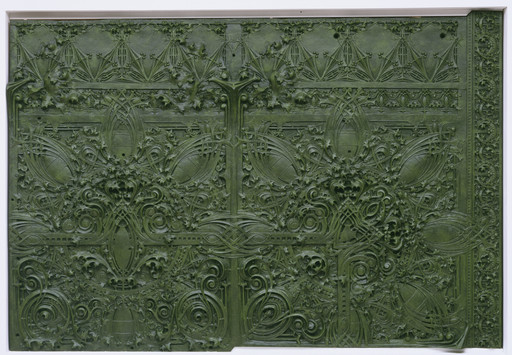

Built environment
The spaces that human design and actions have shaped. These include infrastructural systems like electricity grids or highway networks, cities, buildings and other structures, landscaped areas, and resource-extraction sites like mines or oil wells.
Learn more →

UUmwelt
Sculpture GardenAt a time when AI is dramatically changing how we see, what does it mean to visualize a world that’s no longer centered on the human mind?
Learn more →


Audio
Audio from the playlist Sculpture Garden
Audio from the playlist Kids
From MoMA Design Store


Installation views
We have identified this work in the following photos from our exhibition history.
Licensing
Artwork or archival images
If you would like to reproduce an image of a work of art in MoMA's collection, or an image of a MoMA publication or archival material (including installation views, checklists, and press releases), please contact Art Resource (publication in North America) or Scala Archives (publication in all other geographic locations).
Audio and film clips
MoMA licenses archival audio and select out of copyright film clips from our film collection. At this time, MoMA produced video cannot be licensed by MoMA/Scala. All requests to license archival audio or out of copyright film clips should be addressed to Scala Archives at [email protected]. Motion picture film stills cannot be licensed by MoMA/Scala. For access to motion picture film stills for research purposes, please contact the Film Study Center at [email protected]. For more information about film loans and our Circulating Film and Video Library, please visit Circulating Film and Video Library.
Text from a publication or the archives
If you would like to reproduce text from a MoMA publication, please email [email protected]. If you would like to publish text from MoMA's archival materials, please fill out this permission form and send to [email protected].
Feedback
This record is a work in progress. If you have additional information or spotted an error, please fill out this feedback form.