Louis Sullivan, Dankmar Adler
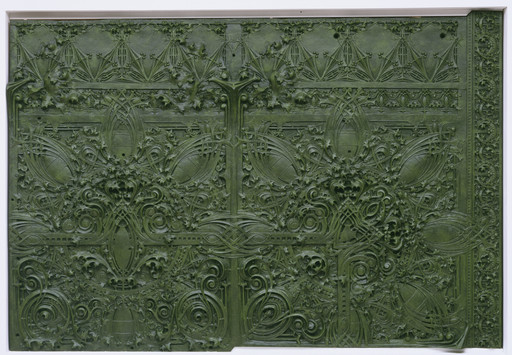
Stenciled Frieze Panel from the Trading Room of the Chicago Stock Exchange, Chicago, IL
c. 1893
Oil on canvas
Not on view
Completed in 1894, Sullivan and Adler’s thirteen-story Chicago Stock Exchange was one of the earliest modern skyscrapers, rising to a new height made possible by developments in steel framing. The second-floor trading room was its magnificent centerpiece. When the building was demolished in 1972, architectural elements were salvaged and gathered by collectors and museums. This particular painted fragment features fifty-two distinct hues in muted tones of rust and gold, green and yellow. Shapes that recall root systems, stems, and leaves are transformed into stylized patterns that allude to prairie landscapes and the fundamental role of midwestern agriculture in the US economy. The rhythm and precision of the abstract design are also reminiscent of Islamic decorative traditions.
In its lush, organic motifs and intricately stenciled patterns, the frieze reflects Sullivan’s goal of synthesizing elements of nature with abstraction. Organic patterns portrayed at different scales and in various mediums were integrated throughout the entire building, arranged to emphasize the structure’s verticality. Motifs recurred in molded plaster and terra-cotta and in the ironwork of staircases and elevator grilles. Sullivan believed that decorative elements and architectural form could, and should, come together to create a unique and harmonious whole. Through his elaboration of a concept he called “organic ornamentation,” he paved the way for a distinctly American visual culture rooted in the simplicity of nature yet brimming with endless variations of architectural expression.
MoMA Highlights: 375 Works from The Museum of Modern Art, New York (New York: The Museum of Modern Art, 2019)
Gallery label from 2020
The Chicago Stock Exchange was among the earliest modern skyscrapers, rising to an unprecedented thirteen stories when it was completed in 1894. The trading room, where this element was installed, was its magnificent centerpiece. Salvaged when the building was demolished in 1972, this architectural fragment features fifty-two distinct hues in muted tones of rust and gold, green, and yellow. Shapes that recall root systems, stems, and leaves form stylized patterns that allude to prairie landscapes and the fundamental role of agriculture in the American economy. In its lush, organic motifs and intricately stenciled patterns, the frieze reflects Sullivan’s goal of synthesizing elements of nature with abstraction.
2020
Explore more


Modern art
Art made from the 1880s to the 1970s—a time marked by the growth of cities, the rise of industry, a surge in technologies, and the development of mass media.
Learn more →


From MoMA Design Store


Installation views
We have identified this work in the following photos from our exhibition history.
Licensing
Artwork or archival images
If you would like to reproduce an image of a work of art in MoMA's collection, or an image of a MoMA publication or archival material (including installation views, checklists, and press releases), please contact Art Resource (publication in North America) or Scala Archives (publication in all other geographic locations).
Audio and film clips
MoMA licenses archival audio and select out of copyright film clips from our film collection. At this time, MoMA produced video cannot be licensed by MoMA/Scala. All requests to license archival audio or out of copyright film clips should be addressed to Scala Archives at [email protected]. Motion picture film stills cannot be licensed by MoMA/Scala. For access to motion picture film stills for research purposes, please contact the Film Study Center at [email protected]. For more information about film loans and our Circulating Film and Video Library, please visit Circulating Film and Video Library.
Text from a publication or the archives
If you would like to reproduce text from a MoMA publication, please email [email protected]. If you would like to publish text from MoMA's archival materials, please fill out this permission form and send to [email protected].
Feedback
This record is a work in progress. If you have additional information or spotted an error, please fill out this feedback form.