NOT IN MoMA'S COLLECTION
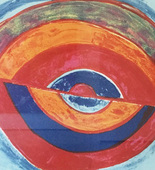
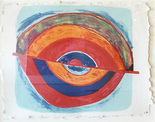
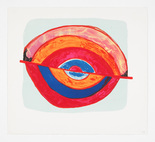
Cat. No. 596/II
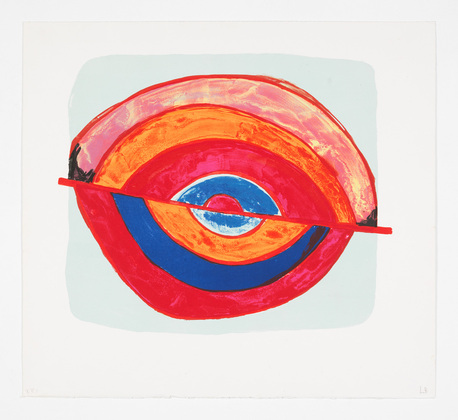
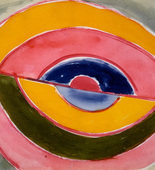
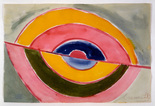
Reply to Stanley Hayter
- State/Variant:
- State II of III
- Date:
- 1997
- Themes:
- Abstraction
- Techniques:
- Lithography
- Description:
- Lithograph
- Support:
- Paper
- Dimensions:
- sheet: 27 × 30" (68.6 × 76.2 cm)
- Signature:
- "LB" right lower margin, pencil.
- Inscription:
- "TP. 1" left lower margin, pencil, unknown hand.
- Publisher:
- unpublished
- Printer:
- SOLO Impression, New York
- Edition:
- 1 known impression of state II
- Impression:
- Not numbered
- Edition Information:
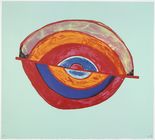
- Proof before the editioning of state III.
- State Changes and Additions:
- Matrices:
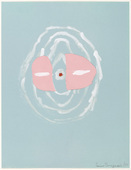
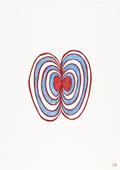
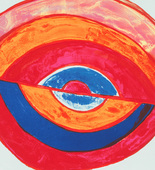
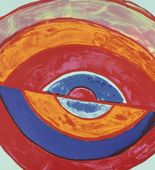
The progression of this composition, as seen in the Evolving Composition Diagram below, included 8 lithography matrices.
Plate 1: light blue background.
Plate 2: yellow areas.
Plate 3: orange areas.
Plate 4: dark blue areas.
Plate 5: magenta areas.
Plate 6: red half circles.
Plate 7: red diagonal line.
Plate 8: black areas.
Print State Changes:
Changes from state I, in plate 4: shading reduced. - Background:
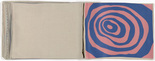
- Stanley William Hayter founded the print workshop Atelier 17, which he relocated from Paris to New York during WWII. Bourgeois worked there intermittently until 1949, enjoying the company of an array of international artists. Bourgeois found Hayter intimidating as he demonstrated engraving, but remembered feeling useful in the shop because she could facilitate communication with the artists who spoke only French. "Le Cauchemar de Hayter," seen below in Related Works in Other Mediums, is another work that references the printmaker.
- Curatorial Remarks:
- The paper type and composition size could not be documented because this work is not in MoMA's Collection and could not be examined in person.
- Other Remarks:
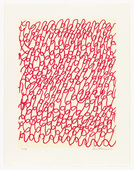
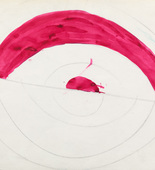
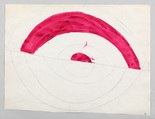
- According to the artist's assistant Jerry Gorovoy, Bourgeois was reminded of Hayter in the 1990s when she met Hayter's daughter. While revisiting some earlier drawings, the artist remembered the difficulties she had with the engraving burin, especially when making long, curved forms like the ones seen here.
- Public Collection:
- Fogg Art Museum, Harvard University
© The Easton Foundation/VAGA at ARS, NY
Reply to Stanley Hayter
1996
Source
1970
NOT IN MoMA'S COLLECTION
NOT IN MoMA'S COLLECTION
Untitled
Ink and pencil on paper
1970
Ink and pencil on paper
1970
Source
1970
NOT IN MoMA'S COLLECTION
NOT IN MoMA'S COLLECTION
Untitled
Watercolor on paper
1970
Watercolor on paper
1970
States
NOT IN MoMA'S COLLECTION
NOT IN MoMA'S COLLECTION
State I of III
1996
1996
NOT IN MoMA'S COLLECTION
NOT IN MoMA'S COLLECTION
State II of III
1997
1997
Published
State III of III
1996
1996