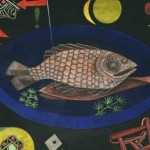
When I was an art major in high school, Paul Klee was my favorite artist—especially the fishy phase he went through in the 1920s. Postcards of Around the Fish, with its straight-up fish-on-a-platter composition


Posts in ‘Five for Friday’
September 23, 2011
|
Five for Friday
Five for Friday: How Do You Like Them Apples?
Five for Friday, written by a variety of MoMA staff members, is our attempt to spotlight some of the compelling, charming, and downright curious works in the Museum’s rich collection.
Like every good New Englander, I eagerly await the start of the fall season and the bounty it brings.
August 26, 2011
|
Five for Friday
Five for Friday: The End of Summer Is Near
Five for Friday, written by a variety of MoMA staff members, is our attempt to spotlight some of the compelling, charming, and downright curious works in the Museum’s rich collection.

August 12, 2011
|
Five for Friday
Five for Friday: Tying the Knot
By the time you read this I will be roughly 36 hours away from getting married. Not that I’m counting. Needless to say, I have weddings on the brain. To call it a momentous occasion is something of an understatement; recent political and ideological debates over the very definition of marriage attest to the concept’s enduring impact. And it certainly seems like a big deal to me.
July 1, 2011
|
Five for Friday
Five for Friday: Life Was a Cabaret
Five for Friday, written by a variety of MoMA staff members, is our attempt to spotlight some of the compelling, charming, and downright curious works in the Museum’s rich collection.
Even though there are advantages to living in this day and age—not dying of consumption or syphilis, transporting money in a wallet, rather than a wheelbarrow—I still fantasize about living in interwar Germany. Maybe it was far too many viewings of Cabaret as a child, but I’ve always carried an imagined nostalgia for the Weimar Republic (1919–1933): its loose social mores, the competing senses of optimism and doom, the passionate political struggles, and of course the edgy art and design. With MoMA’s German Expressionism: The Graphic Impulse exhibition closing July 11, I thought we should have a look back at some of the great Weimar-era works in MoMA’s rich collection. This post is dedicated to Paul Jaskot, the professor who inspired my love of German art and design.
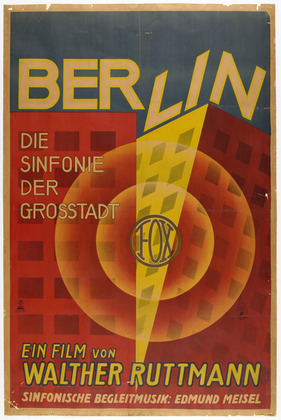
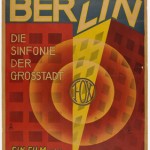
1. Unknown artist. Poster for Berlin, Die Sinfonie der Grosstadt (Berlin, Symphony of the Metropolis). 1927
Berlin: Symphony of a Great City (1927) lent a soundtrack to the Weimar Republic. This film, which MoMA screened in December 2010, portrays the life of a city mainly through visual effects and music, not narrative content. The impression it conveys of daily life in Berlin is dynamic, anxiety-ridden, cacophonous—and a helluva lot of fun!
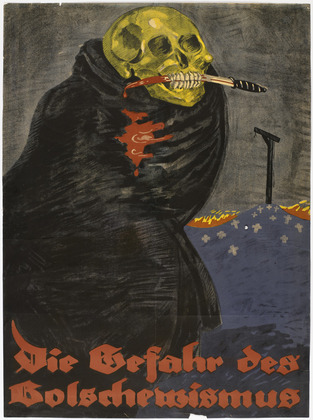
2. Rudi Feld. The Danger of Bolshevism (Die Gefahr des Bolschewismus). 1919
This lithograph, included in German Expressionism: The Graphic Impulse, features a terrifying Death figure gripping a dagger in his teeth. The work reflects a common fear in the aftermath of the First World War—that the 1917 Bolshevik revolution in Russia might spread to Germany, like a plague.
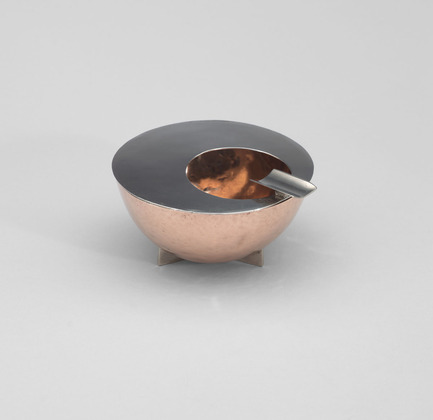
3. Marianne Brandt. Ashtray. 1924
The liberal Weimar Republic inspired a surge of radical experimentation in all the arts. Marianne Brandt was the head of the metal workshop at the German Bauhaus in Dessau from 1928 to 1929. The Bauhaus was a school, founded in 1919 by architect Walter Gropius, famous for its visionary integration of technology, art, and design. This elegant ashtray from 1924 was based on pure geometrical forms, cylinder and spheres.
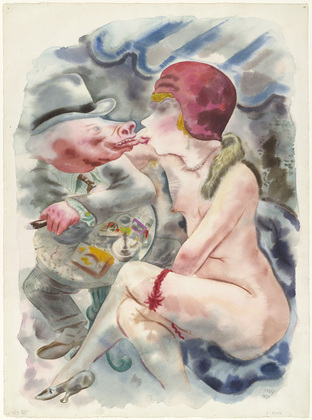
4. George Grosz. .a (recto): Circe .b (verso): Untitled. 1927
In this watercolor, also included in the German Expressionism exhibition, George Grosz critiques the ongoing economic disparities of Weimar society, in which the bourgeoisie could afford every pleasure—even the bodies of the lower classes. The unsentimental style of New Objectivity, pioneered by the likes of Grosz, Otto Dix, and Max Beckmann, emerged in Germany in the 1920s to rival the utopian and romanticized sensibility of Expressionism.
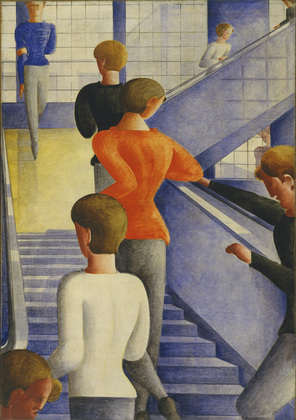
5. Oskar Schlemmer. Bauhaus Stairway. 1932
Oskar Schlemmer’s Bauhaus Stairway, an oil painting on canvas, depicts the interior of the Bauhaus. Schlemmer painted this work just one year before Hitler assumed power and the Nazis closed the visionary school. Schlemmer was among many Weimar-era artists persecuted by the Nazis for producing so-called “degenerate” art.

June 17, 2011
|
Five for Friday
Five for Friday: Happy Father’s Day
Five for Friday, written by a variety of MoMA staff members, is our attempt to spotlight some of the compelling, charming, and downright curious works in the Museum’s rich collection.
I’m no artist. For Father’s Day, I typically buy my dad a funny card, we go out to dinner, and I make sure to get in a hug. Not the most creative, but hey, it’s the thought that counts, right?
May 27, 2011
|
Five for Friday
Five for Friday: A Walk Through the Sculpture Garden
Five for Friday, written by a variety of MoMA staff members, is our attempt to spotlight some of the compelling, charming, and downright curious works in the Museum’s rich collection.
Memorial Day weekend marks the unofficial start of the summer season, and fiiiiiinally the weather around here seems to be cooperating. It also marks the resurgence of my recurring fantasy of uprooting my cube (yes, we work in white cubes, too) and dragging it out to The Abby Aldrich Rockefeller Sculpture Garden, where I’d be happy to work among the gurgling fountains, rustling trees, and beautiful sculptures. I’d be productive, I swear! [Boss reads blog post, rolls eyes.]
May 6, 2011
|
Five for Friday
Five for Friday: ¡Feliz Cinco de Mayo Tardío!
Five for Friday, written by a variety of MoMA staff members, is our attempt to spotlight some of the compelling, charming, and downright curious works in the Museum’s rich collection.
Originally a local commemoration of an outnumbered Mexican army’s 1862 victory over French troops at the Battle of Puebla, Cinco de Mayo has grown to include a major American celebration of Mexican culture and Mexican American heritage. In (belated) celebration of the holiday, here is just a tiny sample of MoMA’s rich collection of work by Mexican artists—and by artists from the U.S. and abroad who have responded to Mexico’s people and natural beauty. (If this piques your interest, be sure to visit MoMA this fall for our Diego Rivera: Murals for The Museum of Modern Art</a> exhibition.)
April 29, 2011
|
Five for Friday
Five for Friday: Basketball and Art
Five for Friday, written by a variety of MoMA staff members, is our attempt to spotlight some of the compelling, charming, and downright curious works in the Museum’s rich collection.
Jocks and nerds don’t mix, in theory, but sports and art overlap more often than one might think. In the case of basketball, players such as Bill Russell paved the way by attending beat poetry readings and collecting art. Many current and recent players boast impressive art collections and are becoming more involved with the art world.

April 22, 2011
|
Five for Friday
Five for Friday: Get Your Green On
Five for Friday, written by a variety of MoMA staff members, is our attempt to spotlight some of the compelling, charming, and downright curious works in the Museum’s rich collection. In honor of Earth Day, here are some eco-friendy—and eco-scary—works to help you get your green on.
If you are interested in reproducing images from The Museum of Modern Art web site, please visit the Image Permissions page (www.moma.org/permissions). For additional information about using content from MoMA.org, please visit About this Site (www.moma.org/site).
© Copyright 2016 The Museum of Modern Art
Welcome to MoMA.org. To take full advantage of all the site’s features, including the option to save works in the collection, please upgrade your browser to Firefox,
Google Chrome, Safari, or Internet Explorer 9.
See our help page for more information.
To take full advantage of all of the features on MoMA.org, please upgrade your browser to Firefox, Google Chrome,
Safari, or Internet Explorer 9.