

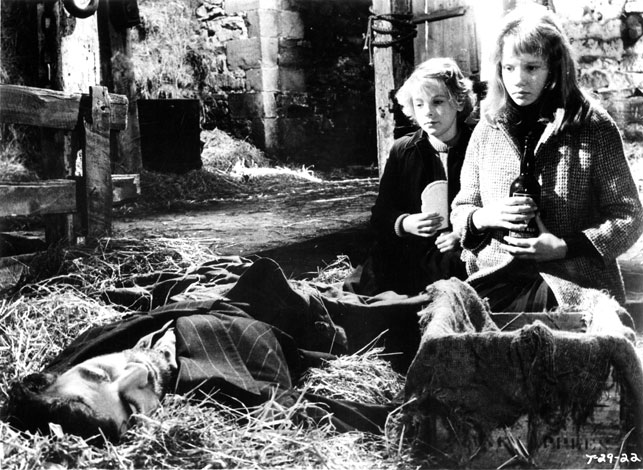
Whistle Down the Wind. 1961. Great Britain. Directed by Bryan Forbes
These notes accompany screenings of Bryan Forbes’s </em>Whistle Down the Wind</a> on October 9, 10, and 11 in Theater 3.</p>
The 1960s were an important period in the history of English cinema, but one that would be hard to label or define. The classical directors were either gone or struggling to stay afloat: the Korda brothers (Alex and Zoltan) were dead; Michael Powell remained relatively active but less interesting; David Lean managed three colossal international co-productions, but the impetus and money came mostly from Hollywood. Laurence Olivier was busy acting. Much of the quality output came from American émigrés like Joseph Losey, Stanley Kubrick, Richard Lester, and Cy Enfield. The British social realists (Karel Reisz, Tony Richardson, Lindsay Anderson) flourished briefly, but they then drifted off into less personal and more lucrative pursuits. Then we also have talented but somewhat amorphous directors like Clive Donner, John Schlesinger, and Bryan Forbes, whose credentials as authentic auteurs might be called into question. Hayley Mills and Alan Bates in Whistle Down the Wind. 1961. Great Britain. Directed by Bryan Forbes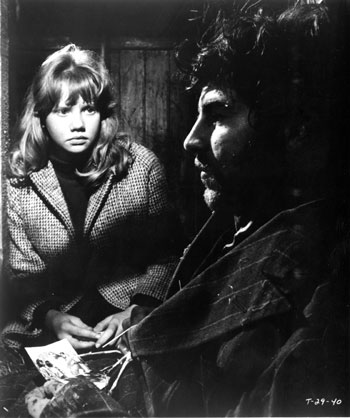
Hayley Mills, daughter of John Mills (who would star in Forbes’s madcap The Wrong Box opposite Ralph Richardson and Peter Sellers), was already a child star thanks to Walt Disney. Although she has continued working, her career didn’t blossom much after such 1960s highlights as Ronald Neame’s The Chalk Garden, Ida Lupino’s The Trouble with Angels, and The Moon-Spinners, a film which brought together the unlikely pairing of Eli Wallach and Pola Negri. Whistle Down the Wind is also based on a novel by Haley’s mother, Mary Haley Bell.
Alan Bates, on the other hand, remained a prominent figure for decades after Whistle Down the Wind provided his first important role. He would appear in films directed by Joseph Losey, Clive Donner, Michael Cacoyannis, Franco Zeffirelli, Ken Russell, Paul Mazursky, Lindsay Anderson, John Schlesinger, Philippe de Broca, Richard Lester, Robert Altman, and even Harold Pinter. The history of British film in the 1960s and 1970s is unimaginable without Bates. Forbes’s film is such a delicate allegory that only Bates’s superb performance holds it together. Forbes and Mills were nominated for BAFTA (the British equivalent of the Oscars), but Bates was not. Like Burt Lancaster and Paul Newman in America, he remained mostly underrated, perhaps as punishment for his good looks.