

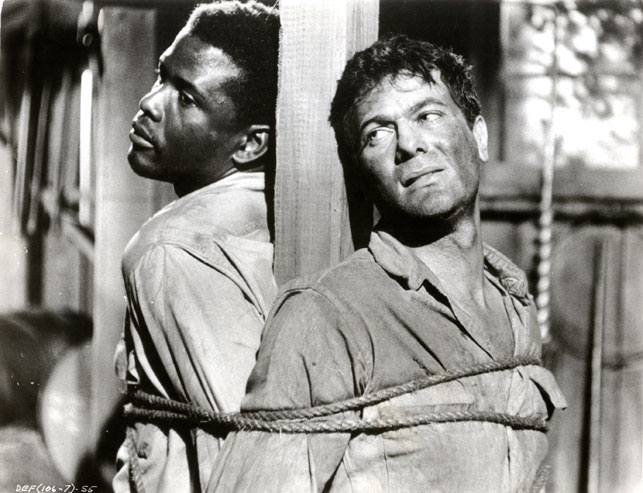
Tony Curtis and Sidney Poitier in The Defiant Ones. 1958. USA. Directed by Stanley Kramer
These notes accompany screenings of Stanley Kramer’s </em>The Defiant Ones</a> on February 20, 21, and 22 in Theater 3.</p>
I don’t think Stanley Kramer (1913–2001) would be too indignant about being labeled more a producer than a director. Although he took credit for directing 20 films, it might be hard to make a case for him having a truly artistic bent, aside from his ability to get some really good and dependable actors to accept roles in his films. Rather, Kramer’s contribution seems to me to lie more in being a conscience of America during a time of considerable anxiety and turmoil. Many great directors (F. W. Murnau, Josef von Sternberg, Max Ophuls, Carl Th. Dreyer, Buster Keaton, to name a few) had little interest in politics, much less in saving the world. Charles Chaplin, John Ford, Alfred Hitchcock, Fritz Lang, and others did deal with contemporary issues, but their personalities and style (in other words, their artistry) tended to override their immediacy. Kramer, however, took strong stands against the Holocaust, racial prejudice, ignorant rednecks, and nuclear war, and the artistry was almost incidental. In the process, he did manage to have a successful and lucrative career.</p>
Tony Curtis and Sidney Poitier in The Defiant Ones. 1958. USA. Directed by Stanley Kramer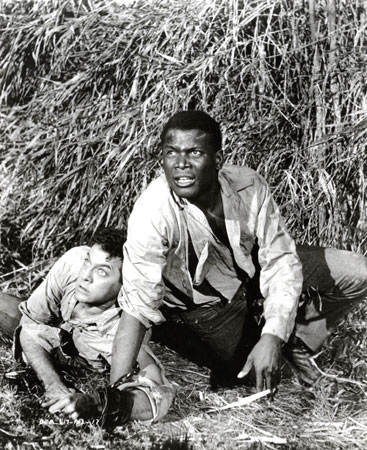
A word of praise, too, for the late Tony Curtis—then in his transition from pretty-boy juvenile to serious actor—who, no doubt, took risks by accepting the role that was turned down by Marlon Brando. As Poitier said later, The Defiant Ones “disturbed a lot of people…and informed them.” Curtis was nominated for an Oscar, and the role clearly didn’t have a negative effect on his career. My impression is that, although he did good deeds, Curtis was not one to toot his own horn. When he graciously volunteered to come to New York for our Alexander Mackendrick (Sweet Smell of Success, Don’t Make Waves) retrospective, Curtis was less interested in serious subjects than in regaling one with the story of how the costumer on Some Like It Hot (screening here as part of The Weimar Touch in April) had pinched both his backside and that of Marilyn Monroe, and pronounced Curtis’s to be superior.
Stanley Kramer was aware that he had probably defined himself too rigidly as a deliverer of “the message film.” As he said, “I would like to express myself a little more simply and, if you will, artistically.” Still, all those Oscars are hard to argue with, and It’s a Mad, Mad, Mad, Mad World demonstrated that Kramer was no Mack Sennett. When it came to ending the world in On the Beach, however, nobody did it better.