

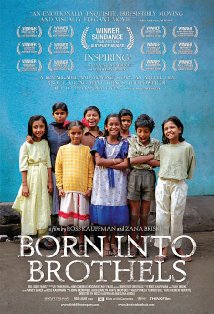
Film poster for Born into Brothels: Calcutta's Red Light Kids
When you hear teens open a question with “I want to know, ’cause I want to be a director,” you understand why you’re doing what you’re doing—why you choose to stay at work late on Friday evenings, why you spend your time off screening films, why you pour over the DVD extras to learn as much as you can about a film’s context. For years now, artist and educator Alejandro Duran and Anne Morra, an associate curator in MoMA’s Department of Film, have been doing just that to guide young artists in the dissection and interpretation of some of the world’s great films.
Occasionally they invite a special guest to talk about films with the participants. In October they welcomed Academy Award–winning director Zana Briski to lead a discussion after a screening of her 2004 documentary Born into Brothels: Calcutta’s Red Light Kids.
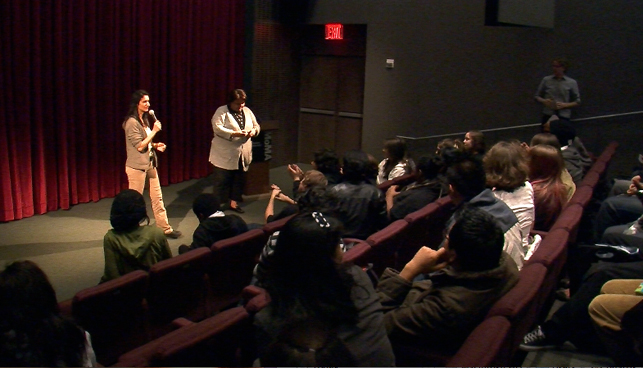
Director Zana Briski and Associate Curator of Film Anne Morra at the MoMA screening of Born into Brothels: Calcutta's Red Light Kids
Here are a couple of highlights from the conversation:
Sarah asked, “Who else came with you to make this movie?”
In 1995, photographer Zana Briski went to India and befriended the children in a brothel in Calcutta. She was there to take her own photographs but soon found herself teaching the kids to record their own lives in pictures. Her partner at the time, Ross Kaufman, joined her and began documenting Zana’s attempt to, as she puts it, “Facilitate a path for the kids to do what they wanted with their lives.”
“[I] didn’t know we were making a film, but felt I had to record what was going on. From the very first photo class…I was responding to what was happening.”
Samantha, another participant, asked, “Were there many times when you felt like you weren’t enough to support the kids?”
Zana’s response: “Every day. India kicked my ass.” In response to a question about how the film was made, Zana explained that it was paid for with credit cards, and living off of nothing at the beginning. “I am a master at transferring balances.” She went on to say that the film cost $350,000 and ten years to make.
Hannah asked, “Was this the first time you worked with kids, and will you do it again?”
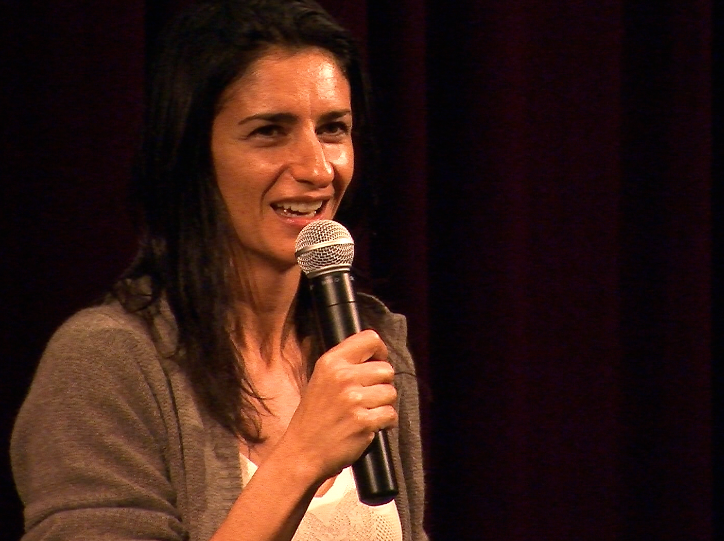
Director Zana Briski answers questions about her documentary.
“I want to work with praying mantises that don’t talk.” Zana’s next big project has been photographing praying mantises throughout Africa, and she has hopes of creating a bug farm in New York’s Central Park. But the kids from the red light district still play a large part in her life. In response to a question about how she views her work now, she said: “When I see Avijit—you know, I go to the movies with him in New York, and I met this kid in a brothel in Calcutta, you know, and he’s brilliant—I’m just in awe of him. And I’m friends with him, and that’s so cool.”
This prompted a question from Miles: “Does he have a Facebook?”
Charleton DeSouza, a regular participant and chaperone from Manhattan Comprehensive Night and Day School, said, “As an Indian, I’m embarrassed. I think the Indian government should watch this film and help the children. I’m proud of you for making this film.”
Zana’s nonprofit organization Kids with Cameras is currently building a residential home for the children in Calcutta. She says her main artistic impulse is “putting yourself in someone else’s shoes and respecting other life forms.”
Chris summed up how we all felt at the end of the night: “I want to express how much I appreciate the movie, this is actually my second time watching it. Can I shake your hand?”
Anne Morra ended the discussion by stating what we generally feel every Friday night: “This has been such a rich experience—not only seeing your incredible film, but understanding the how and the why. [It] gave us a lot to think about. One of the students said that it takes one person to make such a positive impact, and you’ve done that, and we should be very proud.”
Free Teen Nights take place almost every Friday night throughout the school year. In February the series will change its name to Art Underground, and will welcome young adults ages 15 to 23. Read about the upcoming schedule and join us!