Robert Venturi
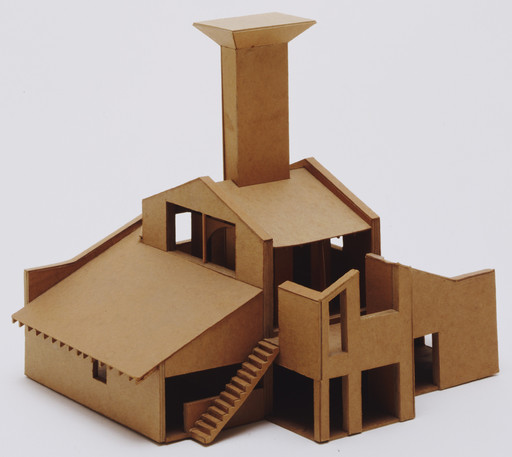
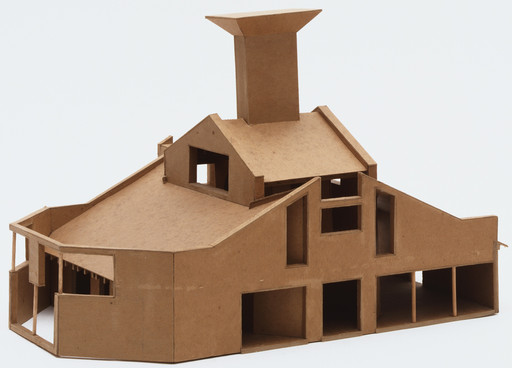
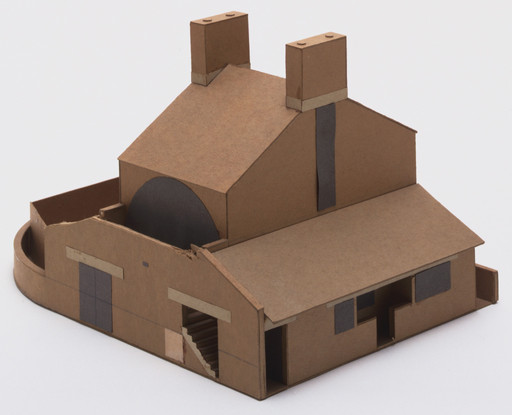
Vanna Venturi House, Chestnut Hill, Pennsylvania, Scheme VI (final) (Scale model, 1/4" = 1')
1959-64
Cardboard and paper
Not on view
The design represented by this modest cardboard study model of a house for the architect’s mother is deceptively simple. The front facade of Venturi’s design, for example, has the elements of a conventional house: a large gable, a chimney, a front door, and windows. Yet throughout the building the adept juxtaposition of big and little elements and the intentional distortion of symmetry establish a richness of meaning and perceptual ambiguity that have made the Vanna Venturi House—built in northwestern Philadelphia between 1962 and 1964—one of the most studied and referenced houses of the second half of the twentieth century. It is one of the earliest demonstrations of the architect’s highly influential theoretical propositions.
The design for the house coincided in 1961–62 with Venturi’s writing of the book Complexity and Contradiction in Architecture, published by The Museum of Modern Art in 1966. This widely circulated and deeply impactful architectural critique, supported by numerous illustrations of historical buildings, sought to overturn the reductive compositional simplicity that characterized orthodox modern architecture. Instead Venturi advocated for an architecture that could “include elements that are both good and awkward, big and little, closed and open, continuous and articulated, round and square, structural and spatial” and that embraced “ambiguity and tension.”
MoMA Highlights: 375 Works from The Museum of Modern Art, New York (New York: The Museum of Modern Art, 2019)
Explore more

Robert Venturi
American, 1925–2018 18 works onlineRobert Venturi stands out among the architects in the second half of the 20th century for his rejection of what he saw as architecture’s reductive goals.
Learn more →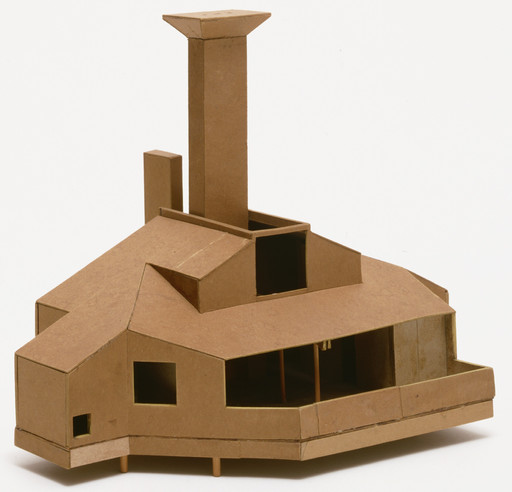

From MoMA Design Store


Installation views
We have identified this work in the following photos from our exhibition history.
Licensing
Artwork or archival images
If you would like to reproduce an image of a work of art in MoMA's collection, or an image of a MoMA publication or archival material (including installation views, checklists, and press releases), please contact Art Resource (publication in North America) or Scala Archives (publication in all other geographic locations).
Audio and film clips
MoMA licenses archival audio and select out of copyright film clips from our film collection. At this time, MoMA produced video cannot be licensed by MoMA/Scala. All requests to license archival audio or out of copyright film clips should be addressed to Scala Archives at [email protected]. Motion picture film stills cannot be licensed by MoMA/Scala. For access to motion picture film stills for research purposes, please contact the Film Study Center at [email protected]. For more information about film loans and our Circulating Film and Video Library, please visit Circulating Film and Video Library.
Text from a publication or the archives
If you would like to reproduce text from a MoMA publication, please email [email protected]. If you would like to publish text from MoMA's archival materials, please fill out this permission form and send to [email protected].
Feedback
This record is a work in progress. If you have additional information or spotted an error, please fill out this feedback form.