Linoleum cut with collage additions from an illustrated book with sixteen linoleum cuts (including cover, two with collage additions)
Not on view
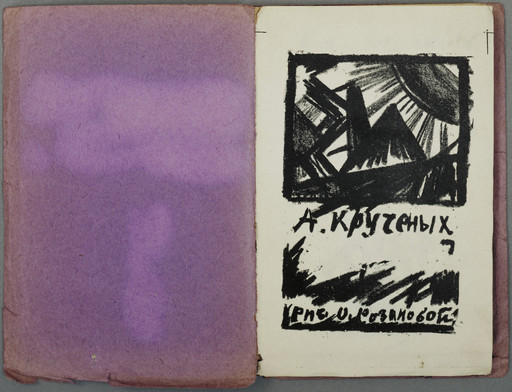
Soaring airplanes, a black bomb, a toppled red building, and a figure free-falling through space: although at first glance Rozanova’s collage of cutout shapes and linoleum-printed papers may look like an abstraction, in fact it illustrates the chaos of a bombing raid. The sheet is one of fifteen pages in the illustrated book Voina (War), which Rozanova produced with her companion and frequent collaborator, the Russian Futurist poet Aleksei Kruchenykh. She used the fractured, shifting forms of Cubism and Futurism to convey the mass confusion and destruction experienced in her native Russia during World War I.
For Rozanova and her generation of Russian artists, the book was a key site for radical experimentation. Working closely with poets, including Kruchenykh, to create an entirely new kind of handmade, often self-published book, they combined innovative poetry with deliberately crude illustrations that were meant to shock and to repudiate the tasteful refinement of traditional fine-press books. For Voina, Rozanova employed the new and unorthodox medium of linoleum cut, which she printed on cheap paper with uneven edges. The book marked a high point in Rozanova’s brief but illustrious career, which lasted only about a decade. She died of diphtheria in 1918.
MoMA Highlights: 375 Works from The Museum of Modern Art, New York (New York: The Museum of Modern Art, 2019)
Explore more
Olga Rozanova
Russian, 1886–1918 207 works onlineSo wrote Olga Rozanova in 1913 in The Union of Youth , the journal of an eponymous artist group that included Kazimir Malevich , Vladimir Tatlin , and Alexandra Exter among its members.
Learn more →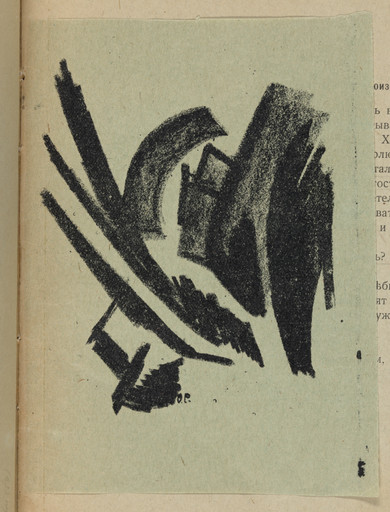

From MoMA Design Store


Installation views
We have identified this work in the following photos from our exhibition history.
Licensing
Artwork or archival images
If you would like to reproduce an image of a work of art in MoMA's collection, or an image of a MoMA publication or archival material (including installation views, checklists, and press releases), please contact Art Resource (publication in North America) or Scala Archives (publication in all other geographic locations).
Audio and film clips
MoMA licenses archival audio and select out of copyright film clips from our film collection. At this time, MoMA produced video cannot be licensed by MoMA/Scala. All requests to license archival audio or out of copyright film clips should be addressed to Scala Archives at [email protected]. Motion picture film stills cannot be licensed by MoMA/Scala. For access to motion picture film stills for research purposes, please contact the Film Study Center at [email protected]. For more information about film loans and our Circulating Film and Video Library, please visit Circulating Film and Video Library.
Text from a publication or the archives
If you would like to reproduce text from a MoMA publication, please email [email protected]. If you would like to publish text from MoMA's archival materials, please fill out this permission form and send to [email protected].
Feedback
This record is a work in progress. If you have additional information or spotted an error, please fill out this feedback form.