Chromogenic print with sand-blasted text on glass
Not on view
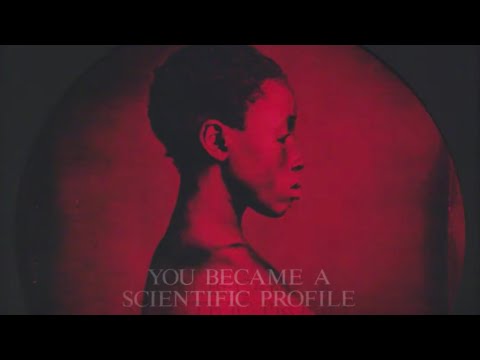
“When we’re looking at these images,” Weems said, “we’re looking at the ways in which Anglo America—white America—saw itself in relationship to the Black subject.” Among them are distressing pictures of enslaved African Americans taken by photographer Joseph T. Zealy in 1850. Commissioned by the Harvard scientist Louis Agassiz, they were meant to support racist theories about the inferiority of Black people. Many of the sitters are naked or half naked and depicted as anthropological specimens rather than individuals. The work is bookended by images of a royal Mangbetu woman witnessing the narrative.
Through her presentation, Weems asks us to question the intentions behind these pictures and their dissemination. She enlarged, cropped, and tinted the images, then placed the prints in circular mattes that suggest the camera’s lens,
emphasizing the acts of framing and looking. Finally, she overlaid the images with her own texts that expose a long history of systemic injustice. “I wanted to intervene in that by giving a voice to a subject that historically has had no voice.”
2020
Publication excerpt from The Museum of Modern Art, MoMA Highlights since 1980 , New York: The Museum of Modern Art, 2007, p. 149.
This is one of thirty-four images that compose From Here I Saw What Happened and I Cried, an elegiac work that addresses photography's complicity in the reinforcement of racist ideas. In photographs African Americans have often been reduced to stereotypes and robbed of their individual identities. Weems's work is not only a commentary on the representation of black people in millions of photographs; it also responds to the status and perception of African Americans in the United States throughout history.
The artist rephotographed images from the time of the American Civil War through the period of the civil rights movement. She used a red filter to diminish the pictures' documentary authority and cropped each image to create a kind of telescopic view that emphasizes the viewer's temporal distance from the subjects. From daguerreotypes to documentary photographs, each picture is accompanied by text written by Weems, etched on a protective pane of glass. The series begins with a profile view of a dignified African woman looking to the right, as if toward the future, and it ends with the same image printed in reverse, so that she is seen looking back over the gathered pictures—hence the title of the series. When the work is seen in its entirety, the short texts inscribed on the glass read like a bitter poem.
The Museum of Modern Art, MoMA Highlights since 1980, New York: The Museum of Modern Art, 2007, p. 149.
Explore more
Carrie Mae Weems
American, born 1953 41 works onlineWhat does it mean to bear witness to history? The artist Carrie Mae Weems has asked this question for decades through photography, video, performance, installation, and social practice.
Learn more →



Articles and videos
From MoMA Design Store


Installation views
We have identified this work in the following photos from our exhibition history.
Licensing
Artwork or archival images
If you would like to reproduce an image of a work of art in MoMA's collection, or an image of a MoMA publication or archival material (including installation views, checklists, and press releases), please contact Art Resource (publication in North America) or Scala Archives (publication in all other geographic locations).
Audio and film clips
MoMA licenses archival audio and select out of copyright film clips from our film collection. At this time, MoMA produced video cannot be licensed by MoMA/Scala. All requests to license archival audio or out of copyright film clips should be addressed to Scala Archives at [email protected]. Motion picture film stills cannot be licensed by MoMA/Scala. For access to motion picture film stills for research purposes, please contact the Film Study Center at [email protected]. For more information about film loans and our Circulating Film and Video Library, please visit Circulating Film and Video Library.
Text from a publication or the archives
If you would like to reproduce text from a MoMA publication, please email [email protected]. If you would like to publish text from MoMA's archival materials, please fill out this permission form and send to [email protected].
Feedback
This record is a work in progress. If you have additional information or spotted an error, please fill out this feedback form.