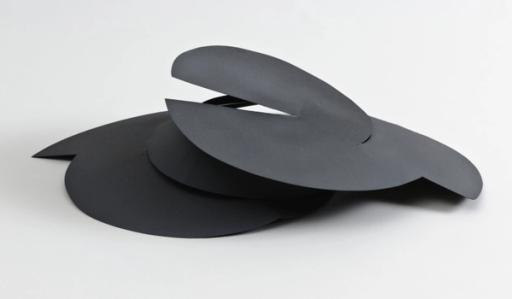
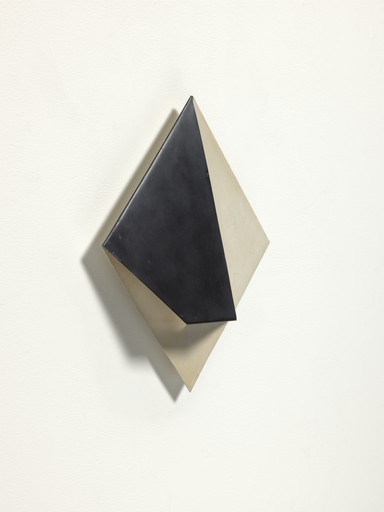
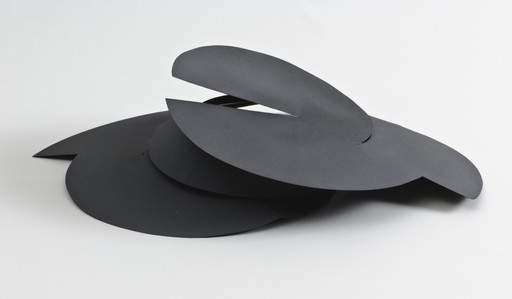
Sundial is what Clark called a bicho, or critter—a type of sculpture whose hinged metal sheets can be folded into multiple configurations or flattened to a single plane. Though strictly geometric and carefully structured around several axes, the work becomes elusive and unpredictable once activated. Clark thought that to interact with Sundial was to engage in a process of mutual discovery and transformation through which identity—the participant’s and the work’s—can be radically redefined.
Sur moderno: Journeys of Abstraction—The Patricia Phelps de Cisneros Gift, October 21, 2019–March 14, 2020
Gallery label from 2006
Sundial belongs to Clark's Animals series, begun in 1960—a group of metal sculptures whose forms can be endlessly modified. The works in this series are flat, curving structures that fold in different ways along a spine–like axis. Capable of many variations in form, they can also be reduced to a flat plane. Sundial was conceived to invite the spectator to modify its foldable geometric shapes.
Provenance
The artist.
[Paulo Kuczynski, São Paulo]
? - 1996, Galeria César Aché, Río de Janeiro (archival code #581).
1996 - 2004, Colección Patricia Phelps de Cisneros, New York and Caracas, purchased through Galeria César Aché.
2004, The Museum of Modern Art, New York, acquired as gift from Patricia Phelps de Cisneros.
Explore more
Lygia Clark
Brazilian, 1920–1988 19 works onlineThe notion that the work of art was more like a body than a discrete object was a radical idea that led many Brazilian artists to embrace the viewer’s subjective experience as the main criterion in art making.
Learn more →
Participatory art
When artists include members of the public in their creative process and encourage them to become co-authors of the work.
Learn more →


Arthur Jafa—Less Is Morbid
1 NorthOriginally from Tupelo, Mississippi, and trained as an architect and cinematographer, he has become well-known for his collages, montages, assemblages, and installations—combining images imbued with what he calls “affective capacity,” or the emotional power of association.
Learn more →


From MoMA Design Store


Installation views
We have identified this work in the following photos from our exhibition history.
Licensing
Artwork or archival images
If you would like to reproduce an image of a work of art in MoMA's collection, or an image of a MoMA publication or archival material (including installation views, checklists, and press releases), please contact Art Resource (publication in North America) or Scala Archives (publication in all other geographic locations).
Audio and film clips
MoMA licenses archival audio and select out of copyright film clips from our film collection. At this time, MoMA produced video cannot be licensed by MoMA/Scala. All requests to license archival audio or out of copyright film clips should be addressed to Scala Archives at [email protected]. Motion picture film stills cannot be licensed by MoMA/Scala. For access to motion picture film stills for research purposes, please contact the Film Study Center at [email protected]. For more information about film loans and our Circulating Film and Video Library, please visit Circulating Film and Video Library.
Text from a publication or the archives
If you would like to reproduce text from a MoMA publication, please email [email protected]. If you would like to publish text from MoMA's archival materials, please fill out this permission form and send to [email protected].
Feedback
This record is a work in progress. If you have additional information or spotted an error, please fill out this feedback form.