Crayon and graphite on sepia diazotype
Not on view
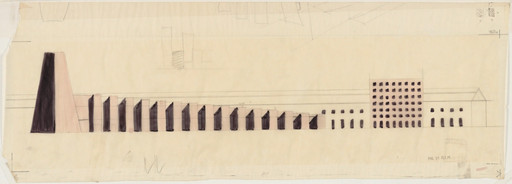
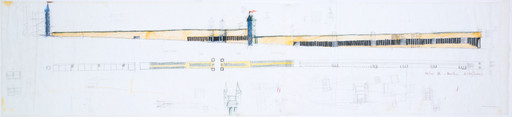
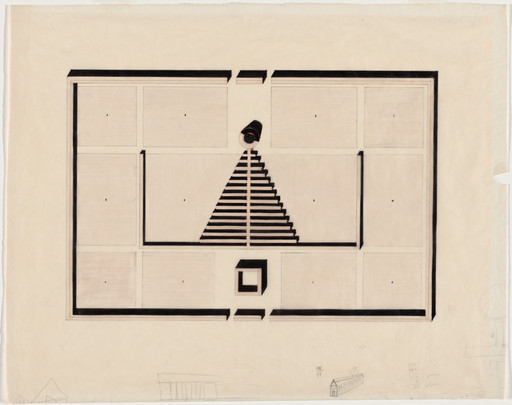
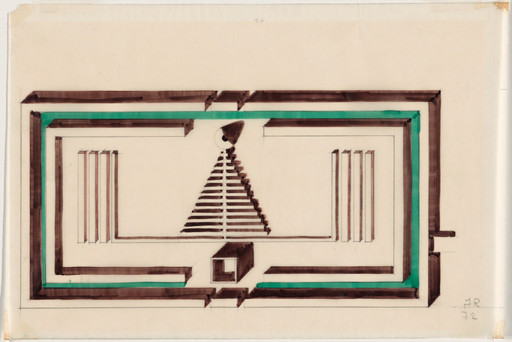
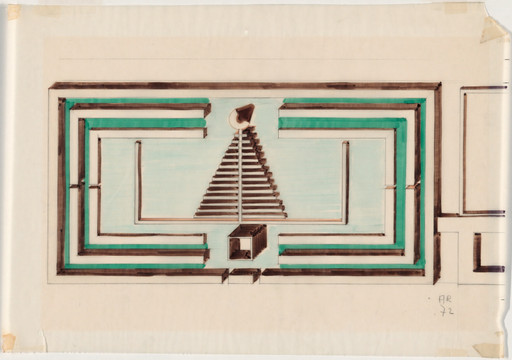
Aldo Rossi designed the Cemetery of San Cataldo for a 1971 competition that called for an extension to the existing nineteenth-century Costa Cemetery. Employing conventions of perspective developed in the fifteenth century, Rossi uses an aerial view to give a sense of the cemetery in both plan and elevation. One enters this wall-enclosed space through a gate opposite what seems to be an abandoned house, a cubic structure designed as a collective or nondenominational temple to be used for funeral, religious, or civil ceremonies. As one proceeds along the central axis, it passes through successive rectangular structures, riblike ossuaries that rise in height as they diminish in length. The journey is punctuated by a cone-shaped smokestack monumentalizing a communal grave for the unknown, and referencing the industrial landscape beyond. Rossi's design is rooted in an Enlightenment typology of the cemetery as a walled structure set on the outskirts of town. It not only recalls the adjacent Costa Cemetery but, as Rossi says, "complies with the image of a cemetery that everyone has." A structure without a roof, it is a deserted building intended for those who no longer need the protection of shelter-a house for the dead in which life and death exist as a continuum within the collective memory.
Through his use of aerial perspective, elemental form, and color, Rossi constructs a visual passage through the drawing that corresponds to the journey contra natura through the cemetery. Shadows stem from a particular light source yet reference no particular time of day. Perspective, traditionally universalizing, is colored with a Northern Italian palette, and draws our eye not back into space but rather up the page. Like the cemetery itself, the drawing presents a road toward abandonment in which time seems to stand still.
an essay by Tina di Carlo, in Matilda McQuaid, ed., Envisioning Architecture: Drawings from The Museum of Modern Art, New York: The Museum of Modern Art, 2002, pp. 160-161.
Explore more
Perspective
Technique used to depict volumes and spatial relationships on a flat surface, as in a painted scene that appears to extend into the distance.
Learn more →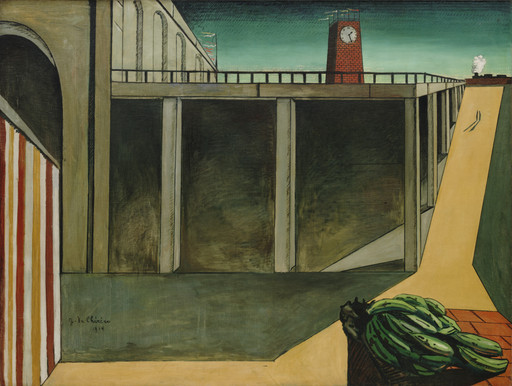
Postmodernism
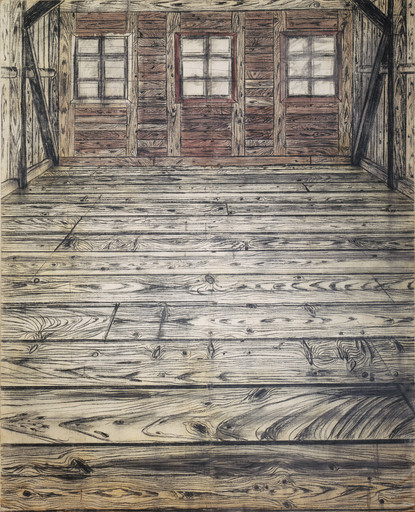
Postmodernism refers to a reaction against modernism. It is less a cohesive movement than an approach and attitude toward art, culture, and society.
Learn more →

From MoMA Design Store


Installation views
We have identified this work in the following photos from our exhibition history.
Licensing
Artwork or archival images
If you would like to reproduce an image of a work of art in MoMA's collection, or an image of a MoMA publication or archival material (including installation views, checklists, and press releases), please contact Art Resource (publication in North America) or Scala Archives (publication in all other geographic locations).
Audio and film clips
MoMA licenses archival audio and select out of copyright film clips from our film collection. At this time, MoMA produced video cannot be licensed by MoMA/Scala. All requests to license archival audio or out of copyright film clips should be addressed to Scala Archives at [email protected]. Motion picture film stills cannot be licensed by MoMA/Scala. For access to motion picture film stills for research purposes, please contact the Film Study Center at [email protected]. For more information about film loans and our Circulating Film and Video Library, please visit Circulating Film and Video Library.
Text from a publication or the archives
If you would like to reproduce text from a MoMA publication, please email [email protected]. If you would like to publish text from MoMA's archival materials, please fill out this permission form and send to [email protected].
Feedback
This record is a work in progress. If you have additional information or spotted an error, please fill out this feedback form.