Not on view
The high scaffold in Watchtower could be a hunters' blind but also whispers of the guards' post—perhaps on the East-West border within a still-divided Germany, perhaps on a concentration-camp fence. Polke stenciled this skeletal frame in a series of paintings begun in 1984, varying the imagery around it. Here, he clothes the watchtower in a baleful phosphorescent glow, which sends up a hollow arm to catch the tower's top.
In the 1960s Polke had produced what he called "Capitalist Realism," a German variant of Pop art. An element of Pop survives in Watchtower's support, made of commercial yard goods printed, respectively, with a cheerful floral and with a weave or mesh. Refusing consistency, however, Polke combines these with both the sinister tower image and an abstraction (which, with its alternately smooth and spidery lines, suggests more than one painting process). Images and styles from different eras, and associated with different moods and intentions, jostle and layer in the same work—a "postmodern" approach that Polke pioneered, and that a variety of artists explored in the 1980s.
Visual layering brings a layering of sense. In Watchtower, painted and printed images compete for visibility; if the watchtower is haunted and haunting, the prints connote a banal dailiness. It is as though different registers of consciousness and of memory were struggling for resolution.
The Museum of Modern Art, MoMA Highlights, New York: The Museum of Modern Art, revised 2004, originally published 1999, p. 306.
Gallery label from 2020
When Polke made this painting, in 1984, he might have had in mind the hundreds of watchtowers that lined the Berlin Wall. He might also have been thinking of the towers circling the concentration camps of the Nazi era, forty years earlier; or of both. Polke’s surveillance tower is illuminated by a ghastly shimmer. It is painted, by stencil, on two swaths of cheap commercial fabric, one harsh and mechanical, the other gaudy and floral. Do these patterns respectively index the communist and the capitalist ideologies of the divided Germany after World War II? If so, neither is particularly alluring.
2020
Explore more
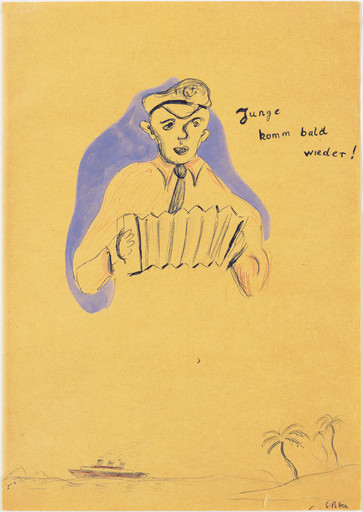
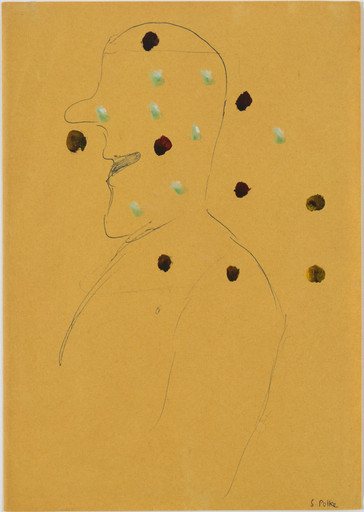
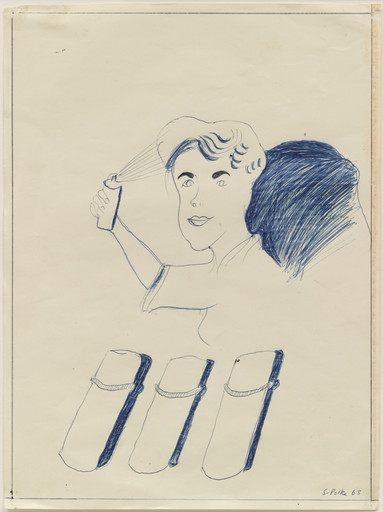
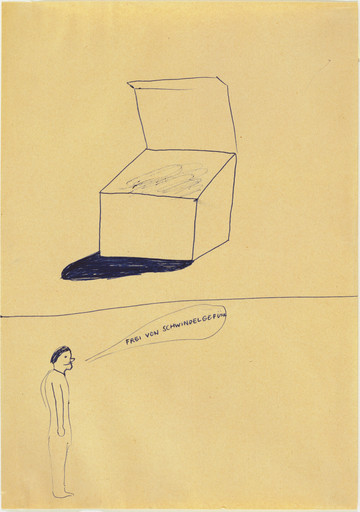
Postmodernism
Postmodernism refers to a reaction against modernism. It is less a cohesive movement than an approach and attitude toward art, culture, and society.
Learn more →
From MoMA Design Store


Installation views
We have identified this work in the following photos from our exhibition history.
Licensing
Artwork or archival images
If you would like to reproduce an image of a work of art in MoMA's collection, or an image of a MoMA publication or archival material (including installation views, checklists, and press releases), please contact Art Resource (publication in North America) or Scala Archives (publication in all other geographic locations).
Audio and film clips
MoMA licenses archival audio and select out of copyright film clips from our film collection. At this time, MoMA produced video cannot be licensed by MoMA/Scala. All requests to license archival audio or out of copyright film clips should be addressed to Scala Archives at [email protected]. Motion picture film stills cannot be licensed by MoMA/Scala. For access to motion picture film stills for research purposes, please contact the Film Study Center at [email protected]. For more information about film loans and our Circulating Film and Video Library, please visit Circulating Film and Video Library.
Text from a publication or the archives
If you would like to reproduce text from a MoMA publication, please email [email protected]. If you would like to publish text from MoMA's archival materials, please fill out this permission form and send to [email protected].
Feedback
This record is a work in progress. If you have additional information or spotted an error, please fill out this feedback form.