Ink with gouache on paper
Not on view
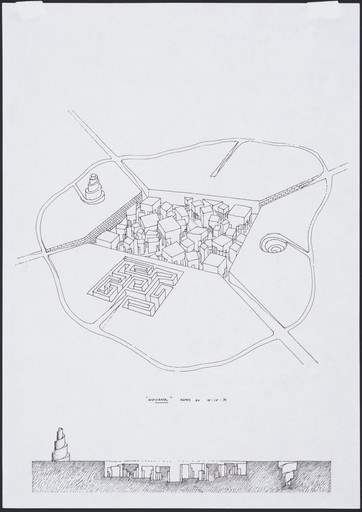
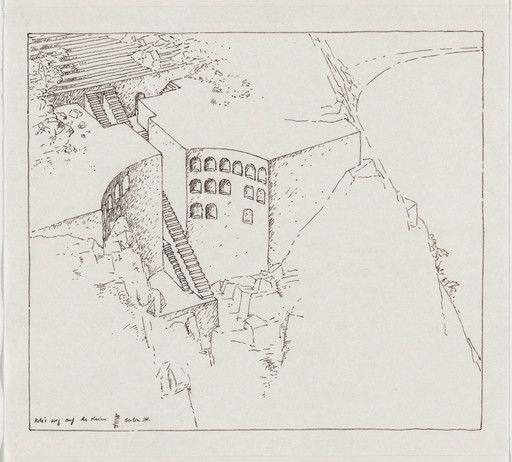
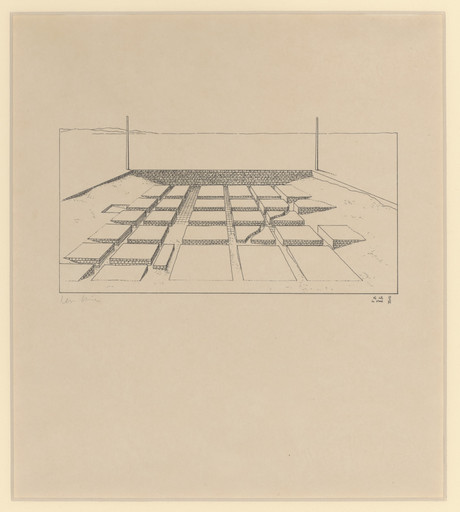
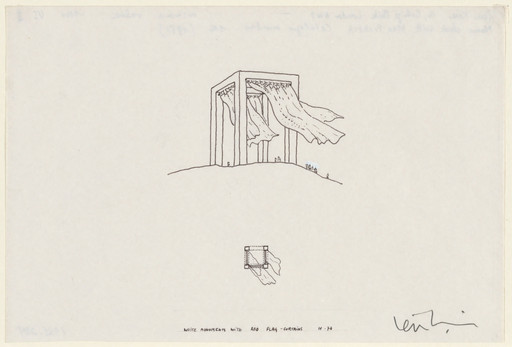
Between 1967 and 1974, Léon Krier both pursued urban projects and produced numerous drawings of architectural follies. The latter were triggered by vernacular architecture or structural engineering and generally situated in remote locations such as mountain sites, deserts, and Mediterranean islands. These visionary projects, inspired by both real circumstance and dream states, were conceived for specific individuals, such as friends or people whom Krier admired from a distance. In these small, highly personal projects he sought an escape from the formal and social principals of the modern masters, in particular, those of Le Corbusier, and a rediscovery of the essential methods of construction.
an essay by Bevin Cline and Tina di Carlo, in Terence Riley, ed., The Changing of the Avant-Garde: Visionary Architectural Drawings from the Howard Gilman Collection, New York: The Museum of Modern Art, 2002, p. 103.
Publication excerpt from Matilda McQuaid, ed., Envisioning Architecture: Drawings from The Museum of Modern Art , New York: The Museum of Modern Art, 2002, p. 184.
Léon Krier's House for Colin Rowe is a vignette on the idea of the perfectibility of the classical villa. Cartoonlike, timeless, and without location, it is an architectural fairy tale, yet its delicately drawn double-walled interior and extending ramparts emanate invincibility. This ideal vision of the villa suggests something desirable yet unattainable, and Rowe, a scholar of architecture, has suggested that Krier's work be studied within this utopian context.
Krier, one of the most polemical architects of the 1970s and '80s, has asserted, "I can only make Architecture, because I do not build. I do not build, because I am an Architect." He believes in the perfection of an idea on paper, and his drawing techniques are influenced by the great traditions of Renaissance cartography and by the eighteenth-century architect and printmaker Giambattista Piranesi. Krier exerts a moralistic fervor in denouncing modern architecture and the industrial world, and in promoting a classical language in architecture. He has designed both large-scale cities and small-scale follies, such as this drawing. The clarity of the plan, with its symmetrical arrangement of main facade elements-entrance opening, pediment, and "Palladian" window-recalls sixteenth-century Italian villas by the neoclassical architect Andrea Palladio.
One can interpret Krier's house as a response to Rowe's renowned essay "The Mathematics of the Ideal Villa," published in 1947. Comparing Palladio's Villa Foscari (c. 1550) with Le Corbusier's Villa Stein (1927), Rowe asserts that both architects share a mathematical standard that they impose upon these projects. Krier's bunkerlike villa shares with Palladio and LeCorbusier the essential idea of the cubic block, but is closer in spirit to Palladio's study and reconstruction of Roman domestic architecture.
Matilda McQuaid, ed., Envisioning Architecture: Drawings from The Museum of Modern Art, New York: The Museum of Modern Art, 2002, p. 184.
Explore more


From MoMA Design Store


Licensing
Artwork or archival images
If you would like to reproduce an image of a work of art in MoMA's collection, or an image of a MoMA publication or archival material (including installation views, checklists, and press releases), please contact Art Resource (publication in North America) or Scala Archives (publication in all other geographic locations).
Audio and film clips
MoMA licenses archival audio and select out of copyright film clips from our film collection. At this time, MoMA produced video cannot be licensed by MoMA/Scala. All requests to license archival audio or out of copyright film clips should be addressed to Scala Archives at [email protected]. Motion picture film stills cannot be licensed by MoMA/Scala. For access to motion picture film stills for research purposes, please contact the Film Study Center at [email protected]. For more information about film loans and our Circulating Film and Video Library, please visit Circulating Film and Video Library.
Text from a publication or the archives
If you would like to reproduce text from a MoMA publication, please email [email protected]. If you would like to publish text from MoMA's archival materials, please fill out this permission form and send to [email protected].
Feedback
This record is a work in progress. If you have additional information or spotted an error, please fill out this feedback form.