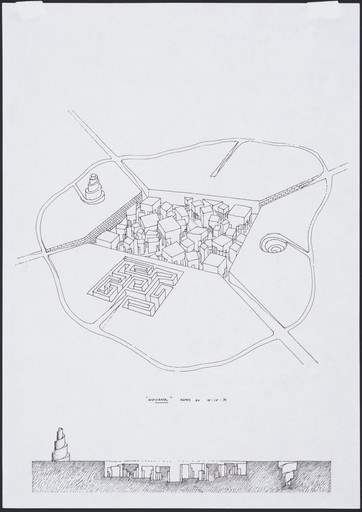
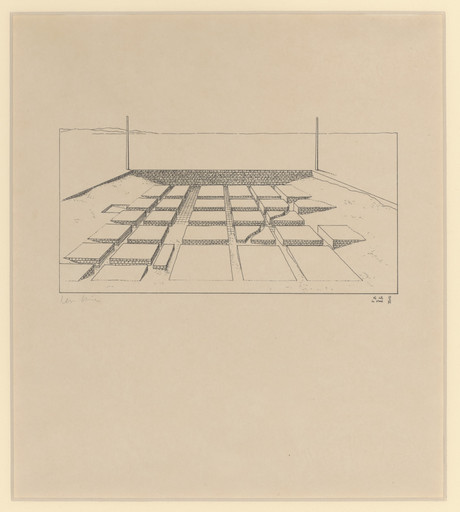
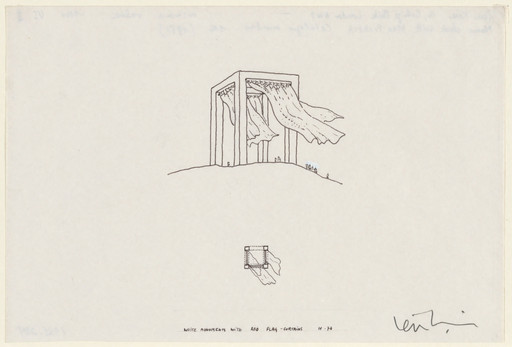
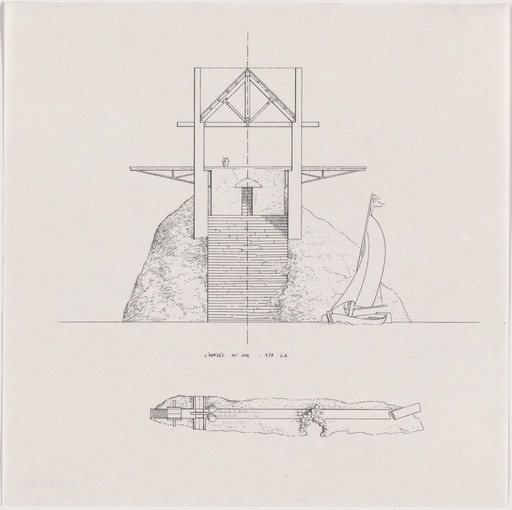
Between 1967 and 1974, while pursuing urban projects, Krier also produced numerous drawings of architectural follies, including this work. He pictured the structures in his drawings—inspired by vernacular architecture or structural engineering—in remote locations, such as mountains, deserts, and Mediterranean islands. These visionary projects, inspired by both real circumstance and the architect’s dreams, were conceived for specific individuals, such as friends or people whom Krier admired from a distance. In these personal projects, he sought an escape from the formal and social principals of the modern masters and a rediscovery of essential methods of construction. He used fictional motifs to both reinvent architecture and shift its role as a definer of existing social and spatial structures. Krier continued to pursue an architecture that rejected modernism and contemporary technology, laying the political foundation for so-called New Urbanism, a movement that reclaimed the civic pedestrian townscape from an increasingly automotive urban society.
9 + 1 Ways of Being Political: 50 Years of Political Stances in Architecture and Urban Design, September 12, 2012–March 25, 2013.
Publication excerpt from an essay by Bevin Cline and Tina di Carlo, in Terence Riley, ed., The Changing of the Avant-Garde: Visionary Architectural Drawings from the Howard Gilman Collection , New York: The Museum of Modern Art, 2002, p. 118.
Between 1967 and 1974, Léon Krier both pursued urban projects and produced numerous drawings of architectural follies. The latter were triggered by vernacular architecture or structural engineering and generally situated in remote locations such as mountain sites, deserts, and Mediterranean islands. These visionary projects, inspired by both real circumstance and dream states, were conceived for specific individuals, such as friends or people whom Krier admired from a distance. In these small, highly personal projects he sought an escape from the formal and social principals of the modern masters, in particular, those of Le Corbusier, and a rediscovery of the essential methods of construction.
an essay by Bevin Cline and Tina di Carlo, in Terence Riley, ed., The Changing of the Avant-Garde: Visionary Architectural Drawings from the Howard Gilman Collection, New York: The Museum of Modern Art, 2002, p. 118.
Explore more


From MoMA Design Store


Installation views
We have identified this work in the following photos from our exhibition history.
Licensing
Artwork or archival images
If you would like to reproduce an image of a work of art in MoMA's collection, or an image of a MoMA publication or archival material (including installation views, checklists, and press releases), please contact Art Resource (publication in North America) or Scala Archives (publication in all other geographic locations).
Audio and film clips
MoMA licenses archival audio and select out of copyright film clips from our film collection. At this time, MoMA produced video cannot be licensed by MoMA/Scala. All requests to license archival audio or out of copyright film clips should be addressed to Scala Archives at [email protected]. Motion picture film stills cannot be licensed by MoMA/Scala. For access to motion picture film stills for research purposes, please contact the Film Study Center at [email protected]. For more information about film loans and our Circulating Film and Video Library, please visit Circulating Film and Video Library.
Text from a publication or the archives
If you would like to reproduce text from a MoMA publication, please email [email protected]. If you would like to publish text from MoMA's archival materials, please fill out this permission form and send to [email protected].
Feedback
This record is a work in progress. If you have additional information or spotted an error, please fill out this feedback form.